
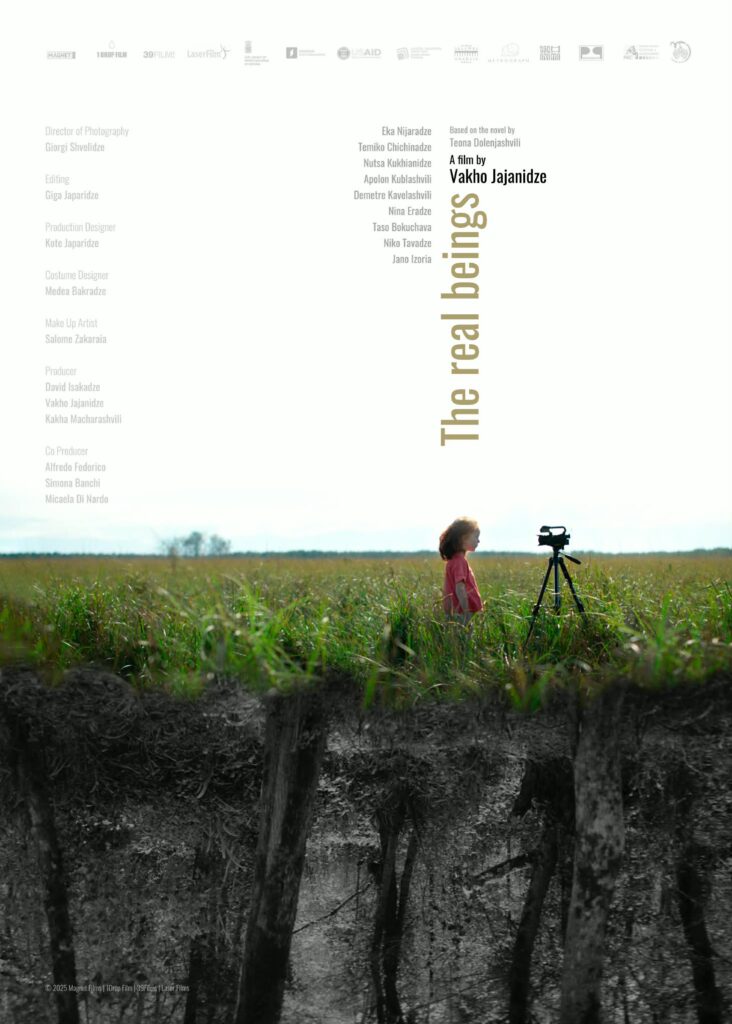
As it is commonly called, two nuclear families (husband and wife + children) check in in a family hotel to spend the summer days of their vacation. The hotel is located in the middle of the forest, near a lake and a swamp. Solitude is excluded, which might have been the goal of each of them when they chose this very place for their vacation and environment, isolated from “civilization.”
These are the conditions in which the story of Vakhtang Jajanidze’s feature film “The Real Beings” (2025) unfolds. Solitude, isolation, alienation, indifference, formal relationships, broken internal connections – are the main line, the expression and the message of the film by placing it in the appropriate environment and atmosphere. (The film is a joint Georgian-Italian project, produced by Magnet Films, with funding from the Georgian National Film Center’s feature-length debut film competition, the production of which was completed in 2025 and premiered at the 26th Tbilisi International Film Festival).
“The Real Beings” is a story of the same name by Teona Dolenjashvili (winner of several competitions). Distinctive – with the plot, the problem and the context, its unique style and depth. Later, the author continued the story of “The Real Beings” in the novel “Replacement” (which is also not an insignificant fact for the history of Georgian literature).
Vakhtang Jajanidze’s “The Real Beings” is based on a story, following the main plot and the course of events and being close to the essence, however, in form, narration, structure and style it is quite far from the story, transferred to cinematic language and plastic expression.
One of the characters in the story, 13-year-old Datuna has a goal to “replace real creatures” – “miserable, degenerate, inferior people – with new, beautiful, perfect people created in 3D.” He replaces the hated reality as well as immediate environment with good and evil avatars, virtual space and computer games and takes refuge there.
Datuna's pursuit has a unique artistic form and meaning, a goal and a target. The real place of action (Paliastomi Lake and its surroundings) replaces reality and is taken into a new, mysterious dimension, just like the world of computer games. The mechanics of action, unreality, convention, schematicity and artificial, unnatural rules are allegorically transferred to Vakhtang Jajanidze's film and are an expression of the director's metaphorical thinking.
In “The Real Beings” there are several “visible” active characters – Lana (Nutsa Kukhianidze), Mika (Polika (Apolon) Kublashvili), Keta (Eka Nizharadze), Tengo (Temiko Chichinadze), the forest ranger (Niko Tavadze), Nia (Nina Eradze), Bebe (Taso Bokuchava), Datuna (Demetre Kavelashvili), the photographer (Jano Izoria). And no one else. Beautiful, graceful, attractive and with a “non-simple,” non-standard appearance – people not from the “mass.” From the same social circle. They have a lot in common. They seem to live peacefully and without conflicts. They do not disturb the peace of the surroundings, although they themselves are not at peace.
It is seen and felt from the very first episodes that everything is temporary and mediocre for these people. Monotonous and meaningless. It is visible and felt that nothing makes them happy, excited from those “data” that are called and for which life is worth living. Their doom stems from the lack of moral principles, the loss of living emotions, feelings and interests. First of all, towards each other and then, naturally, towards others. This is what happens when people cannot and do not understand each other; when parents, children, members of society do not understand each other, are neither interested nor excited. Which shows that the problem is much more complex and dead-end than any specific dramatic situation, which has either an end or a solution sooner or later.
Despite their similarities and being “creatures,” the actors create characters with expressive and precise psychological features, whose qualitative characteristics expressing their nature and inner state include more than one layer and angle.
The only one who has not yet lost her noble qualities is Bebe, a little girl who sacrifices herself to the negligence and indifference of her parents, elders, and society - as an inevitable punishment for everyone because lack of love, sincere connections replaced by coexistence, inevitably lead to such sacrifices - in the form of the purest and brightest "real being."
The beautiful and diverse, enchanting landscapes captured by cameraman Giorgi Shvelidze, as well as vast and open spaces, a lake, a swamp, meadows, forest paths, boat docks, the sun, greenery – everything that surrounds a house standing in a deserted place – should be peaceful, meditative, bringing a sense of comfort and inner freedom. The microcosm of “real creatures,” neutral and detached, indifferent and cold-hearted nature, becomes a clear and distinct metaphor for isolation, impotence and hopelessness.
Here, in this emptiness and aloofness, neither the hotel owner nor the service staff are visible from the outside, although somewhere, “behind the shot,” the presence of “real” hosts confirms that the place does not look without an owner and abandoned. Breakfast is served on site, the rooms are tidy. With the absence of “others,” the director intensifies and activates the parabola of isolation, mystery and alienation.
Instead of intense plot and collisions, Vakhtang Jajanidze resorts to monotonous, “immobile” action and silence spread over time, distancing, internal drama and tension, the power of expressing an unbanal internal rhythm. Silence and actual immobility are the main signs of the artistic style of “real beings” – both the characters and the film as a whole. Silence, “doing nothing,” non-creation. If I apply the established terms and definitions, “contemplation” and “meditation.”
The director is an observer, not a participant, which is a direct authorial “response” to the characters’ qualities, lifestyle and problem, which “The Real Beings” is about. In any case, the connection should always be internal, not external. Because if this does not happen, authenticity and “authorship” are replaced by artificial schemes. Dogma, however, is always what spoils the work and deprives objects and events of their essence and purity, their purpose. It tarnishes. Both in relationships and in art.
The viewer is also left with a feeling of being there, of being involved in that environment. He also watches the story framed on the screen “from a distance.” A seemingly accidentally blindfolded, colorless section of the lives of two families. And he remains cold, indifferent to the characters’ fate, even to the fate of the child who starts to drown in the swamp. And only then, when everything is over, is the viewer “forced” to reassess what happened, to look at it from a different perspective and perceive it from a different angle.
Vakhtang Jajanidze shows with clear and precise nuances the uninteresting, boring and banal monotony of the characters’ lives. He shows that, practically, everything has happened, that it is already a result, and not a cause and process. By showing the atmosphere of emptiness and the “inner” essence of reality, the director limits the existence of such a world in the space presented by an individual vision and follows the path of personal creative freedom.
Lela Ochiauri


