
Snow is a rare and somewhat mystical phenomenon for southern countries, including Georgia. It seems to stop time and people feel a sense of separation and loneliness from the world in this stopped time.
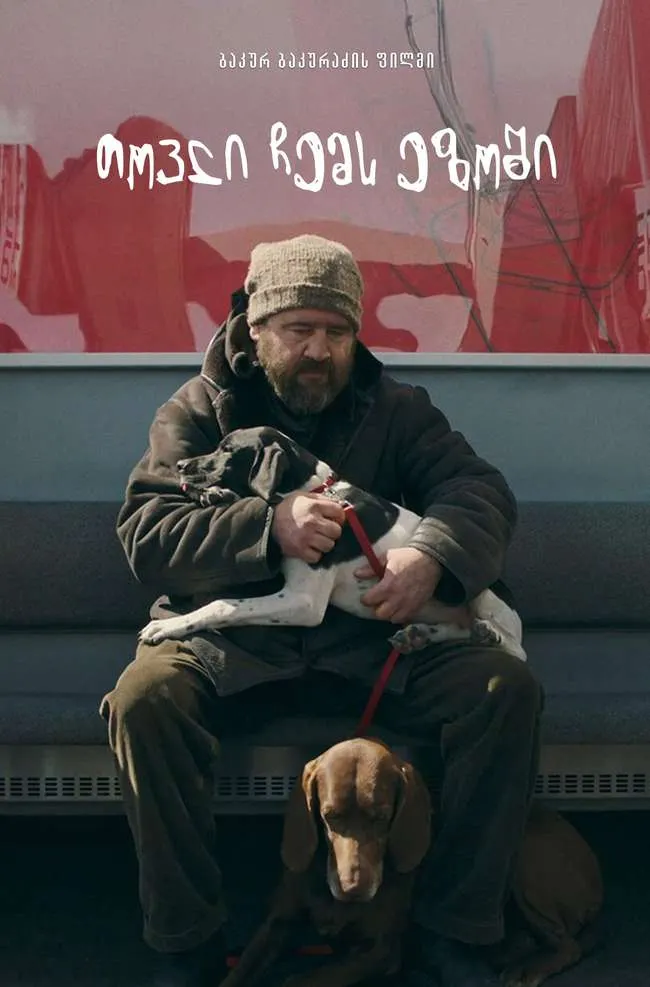
In Bakur Bakuradze’s film, “Snow in My Yard” (2024), it is snowing heavily with wet flakes. As the snow falls, the audience becomes a silent witness to the characters’ frozen lives and suspended time.
The main character is Levan (Levan Gogoladze), who used to be a rugby player and member of the Georgian national team but after an injury, he has withdrawn not only from sports but from life as a whole. He lives in an Italian yard in Mtatsminda district, in a small room like a den filled with old, broken objects, which is not even heated properly. Levan has diabetes and recently suffered a stroke. His ex-wife and three children live in perfectly good conditions outside the city. Levan also visits them periodically, brings gifts and plays football with the children but as his ex-wife tells him, in just a few years they will notice his worn, torn and dirty clothes and will be ashamed of such a father. Levan has only two native creatures, in whose warmth he seeks refuge from loneliness – two dogs with the same names: Big Jesse and Little Jesse. That’s all. Periodically, a neighbor boy comes to him and shares food obtained by petty theft. To endure this mediocre and joyless existence, Levan takes diazepam.
The other character is Levan’s schoolmate Givi, whose role is played by the director himself. Givi lives in Moscow (Russia) and makes auteur films. Givi also has a certain existential crisis – in this world there is less and less space for auteur films. His life is also joyless and empty. As the producer advises, to whom he goes with the idea of a new film, they no longer make auteur films at the age of 50 and it is better to think about a blockbuster. Givi’s idea is that Levan should describe his daily life in writing, for which he will pay 5 GEL per page. This is a lot of money for Levan, who is on the verge of starvation. It is Levan’s notes that should become the plot of Givi’s future film, and they will, but for Bakuradze’s own film.
“Snow in My Yard” is Bakur Bakuradze’s fourth full-length work. His previous two films “Schultes” (2008) and “The Hunter” (2010) were presented at the Cannes Film Festival and have also won various festival awards. “Snow in My Yard” was made by the director after almost a decade of silence.
You never forget that you are watching a documentary throughout the film, each shot is so convincing and the characters themselves are so sincere. You have no doubt that you are watching real life and not staged episodes. It seems like another story about guys who have lost their lives but the film is shot in such a way that you cannot take your eyes off the simple stories depicting the characters' everyday lives for almost two hours - Levan puts on his long-suffered trousers and sits at the computer, covered in a plaid, to write a diary for Givi, gets an insulin injection and has dinner on the balcony with buckwheat and stolen eggs together with a neighbor boy heavy snowflakes fall lazily through the yard. In Moscow, Givi prepares dinner and eats it in complete solitude, without any expression on his face, gets a haircut with a random lover and waits for a woman in bed without any passion. By showing these small details of everyday life, the director introduces us to the characters and tells us the story of their loneliness.
Bakur Bakuradze’s film is convincing because there are many such Levan and Givi in their generation. Both of them are children of the 1990s, which were difficult for the country and not completely finished. At the beginning, in one of the dialogues, they recall that time and black pasta, which was the only and cherished food for that period. After the end of his sports career, one of them could not keep up with life and became a helpless marginal. Accepting his fate, he follows the life without any resistance and can only regret that he lives on the second floor and might get only injured if he jumps. “I want to tell you, dear Givi, that the city has changed a lot. The city no longer looks like a city, the district looks like a district, no one stands in the street corner. There are no good guys anymore. Perhaps, like me, they are hiding somewhere in the corner…” – writes Levan. Like many young people of his generation, Givi went abroad for professional fulfillment and lost touch with his roots to some extent. The same is true of Levan and Givi's mutual friends, middle-aged men, with their loneliness, helplessness, and trauma. One of them is a former KGB official who is trying to force Levan with a gun threat to unblock him on social media because he needs someone to listen to his endless monologues.
Bakur Bakuradze is making a film about a topic he knows very well and such a case is impossible without a personal attitude. This is a very Tbilisian film, where even if you have been useless a thousand times, your friends will still visit you, help you, send you money for tobacco and medicine and they will still give you bread and wine on loan in the local store despite your numerous debts and they will not even notice a stolen cigarette. Even Givi’s offer to pay 5 GEL for one page is perceived as a disguised, self-respecting desire to help. Or this might be the old Tbilisi that continues to exist in the memories of those who have left their homeland to live far away.
Perhaps it is these moments that give the film a certain lightness, despite the gravity of the topic. Levan himself looks at his life with a kind of self-irony and writes in one of his letters how he wants a poster with an obscenity words to be hung on his chest in response to the question “How are you Levan? How are you Levan?” To describe his life to a random passing driver, he tells him that he wakes up in the morning, goes to sleep at night, and that’s all, although he tells the shop assistant in the local store that he is happy to see the sunrise in the morning and then he slowly gets worse.
As well-known filmmaker Mikheil Kobakhidze stated, the sense of pause is very important for a director. There are many such necessary, breathing pauses in Bakur Bakuradze’s film. Periodically, the characters’ dialogues turn into voice-overs and the camera begins to move freely, “looking” at the typical Italian yard, the worn-out balcony and stairs, the fruit-bearing trees following the streets of Tbilisi from a moving car, or just “watching” how snow falls through the fogged windows of Levan’s house.
At the end of the film, Givi returns to Tbilisi to sell his paternal home. His gaze lingers for a long time on the house, which is dark with windows and without people. Then he also sits in the dimly lit empty room with cracked walls for a long time, goes out onto the balcony and looks at the city that is alien to him, until he hears the meowing of a small, weak kitten, who needs help and warmth, just like Givi himself.
In Tbilisi, it snows most often with falling heavy and wet flakes, which are beautiful to watch only from the window of a well-heated house but if you don't have such a house, this beauty will only make you feel solitude and pain.
Tamta Turmanidze


