
Tbilisi in the autumn of 1952. Sololaki area. Davitashvili (present Amagleba) Street. An old vinyl is spinning and the sound of music is heard from somewhere, in the distance. Boys are playing football in the street. A car passes here and there. It is either an overloaded trunk, or a brand-new, shiny "Pobeda," or a war-torn American "Studebaker." As soon as the children hear the sound of the engine of any car, they stop the game and chase it with a babble. Suddenly, the car turns a corner and a large poster appears on the wall. It depicts a blond-haired leader worker. She is punching a grumpy American uncle, who is dropping a stack of stolen dollars. The poster has the inscription: Долой американский империализм! ("Down with American imperialism!").
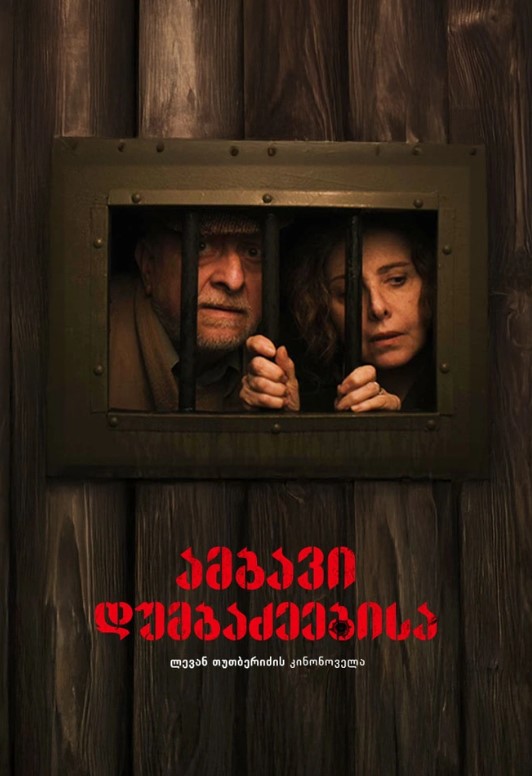
Ramaz (Buba) Khotivari’s film story begins with such a scene from the Tbilisi amarcord. Buba Khotivari was the director of films that were loved by the Georgian audience: “Lazare’s Adventures” (with Kartlos Khotivari), “Demetre II,” “Chiriki and Chikotela” (with Levan Khotivari) and others. He wanted to make this film story, but he passed away. After his death, film director Levan Tutberidze turned this story into a short (45 min.) film, called “Traitors”
As the author tells us, the film story has three conditional titles that give us more information about the events that took place there: “The Story of the Dumbadzes” or “Professional Musicians,” or “Arrest in Georgian.”
This is not the story of the 1930s which might remind us of the word “arrest.” This is the 1950s, when the Great Terror period has passed although people still remember it well. The Second World War, which was called the Patriotic War in the Soviet Union, has also passed. The country has almost healed the wounds left by the war, mourned the dead, received soldiers returning from the front, restored or rebuilt everything destroyed and moved on with life, although the Soviet regime is still strong and Stalin and Beria still sit in the Kremlin in Moscow. In addition, anti-American agitation is still at work despite the fact that just seven years ago the United States was an ally of the Soviet Union in the war.
However, the war is not over for those whose family members were considered missing. Among them is the Dumbadze family – a middle-aged couple who know nothing about their only son who went to war.
In the film, their roles are played by excellent theater and film actors – Gia Abesalashvili (Mamia) and Keti Chkheidze (Dali). This couple is well-recognized by the public. The Dumbadzes' duet songs and humorous couplets have brought much pleasure to the audience and listeners (including the security officers who go to arrest them). They don't seem very old but the almost 10-year wait for their son's return has broken both of them. The mother is bedridden and the father takes care of him. The couple's income is from the private lessons in music and dance that the neighbor's boy (another important character in the film) takes.
The audience watches the events unfolding in the film through this child’s eyes. This is the boy who plays football in the yard with the others, learns to perform Schubert's play with Mrs Dumbadze, demonstrates Georgian dance moves with Mr Dumbadze and then excitedly listens to the clatter of boots on the winding iron stairs at night, runs away in his childish secret ways, and watches the drama unfolding in the Dumbadzes family from the roof of the neighboring house with bated breath.
The drama is that a group of Chekists arrives at night to arrest the Dumbadzes. The couple, who have not appeared in public for a long time, cannot even imagine what the reason for their arrest could be. "Take warm clothes, it's very cold in Siberia," the uninvited guests advise and give them fifteen minutes to prepare. The distraught couple refuses to go with them. Dali says that her legs are not working and she cannot walk, but it turns out that the Chekists know very well that if Dali really needs it, she can force herself to stand up. The wife is supported by her husband, and they decide that it is better for both of them to end their lives right there in their own house than to go with the Chekists. Here begins a psychological duel between Mamia and the Chekist chief. Mamia tries in every way to have him killed. He only asks for this - shoot me in the head, and my wife in the heart, don't disfigure her face, she is a woman after all. The author has masterfully written this passage, which shows how many feelings the Chekist will go through. This is a person who sincerely serves the regime and believes that the end justifies the means. How many times does he want to kill Mamia but each time he is reminded of his duty - he must put both prisoners alive into the black special vehicle with tinted windows, the "Chorny Voron," („Black Crow“) the appearance of which has caused such a panic among everyone.
The situation changes when the headman utters the word “ChESIR.” This is a Russian acronym and is coded as “member of the family of a traitor to the homeland.” Here the Dumbadzes realize that their son is considered a traitor to the homeland, which means that he is not missing without a trace, nor dead but was captured which was perceived by the Soviet regime as treason.
Here the narrative changes again and we can see a happy mother and father who are brought news of their son’s well-being. It turns out that he was not killed and fled to America since he would not return to his homeland after the war. He now lives there and is a “businessman”– so the Chekist said.
The film’s image, distinguished by the dominance of dark colors (art director Anka Kalatozishvili, cinematographer Sandro Vysotsky) offers us a transitional variety of light and shadow. With such an image, the director does not impose an unambiguous attitude on us, as in the story shown in the plot - what should have brought great trials and suffering has become a source of great joy and happiness.
“No one has ever brought us such good news” - Mamia is the happiest. The joyful Dali also forgets the pain in her legs and is eager to set a table for the heralds of good news. The host puts a demijohn full of the best wine on the table…
And what is the film about anyway? About Soviet terror? Repression? Injustice? All this, of course, is visible in the film but it is still about something else and this other thing is love. In this case, the love of a child works wonders. This feeling can also forgive and understand the enemy. A happy husband and wife sing in the “Chorny Voron,” driving to the place where interrogations, torture, and exile to Siberia await but fear has already been defeated. The expectation that they might one day meet their son, gives both parents great strength.
Injustice, repression and violence from the powerful have become a part of our lives. The old “Chorny Voron” has changed its form but it still moves. Power also plows the hill but it can never interfere in love – love for loved ones, country, God, and freedom. Love also inspired Levan Tutberidze to make this film (the author of the screenplay was his teacher and uncle). He might have tried especially hard to make the film the way Buba Khotivari had imagined it and that is why “Traitors” differs from the director’s other films.
Ketevan Pataraia


