
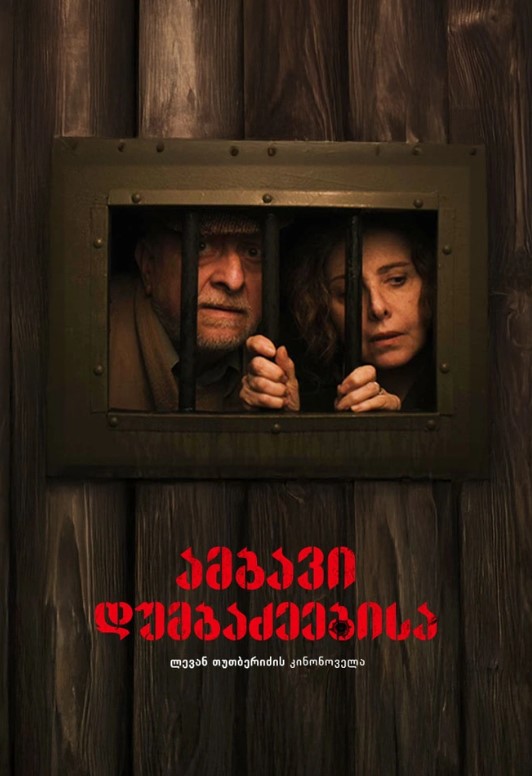
Contemporary Georgian cinema continues to actively represent important and painful events of the past century despite its thematic diversity and response to contemporary social processes. This might be explained by the fact that topics that seem to be a thing of the past at a glance, are still associated with the present. Who would have imagined that the fate of Georgia in the 2020s would have turned out in such a way that the words “repression,” “terror,” “dictatorship” would still appear in the colloquial dictionary of a modern person, and the statement “They will catch Triphon, they will catch me and they will catch you too, they will catch everyone” would also be suitable for today.
An artistic person sometimes has such a developed sense of intuition that he even foresees the fate of his own country. When Levan Tutberidze made the film “Traitors” (2023) based on Buba Khotivari’s story, he might not have imagined that the scene of the arrest described in it would fit the plot of modern arrests as well as the round-framed glasses on the officer’s nose in the film would fit the outline of Beria’s glasses. The film premiered at a time when people similar to the characters in the film appeared in large numbers in the modern era.
In 2012, Buba Khotivari recalled in his memoirs a childhood story about his neighbors, the Dumbadzes, who thought their son was lost in the war but learned from the officers who came to arrest them that their son was a traitor to the country, was alive, lived in America and was engaged in business, which is why the old couple are arrested on charges of being a traitor's family and sent to Siberia. It was the story that he wanted to make a film called "Georgian Arrest." The film is based on this true story, the main character of which is a little boy, who is the main sharer of their tragedy, a watchman, before whose eyes the entire history of his neighbors, the Dumbadze family, unfolds. This is the boy who fills the emptiness of the old couple's lost son. Dali (Keti Chkheidze) teaches him to play the piano, and a drummer Mamia (Gia Abesalashvili) teaches him to dance.
The old Tbilisi district, narrow cobblestone streets, pioneers playing in an Italian yard, the shouts of a roast sunflower-seed seller and a vendor of matsoni with a sack on his shoulder, a Pirosmani-style yardman - these are the shots with which the director tries to perfectly convey the appearance of old Tbilisi in 1952 from the very first shots, which are accompanied by Gustav Mahler's 5th Symphony in the background. Although the director tries to give the film a dramatic, sentimental tone and arouse strong emotions in the audience with Mahler's music and Lado Asatiani's poem read by the man standing on the balcony, the poster shots and artificial, depthless mise-en-scènes, accompanied by the protracted music are perceived as more fake.
Some shots in the film are quite stretched and artificial, and the rhythm is monotonous. Against this background, the cruel terror of that regime and the anxiety caused by repression are still felt in almost every episode: in the darkness of the night, the fearful surveillance of a neighboring mother and daughter as the "death machine" invades the darkened yard, the sound of the officers’ harsh footsteps firmly walking up the stairs. It is unclear to the grieving mother and daughter which neighbor they visited because suspicion was unfounded at that time. How could you have understood then who was threatened with arrest, execution, exile, when there was almost no “guilty” worthy of this sentence.
The rhythmic footsteps of the “Russian boots” (both in the literal and indirect sense) deafen the silence of the dark night, approaching the doors of the Dumbadzes on the third floor with stern steps. It rings a bell of fear on the calmly sleeping darkened balconies and rudely breaks into an old couple’s cozy apartment. Such a scenario of arrest was not unfamiliar at that time. After all, night is usually the time when everyone rests, sleeps, and it is at this time that the ghosts of the night attack you. You wake up and think that you are again in a nightmare. The real nightmare called Siberia, for them begins now, where work in the mines awaits the old Dumbadzes as a torturous ordeal.
The constant rhythmic sound of water drops, which is periodically heard from the balcony, seem to be performing the function of a metronome and bringing the Chekists’ special operation to precision, is strict, like the discipline characteristic of them. This is not the sound of romantic raindrops, falling lightly on the windowsill, but resembles the sound of raindrops falling from the cracks of an old roof, which fall heartbreakingly, monotonously into a puddle that gradually, slowly fills up, like a cup of people's patience, which one day will burst so that it will wash away the abode of injustice and evil like a torrent.
The film reaches its climax precisely when the mother learns that her son is alive. According to the Chekists, he has become a capitalist, a workers’ bloodthirsty. The confrontation between capitalism and the Soviet system based on socialist principles is so emphatically and loudly expressed in the film that the husband and wife, delighted by the officer's words, try to ironically support the officer in his contemptuous reference to America and accept such a "betrayal" of their son not as the Chekists understand it but rather to consider his action as the best way to escape from the scum, the Soviet terror.
The husband and wife, who were ready even at the cost of death to disobey, not to move from their nest, even to have their foreheads pierced by bullets and exiled to cold Siberia, are now ready to voluntarily follow them in order to save their lives. Even the thought that after ten years, those who have returned from exile will see their son brings them such joy that they leave the room filled with sadness and waiting without looking back.
The dialogue between the officers and the couple is the most important and telling episode in the film, despite the fact that the composition of the shot is so dry and shallow that it gives the impression of a television play rather than the structure characteristic of film aesthetics. The action is noticeably dragged out. The story, which should evoke certain feelings in the viewer, drags on in time and the emotional charge is lost somewhere. This cinematic lapse is covered up by the acting skills as much as possible. The natural timbre of the actors' voices, facial expressions, gestures, and adequate manipulation of feelings give the shot more authenticity. The sudden replacement of a stern, unyielding mood with a submissive, gentle, and ironic emotion occurs so naturally that the connection between actor and audience is never broken for a single moment.
Although not related to the years of mass repressions, the era depicted in the film still continued political repression in the Soviet Union, deliberately harassing, punishing, arresting, deporting, and shooting innocent people. The ominous mood of that time is most created by the dark, musty, blackish-brown colors of the film. The contrasting play of light and shadow in the frame sometimes creates the effect of the artistic technique - chiaroscuro, thereby increasing depth, dramatism, and emotional intensity. The intensity of dark colors in the film is metaphorically directly related to the dark dictatorial regime that turned the city, streets, yards, and rooms into an atmosphere of fear.
Quite a lot of time has passed since this story. It seems that, at a glance, life, lifestyle, views, social mentality, political ideologies and regimes have changed, but the story described in the film at least resembles the present in some way. Arriving at home, accusations made in a comfortable and calm tone. It seems that the progress of time has changed course and turned us back again. The past and the present are intertwined in such a way that not a “death machine,” but a “silence machine” freely roams the yards and flats.
On a road hidden in the blue-gray mountains, which evokes associations with glaciers, a "slippery" car drives an elderly couple far away into harsh nature, from where they will probably never return, and they will never see their son, who survived being wounded years ago, escaped German captivity, and feeds on the blood of the working people of a capitalist country, the blood that the Chekists, who were so intoxicated by the blood of "family members of a traitor to the homeland," could not stand.
Ketevan Ghonghadze


