A person often becomes a victim of his own thoughts and obsessions. Our nature is not stable enough to be free to tolerate conditions that are unpleasant for him. Frequently, simple things play on our nerves so much that we are surprised how a person can endure great pressure and pain in life, when the smallest details drive him crazy?! Or, in general, should a person be able to endure all this when we can be symbiotic creatures and help each other although it has never been so easy and might not ever be. Everyday life, routine, problems still manage to affect mental health and shake our psyche.
Shota Meskhadze's student film, “Common Wall” (2020) explores precisely this shaken psyche. The main allusive center of the film is Anthony Burgess's cult book, "A Clockwork Orange," which one of the film characters takes from the table and seems to predetermine the entire film.
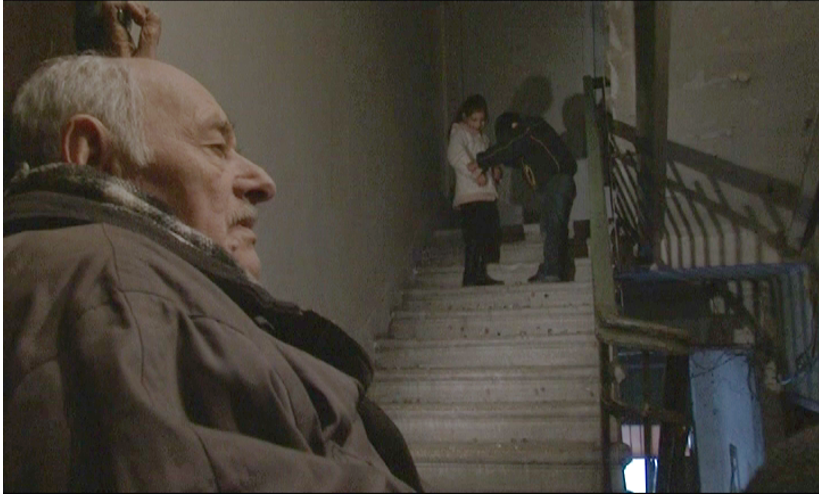
Nika and Nika are neighbors across the wall. The biggest discomfort certainly is the sound that passes through the wall, especially when they are clearly different individuals. Nika is obsessed with watching movies, although you can't call this a condition caused by a direct love of movies, it's more of an attachment to the screen, which is also expressed in his immobility. Objects scattered around, energy drink cans, packets of chips and a poster of David Fincher's "Fight Club." His situation is chaotic but comfortable for him, he likes to be in this spiral, where he doesn't take his eyes off the screen, unless he falls asleep in between, and he is satisfied with this state alone.
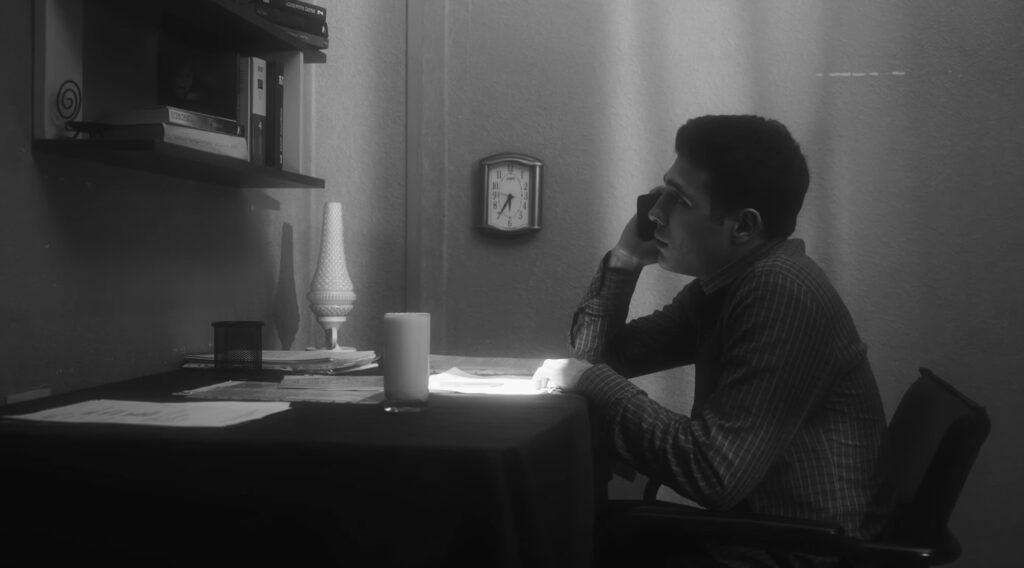
The other Nika is sitting at a table by the lamplight and working. There are a lot of numbers visible (we are probably dealing with economics here), his work requires concentration and accuracy, but Nika is not given the opportunity to do all this because from the other side of the wall comes the sound of the TV turned up to full volume. The sound neither decreases nor stops, nor does Nika's cup of patience stop and fills up before our eyes, just as a full glass of milk standing next to him. This is a direct analogy with "A Clockwork Orange." We may also be reminded of Stanley Kubrick's famous film of the same name, when Alex's character looks at us with a manipulative gaze and drinks milk at the same time. Milk, as a theoretical symbol of purity and innocence, appears to us in Kubrick and Burgess in a different way, as a sign of the loss of this very purity.
The director wanted to emphasize this in this student film as well. A character who is very organized and purposeful at a glance, slowly loses himself or, conversely, reveals his true face. At first, this is expressed in breaking pencils. Nika can no longer stand the noise of his neighbor and smashes his own things to calm his nerves. Then this Nika calls that Nika and asks him to lower the voice but something interesting happens here. The other Nika deliberately starts to rustle a plastic bag at the phone microphone and switches off the neighbor. This is another interesting person who refuses to even slightly lose his own comfort and does not take into account other people. Here the director tries to present us with the contrast and even similarity of human physiology. Both care about their own comfort but without considering each other. Added to this is the actors’ overly dramatic acting which does not correspond to the film stylistics.
The film is shot in black and white, which really suits the aesthetics and the director creates symbols of their mental labyrinths with an active play of shadows. The way contrasting shadows play on Nika’s face, who is glued to the TV screen and the way the wind strongly blows the shadow of the curtain in Nika’s room, who works in finance. These seem to emphasize their personal conditions.
After an unsuccessful call, Nika's patience is reaching its peak. After looking at a lot of broken pencils, Nika goes to his neighbor and asks him to turn down the TV. Considering the flattering situation, Nika says to him, "You should have told me clearly before and I would have turned it down, what else should I have done?" And then he takes a sip from a glass of milk. The director actively plays with the symbol of milk in these two characters. Nika does indeed turn down the TV, but only temporarily. It is interesting that in the intervals he actually falls asleep, he has no need to hear the constant sound, which is actually the leitmotif of the film. Then Nika's character returns to the neighbor's flat, exhausted and now Alex from "A Clockwork Orange" really wakes up in him, the face of a savage person who has lost his moral compass and beats his neighbor with full force. Presumably, he even kills him, since he is no longer seen after that. Instead, we can see how violently the neighbor wields an unknown device and it seems that the viewer becomes his victim and a sense of guilt arises for bringing a person to this state, to some extent.
At the climax of the film, the face of the wild man calms down again. Nika's character harmoniously observes the neighbor's room, his parrot, and then sits down at the TV. He puts on Nika's glasses and becomes exactly his neighbor’s prototype. The shots run in front of him in rapid motion and he watches them calmly and with interest as if he had not just killed a person, but he feels victorious because now he has found peace, he no longer bothers his neighbor although he himself can become the annoying neighbor for someone else who used to torment him.
The young director tried to talk about human injustice and pathos with this film. Of course, its plot is deliberately resolved in a gloomy style. In reality, everyone has had similar experiences, everyone is bothered by the noise of neighbors, however, such fatal cases do not occur, fortunately.
Lizi Gaprindashvili