
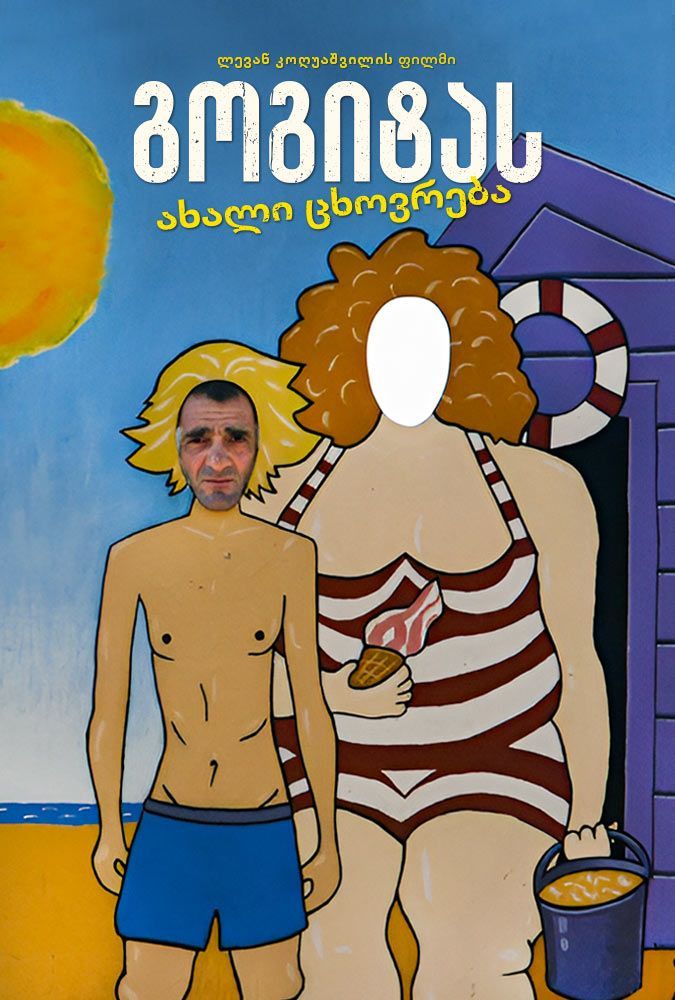
A difficult socio-political situation developed in Georgia after gaining independence. In the country there appeared lost territories, refugees, marginalized people excluded from family and society and immigrants who went to different countries to earn a living. The reflection of this diverse range of problems in Georgian cinema began with its usual superficiality. Authors limited themselves to only certain accents and concentrated on issues that were painful and urgent for society. Just as in the Georgian documentary of the previous period (1970-1980), the tendency to “aestheticize” the problem remained relevant. Georgian film director Levan Koguashvili creates his interesting works in a style that differs from this tendency.
An interest in his work arose from his very first films which is partially conditioned by the realistic, light style of narration characteristic of this author's work, the ability to create an interesting environment, a common atmosphere and to bring to the foreground narratives relevant to society in routine life. The director never expresses actively his own position, thus leaves the viewer the space to determine, think, evaluate, draw the appropriate conclusion and express a position on existing problems. Such are the films he made: “Random Dates,” “Women from Georgia” and “Gogita's New Life.” In all three films, Levan Koghuashvili tells us about heroes to whom life and society did not leave a personal choice, about people lost in time, who continue to live by inertia, are dependent on a chance.
“Gogita's New Life” (2016) is a feature-documentary film. It is more like a so-called pseudo-documentary film, as they call it. This is a story about a former prisoner who is trying to live according to the established norms of society. The years lost in prison, an inferiority complex, an acute feeling of being left out of life force Gogita to look for a way out in creating a family. This is the only thing he can do and what may change his life, the only perspective that will allow him to establish his own place in the existing society. But even here, there are restrictions, established stereotypes, according to which the “bride” must exactly fit the general requirements not only in terms of her status and abilities but also in terms of her appearance. “Gogita’s New Life” is a banal love adventure about rejection and recognition.
After an interview in prison in the first episode, before going home, “released” Gogita actively searches for father, a spiritual guide through whom he was able to overcome the routine monotony of prison, the sadness caused by injustice. There, in that confined space, religion became for him the support that gave him the inner resources and strength to start life anew. From the very first episode, Levan Koghuashvili emphasizes the blind attachment of the majority of Georgian society to faith and the church. In this case, the church is presented as a necessary element for adaptation in society. For free Gogita, this element is no longer needed.
Relationships that begin on the Internet, in independent spaces of simple communication, become an indicator of a new layer of modern reality, the alienation of people, when virtual existence makes the prospect of establishing direct relationships with the same mood almost impossible. What is possible virtually is unacceptable in reality. Under the influence of his family, Gogita's loved one is rejected because of her excess weight. In virtuality, benevolence, dream, the prospect of seeing a secure future, an illusion that has nothing to do with the lover's appearance become important to Gogita, which is why he does not think about what others will say but he becomes powerless and dependent in front of society, family demands and stereotypes in reality, temporarily though. Real relationships are connected with a different emotional spectrum.
Having gone alone to Batumi, Gogita tries to build a relationship, to find the ideal woman on the boulevard. The environment created by the association of the Soviet period, Russian tourists, and Gogita's attitude towards them indicate both the mental state of the lower layer of society, the forms of relationships that have become habitual since Soviet times, as well as his internal problems and complexes that do not allow him to have free relationships.
Life's "random dates" do not disappear without a trace and the film characters continue their relationships whether they want to or not since their connection is more than visual and societal stereotypes. The musical leitmotif plays an important role in the film narrative, creating an additional emotional spectrum and mood, romantic and nostalgic. A feeling of lightness, compassion, and sadness appears in the last scene, when a couple is walking in a blizzard and cold and dream about the future, left alone facing life's problems.
The director devotes significant space to the expressive structure in the film. At the beginning of the story, the shot is dominated by a gray, cold tone, which further intensifies Gogita's feeling of loneliness but a warm tone is added to the shot after his decision to start a family, which gradually gives Gogita hope for a "new," different life. The narrative is built on both staged elements, as well as documentary footage and interviews.
The lightness of the narrative characteristic of Levan Koghuashvili's work, comes from the features of the Georgian character, the "coexistence of poetry and prose." Considering the Georgian character, problems are not liked in Georgia and thinking about them, moreover, becomes idle and entertaining.
Everything is covered with a romantic area, this is a constant tendency to escape from reality, which forces the nation to walk in circles. Levan Koghuashvili's light-hearted narrative style doesn't also allow you to think while watching the film, you just follow the story, you emotionally experience what happened but then some unpleasant feeling appears, which still forces the viewer to think about the problems. To think how easy it is to stigmatize people and how difficult it is to free themselves from it, how society tries to prevent an individual from being happy and living their own life with stereotypical attitudes.
Maya Levanidze


