
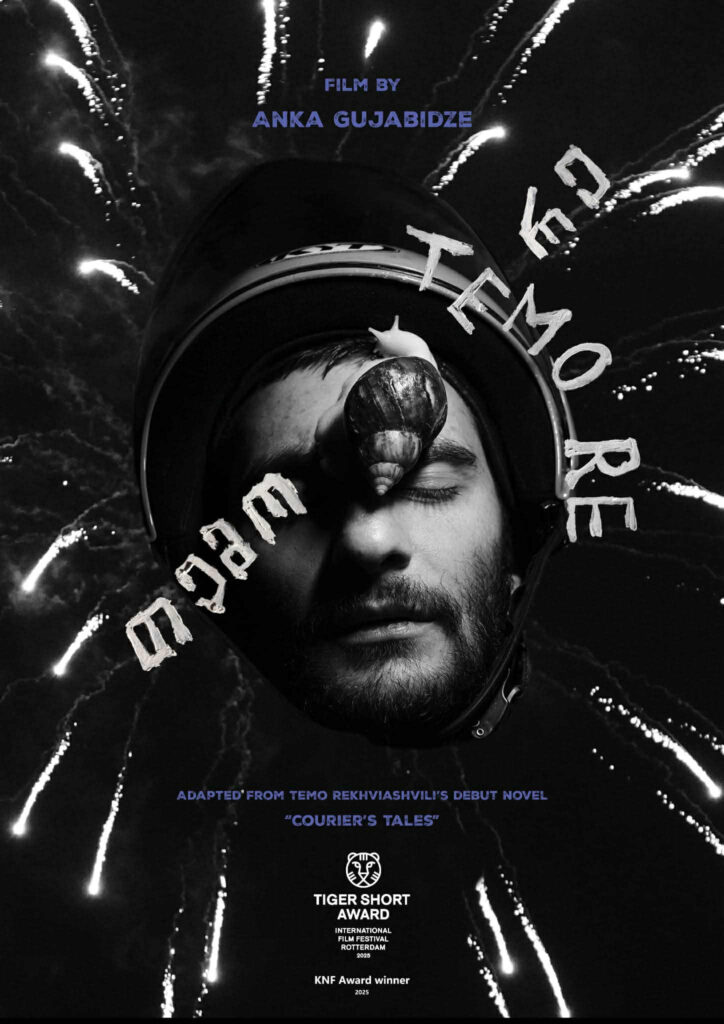
“Temo Re” (2025), the film by director and photographer Anka Gujabidze attracted viewers and critics’ attention at the Tbilisi and, a bit earlier, Kutaisi international festivals. Its international success began at the Rotterdam 2025 Film Festival, when it was awarded the Tiger Shorts and the Netherlands Film Critics’ Awards for Short Films. These “awards” and prizes have a solid and unmistakable foundations - based on the fact of an unconventional vision, a new film language and style, a different way of presenting a literary text on the screen and the creation of a new artistic reality. Anka Gujabidze combines her two professions in an unconventional way and effortlessly breaks into the space of cinematically expressive film.
Along with Anka Gujabidze, the scriptwriters (this unity is not insignificant, since they see the problem, topic and issue from different angles) are film critic and journalist Salome Asatiani and actor, playwright and writer Temo Rekhviashvili. “Temo Re” is based on his novel, “The Courier’s Tale” and was filmed with his participation. Anka Gujabidze is the cameraman, editor, photographer and art director. In short, “Temo Re” is an auteur film in the literal sense.
Temo Rekhviashvili is an actor. Then he became a courier and an animator. Based on this experience, later he wrote an autobiographical mini-novel, “The Courier’s Tale,” for which he received the literary prize “Saba” (2022) in the nomination for the best debut. Then he emigrated, came back and founded the Haraki Theater, a free and distinctive theater in every sense together with his associates. He also became a playwright. He wrote the play “CO2,” which won the Friedrich Ebert Foundation Prize in 2024. The play was staged at the Theater on Atoneli by Ilia Korkashvili and was a success.
As the novel and the film narrate, his new life began when he once started working as a courier (he made up his mind to work as a courier because the actor's salary is 12 or 20 GEL per day, or 30 - with a deduction, because the actor is "worth 20 GEL" - this kind of stencil appeared on the streets of Tbilisi a few years ago, which Temo Re also recalls). A courier’s life is movement, travel, meetings, 100 kilometers covered per day and seemingly routine and monotonous but colorful adventure - with different characters, short episodes included in the "axis route," fragments of someone's life, incidents, in the background or at the epicenter of the general life of society.
"Temo Re" covers more than one contemporary and acute problem of today - the social situation, state corruption, the activities of local officials, pretense, the “image” activities of officials, hypocrisy, emigration, poverty and the dead end of reality, which the actor-courier encounters in one day while working, delivering orders, on the spot or on the way.
The film is “shot” entirely with photographs. They come to life, move and carry the story. However, the narration is not a story in the classical sense either. This is a story that any courier, and not only a courier, can tell himself in one endless day.
And this one day, like many other similar ones, includes many other stories, many other meetings, many facts of life. It has a beginning and no end in sight. You involuntarily identify the character and the story, identify the book with the author, the film with the character, the character with the actor/courier and the story, if not all of them, with the panorama of the lives of large groups of people. With such a course of life. With such a perception and expression of such reality. With the authenticity of such a conditional expression and the document of conditionality. With the documentary confirmation of everyday life. With the metaphorical appearance of reality.
These stories and the events of this one day, which resemble all other days and other events and reflect the course of life - the actors - Mikheil Abramishvili, Natalia Gabisonia, Gaga Shishinashvili, Sandro Kalandadze, Akaki Sioridze (who stand out from the general panorama in different episodes) show, perform with irony, sarcasm and grotesque and recite the texts with an emphasized mannerism, parody, however, with "voiceover" behind the scenes.
Sometimes you are “deceived” and until the episode unfolds and ends, or until you recognize the actor, you may think that these scenes are not staged but real and that the characters in the scene just as “accidentally” fell into the shot - into the lens, like real passers-by on the street - suddenly fixed and disappearing from the field of view.
Like them, Temo Rekhviashvili accurately and keenly feels the genre and specificity of the film, and also what a photographic image is, in contrast to cinema and how to act when the ways and forms of action, role, character appearance and development are sharply different from the usual. On the one hand, he is the “narrator” of his own invention, his own text and at the same time, he obeys the will and vision of the director as an actor.
The narration in both the novel and the film is “in the first person” and everything which is in the text turns into an image of acute sharpness on the screen. A black-and-white image, in the space of which there are fragments of life - people, city streets, half-destroyed housing or enterprises, buildings that seem to be almost empty of life and people. During the day - strongly illuminated under the sun and at night completely darkened, without a trace of life. Such is this city, its districts, where the courier has to appear and move.
It creates documentary and an artistic generalization of documentarism at the same time. Fictional and “staged” episodes with different topics, even character or genre, become reality, and vice versa. Real panoramas, landscapes or corners take on the form of generalized and loaded metaphors, depending on the quality of filming, expressiveness, light-shadow contrasts and textures. Like imagination and conversely.
The stillness of this world is filled and “animated” by sounds, noises. When some action begins and so does movement, real sounds are heard, which these objects or events emit, which activates the viewer’s imagination and he sees how the courier’s “moped” is “really” moving, or the noises of cars, or the sounds of the city “show” the flow of life. Such “voice-over” is interspersed with human voices – texts from visible or invisible customers and encounters, comments that become part of the courier’s life, based on his work, in the workshop, in the square or at the railway crossing.
The narrator’s voice, the description of the events, his style of speech, phrases uttered in various manners, sometimes clearly spoken words, sometimes deliberately, vaguely spoken, complete or interrupted sentences, sometimes mumbling; here and there recited poems. Poems from the other side of the shot – a kind of inserts with which Temo Re voices his thoughts or speaks out loud his inner monologues.
All this and the music and subtitles infused into the shot - comments on this or that story - create the effect of authenticity as it is in real. Which is common for life and which, in this case, creates a convincing illusion of moving "frozen" shots. The same illusion is the performance with the participation of the courier, how one scene recorded in the photo, changes to another and how the angry partner reacts to it, who does not let go and does not agree with what Temo Re's character decides in the performance according to the play.
And when the day ends and everything changes with Temo Re's dream, in which fragments of the past day, blindfolded details come to life, it is visible how Temo Re's reality activates his imagination, subconscious, anxieties and ideas, feelings and thoughts, like waves, disorderly and uncontrollably. The dream that turns into a mirage is also a telling metaphor for the absurd life of a courier, which has its own logic, rules and development system.
In this dream, actor, artist, and opera singer Mikheil Abramishvili (with his clown wig and make-up, with the change of shooting points and views or angles - is Temo Re’s another dream) performs the countertenor part from Nodar Gabunia's song cycle, "Song" to Vazha-Pshavela's poem, which contains the following text - "I will not delay goodness for the sake of goodness. I will not harm anyone's heart with evil words, with evil actions. I am like a bull in a ravine, I gouge the ground with my horns, I roar: God, make my homeland live! - I hum even in my sleep." And the actor, with such conditionality and transformation, introduces a new flow into the narrative, which is transformed from reality into the unreal, or dream - into the super-reality.
“Temo Re” is embodied in the formula of “pure cinema” - movement, visual composition and rhythm. Movement here is conditional. But the sequence of phases of movement, views and angles, the overall composition and editing of the shots create a complete and perception of movement in itself, which has its own beginning, development and corresponding tempo-rhythm.
This is the purity of film editing, the shot and the powerful expressiveness of the film language, the artistic action and the strangely animated movement that only cinema can achieve from time immemorial, even before the shot was set in motion. This is “pure cinema,” such as in Georgian cinema, for example, Aleksandre Rekhviashvili; in French - the early Rene Clair or, as it was, even earlier - the British Eadweard Muybridge’s 1872 photo experiment - “The Horse in Motion” (which is recognized as one of the first “cinematic experiments” - as “visuals” expressing the phases of movement, its essence, nature). It is precisely the indirect “connection” with the latter, but the “internal” proximity to its task and result that makes Anka Gujabidze’s film even more special, a herald of innovation in Georgian cinema.
“Temo Re” was filmed without funding and with public donations, the list is very long, as is the list of people to whom the authors give “special” thanks and this is reflected in the titles, the internal and informational shots, the graphic form, the background music, the artistic/expressive concept and the reality about which and when the novel and the film were created.
“Perhaps someday I will tell you the famous story of how I found myself in Hamburg for a few hours and got lost in its dark streets after going for a walk with friends on Lisi Lake. But before you and I get to know each other well enough to get to this point, I will probably have covered a few thousand kilometers more on my “moped” which I borrowed in installments from a friend after returning from Hamburg,” says Temo Rekhviashvili. And if he or/and Anka Gujabidze ever tell us “that” or any other story, it will probably be a completely “different” history, a totally different story and hopefully – happier, more “carefree” and more productive in every way.
Lela Ochiauri


