
There is a clear tendency in the contemporary world cinema to search for new forms of fables, myths or fairy tales which are aimed at a “philosophical” assessment of modern society, man’s inner world, the essence of life and its values, as well as issues facing society within the free framework of the genre.
The same processes are present in the latest Georgian cinema of last decade. Directors of different generations and radically different in many ways – Levan Koghuashvili with “Random Dates,” Giorgi Ovashvili with “Corn Island” and “Frost and the Little Disciple,” Zaza Khalvashi with “Namme,” Aleksandre Koberidze with “What Do We See When We Look at the Sky” and “Dry Leaf,” Anka Gujabidze with “Temo Re,” Giga Liklikadze with “Pig,” Soso Bliadze with “Otari’s Death,” Vakhtang Jajanidze with “The Real Beings,” Levan Tutberidze with “The Village” (“Beyond the Nine Mountains”) and others – follow the spiritual state of modern society, its worries and desires and look for a place to take refuge together with the heroes after the eternal ritual of “expulsion from paradise.”
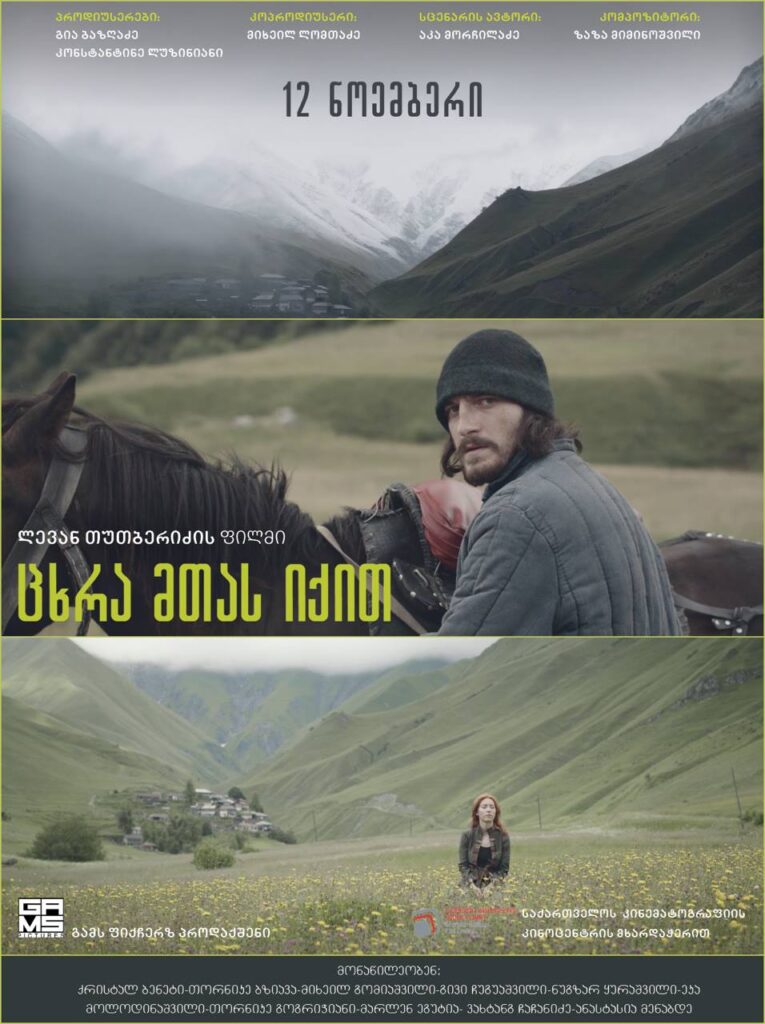
What happens in the modern village of the film “The Village” (2015), which seems to be cut off from civilization, the road to which is often impassable but for which this “remoteness” is a way to stay with oneself and survive? When is the peaceful coexistence of two worlds possible and when does it become impossible? What do people expect from the discovery of a new society, what does this society offer and are their ideas always consistent with reality and identical and if not, what is the reason for this in both cases?
These and other topics are covered in Levan Tutberidze’s feature film, according to the plot of which a group of ethnologists sets off on another expedition to a Georgian mountainous village. For them, as professionals (who, as a result of many years of research, are well acquainted with the locals and their ways of life, traditions, and legends), nothing and no one is strange in this world.
Here – in this village – beyond the nine mountains – everyone knows each other, both the locals and visitors, they know the value and quality of relationships here. They know each other’s identity, their worth, their goals, their interests and they take care of all of this as much as possible. It can’t be otherwise – this is the “law” of the mountain and no one allows themselves to violate it.
One of them, the unchanged leader of the expedition, dangerously diseased, travels to the village (where he has spent most of his life happily) to say goodbye. His stay beyond the nine mountains turns out to be the end of his stay in this world.
The village in the film has no name and is not characterized by any special angular or exotic features. The characters - actors - do not speak any Georgian dialect and do not stand out with any regional, say, facial features or clothing.
Such a place can be found everywhere, in the mountains or plains of Georgia, as well as anywhere in the world where people are closed in their own society, attached to the past, moral-psychological rules, and “really” existing traditions, however, live in a unique environment spread out in a vast space. Surrounded by myths, legends and tales that have become reality. Here, legends are equal to reality and no one doubts their existence as a reflection of reality. But what is ordinary, a part of everyday life for locals, is alien to those who try to create their own imaginations and construct their own myths in this world.
Levan Tutberidze chooses a "national" directing style - he observes the villagers and studies their lives with a young foreign photographer, Annie, which creates a condition for detachment and self-perception of attitudes, and a foreign eye - sharpened by the lens of a camera - produces a diverse spectrum of views.
For Ani, everything that is unalternative for others – nature, myths, characters, lifestyle, past and present, legends and customs, people – is alien and unexpected and becomes a cause of new relationships, peculiar perceptions, desires, passions, and interest.
The world to which locals and ethnologists are accustomed and which is governed by its own, practical or internal laws, which are passed down from generation to generation “orally”, which are not written down anywhere, but are stronger than all other existing ones – becomes the basis for exaggerated ideas and fantasies for the foreigner and the basis for the dramatic and even tragic, development of events, for him personally and for others.
Levan Tutberidze creates the atmosphere on the border of these two realities, two worlds. The film contains many mysteries, which the viewer is unable to solve until the finale. There are many lines and several topics in it. Several with origins and mutual consequences. This adds dramatic tension to the film and organically complements the slow, as if stretched, unexciting tempo-rhythm of the narrative, which is created by the interweaving of everyday and conditional details.
The intrusion of an English woman into this closed and free, open space seems to disrupt the usual flow and rhythm of life for a while but this change is just as “ordinary” and eternal as life and death, even violent, like a natural and inevitable transition from one state to another. Like the eternal variability of nature, the cycle of the seasons. As a result, reality and imagination, the present and mythology, reality and fiction, past and present are mixed and merged. The connection or collision of two cultures begins to shake both.
However, it is the person in the first place who is both the cause and the “victim” of the conflict, whose perception of events turns out to be “wrong” and inappropriate. More precisely, he creates his own myths from what he has seen, heard, from preliminary expectations or obsessions arising from imagination, which contradict what exists. With local myths. With local reality. Not because this world does not accept it as a stranger but because it is impossible to interfere in the established way of life and change it, to make a decision to change it, based only on personal desires and ideas.
A person is attracted to what is beyond reality, is wrapped in mystery and he strives to become visible, to turn his gaze into a piercing one and see what the “unarmed” eye cannot see. The memory of mankind stores a lot of information that is passed down from generation to generation even if centuries pass. Memory forms consciousness. The past reaches the present like an echo and affects the present. Equipped with such “knowledge,” a thinking person, first begins to search for clarity within himself (who we are, where we come from and where we want to go) and sets out on a certain path, even when he believes that fate has its own laws and plans.
Afterwards, a collision and eruption occur when all this accumulates. Explosions create new circumstances and unexpected constructions. The mechanism starts moving and it is no longer possible to stop it. This is an eternal process, and once, when someone sets out on the same path, he discovers that nothing in the world changes - the nature of man, society, the way of existence, aspirations, action or inaction, indifference or sympathy are the same as they were at any other time. It is eternal and so is the desire to understand the world and transform something in its “organized” system.
The characters in Levan Tutberidze’s film as well as the director go through these processes and the director analyzes the process of creation, birth, establishment and rejection of myths. He himself creates and destroys them, drawing attention to the meaninglessness of tradition and vain novelty, the invasion of useless new currents.
Lela Ochiauri


