The unique ability of animation to convey a person’s inner world in a surreal way lies in its complete freedom to ignore all the laws of physics and logic, which feature film can never achieve. This medium becomes a direct window into the subconscious where emotions, fears and thoughts are not only described but also materialized on the screen. Surreal animation allows objects and environments to change shape and content instantly and illogically, thus directly letting the image follow the flow of the character's thoughts. For example, during times of deep anxiety, objects take on an uncharacteristic form, which visualizes a feeling of chaos, loss of control and disorientation. Abstract concepts, such as guilt or trauma, can be transformed into specific but surreal entities that the character sees or imagines in an illogical space, where thoughts are incorrectly connected to each other and the logical chain is not connected by content but by irrational associations conveying the fragmentation of memory and internal tightness. Color and light in this process become emotional weapons. During a mental crisis, the palette can be aggressive and unnatural or completely monochrome, reflecting emotional emptiness.
Elene Zhorzholiani’s student animated film, “Bad Trip” (2017) responds to this very challenge and attempts to convey on the screen the chaos and pain in the human mind by means of non-standard language of animation. The film does not convey the documentary reality of events but is entirely focused on the visualization of emotional feelings.
A “bad trip” is a term used to describe an extremely negative, frightening mental experience under the influence of psychedelic substances. It is an acute psychological crisis in which a person experiences immense fear, panic and a breakdown in their own identity and reality. Its main characteristic is an acute feeling of paranoia, when familiar surroundings and people are perceived as hostile. This is accompanied by a different perception of time and space. Time can drag on indefinitely or, conversely, pass too quickly. The impact of a “bad trip” can leave a strong negative mark on a person’s psyche, causing post-traumatic stress disorder, anxiety and many other mental problems.
This student film is an extremely powerful, subjective and surrealistic portrayal of the experience of a psychedelic crisis, where physical movement and the perception of the environment serve to visualize the progressive process of mental breakdown. The film depicts two realities in parallel. The first is objective reality and the other is the main character’s inner world, a distortedly perceived reality. The alternation of particular objects and abstraction seems to comment on the reality seen by the subject and tells about his negative attitude towards everything.
The film begins with the bus movement indicating that the journey has begun, both a vacation at a seaside resort in reality and an exploration of the labyrinths of the subconscious. The bus ride itself is a metaphor for the beginning of an internal transformation. The director skillfully leads us to the collapse of consciousness. Sunbathing on the beach is no longer a peaceful rest but the initial stage of a perversion of perception. At this point, the language of animation begins to change: familiar surroundings and people take on a negative tone, faces and gestures are replaced by images reflecting inner feelings, which shows how paranoia and a crisis of social trust develop where everything, even a harmless situation, is perceived as a threat. Lines and shapes cease to obey the laws of reality and become direct expressions of anxiety and fear. This progressive visual negativism reaches its culmination in the materialization of a dangerous spider. The symbol of the spider here is not only irrational fear but also the visual embodiment of the absorption of the psyche, the collapse of identity. The spider, as a creature that is able to catch a fly, establishes a direct metaphorical connection with the most terrible phase of a bad trip, when the main character seems to be disintegrating or losing control of himself.
The structure of “Bad Trip” is based on the alternation of images of negative charge with gradually increasing intensity in a sequence of carefree, positively charged shots. This transformation occurs not only in terms of plot, but mainly through sharp changes in the visual vocabulary. From depicting reality, the animation moves to moving creatures drawn with wavy black lines, which carry a charge of anxiety and nervous tension. A series of drawings carrying negative emotions (bacteria, tablets, black windows, emptiness in the eyes, spiders) which come directly from subconscious fears, enhance the dynamics of the animated film. Along with the intensity of the image, this is accompanied by music of increasing tension, which in turn helps the director create a conceived effect.
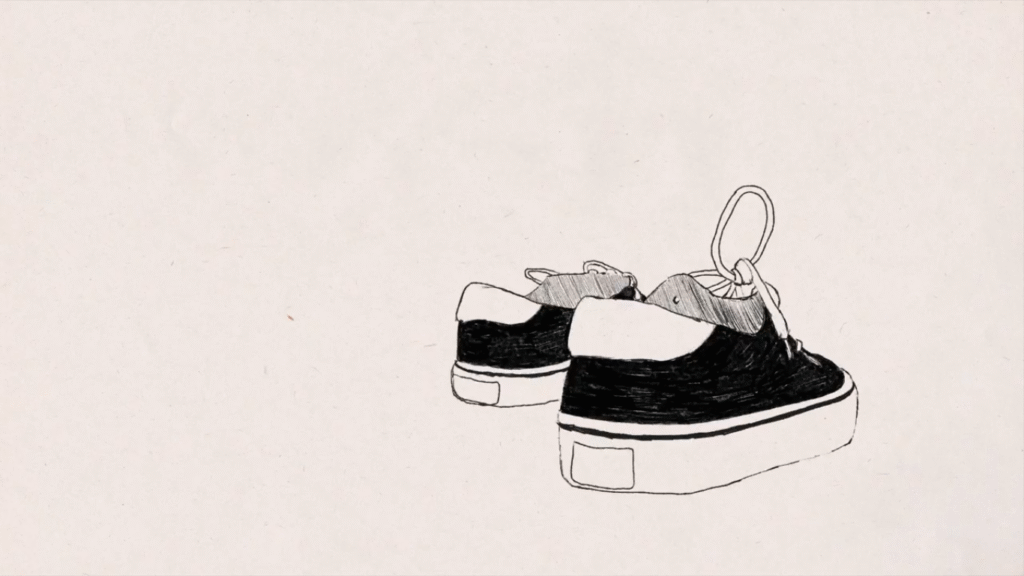
The visual side of the film really deserves attention as it is precisely its artistic language that makes it an impressive psychological work. The drawing is made entirely of black contours. The aesthetics are the embodiment of constant instability. The director does not use straight lines but deliberately preserves the visual and dynamics of the sketch. Each shot moves, vibrates and comes to life in an emotional rhythm. This constantly changing drawing conveys the feeling that the main character’s reality can change, collapse at any moment, which very well reflects the unstable feeling of altered consciousness.
Thus, Elene Zhorzholiani proves that animation is a unique artistic tool that can not only describe but also make the viewer fully feel and share mental and psychological subjective experiences.
Salome Gogoli