
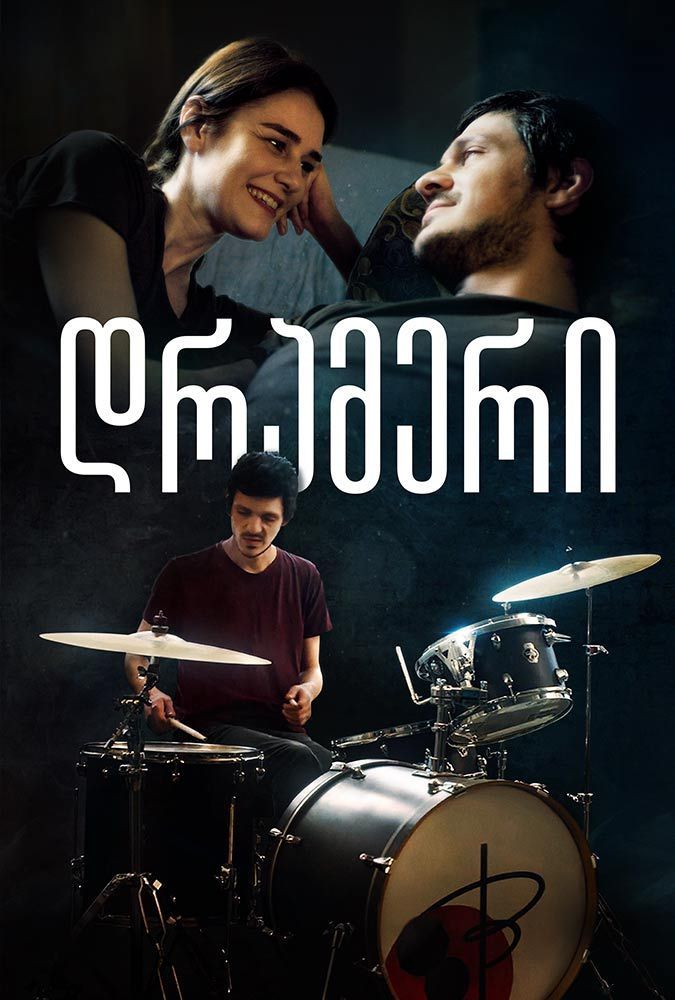
You are not alone even when you consider yourself being most invisible. Just stop and take a deep breath, smile and keep walking when you think that people do not notice you, do not acknowledge or recognize you. Sometimes everything is not as it seems from a distance. You need to stand close to them to understand events well. People are not as evil as they seem from afar. They are just fighting to survive in this cruel world. Some find solace in music, some in drugs and even sacrifice themselves to it. The culprit in all this is not a specific person, but time. Time that spares no one.
“Ronin was sitting on the roof of the house and did not come down to people” - this phrase kept ringing in my head for a long time after the film ended. The character Niko in Kote Kalandadze’s film “The Drummer” (2022) is immersed in chaos. He cannot find his place in society and the only escape for him is drums. He plays until his fingers get tired although being a famous drummer is not his goal in life. It is his way of having fun, an escape from the gray world. Or he might have wanted to be famous in childhood, and as he grew up, this desire was not fulfilled. The place where he lives suffocates him. The country’s economic situation is best described by musicians and this is the case here. He has to go off the road in order to buy a good drums and this movement swallows him completely. People around him cling to him like moss and drag him into a swamp, somewhere on the edge of an abyss he comes to his senses and tries to return to the real world.
Loneliness is an illusion. In depression, people become lonely in an attempt to separate themselves from society and escape from reality. Loneliness robs Niko of his ability to be happy. He is comfortable with neither the band nor with Nata. The only thing he wants is to escape. He would gladly become invisible and disappear but reality is different. Life is not a movie and when you need it, you can't vanish.
The film does not have a main problem. There is no conflict on which the plot is built. The topics are scattered; it is not clear at first what the film is about or who the main character is. Each character has their own problem and lives with it. The main line of the plot is unclear. If the viewer does not have a close look, he will not realize that the already grown-up boy is Niko and that the story revolves around him.
The sound design deserves special attention. The scenes of the drama are never just entertainment, they are noisy attempts at catharsis, which come in sharp contrast to Niko's constant, inner silence. It is precisely these cinematic techniques that double the emotional weight of the story, making the chronicle of alienation more personal and immediate for the viewer.
“The Drummer” is not just about one boy - it is more a chronicle of the alienation of a new generation. A generation that has almost no choice left: to live in a constant financial crisis or to deviate from the path and lose itself. That is why Niko's adventure becomes more than a personal tragedy. It is a kind of symptom - a symptom of a society that cannot provide space for music, art and breathing.
Niko's everyday life is stuck between these two extremes. He seems to be trying to stay on the same line but the environment constantly forces him to deviate. There is no space in his life where he can breathe freely – not at home, neither in the city, nor in the band. Niko's refuge is drama, but even this is collapsing and he has to start a fight with himself.
Who is Nata in his life? The reason for whom he must learn to live. Facing reality is the only way to solve problems. What happens to Niko is not only the fault of financial problems. The character is emotionally weak and at the initial stage, loses the right to choose only because of this. He can refuse to agree to "easy money" and not deal drugs. He wakes up when Nata is also dragged into filth. He realizes that he has a choice and can always return to the right path. Niko embarks on a long and difficult path of awakening. Ronin comes down to the people and begins to live with them.
The noisiest thing in Niko’s life is not music but the silence that constantly follows him. He seems to be searching for his own place in all directions. Neither the environment nor the people who hang around him help. Everyone has their own worries, and there is no space left for Niko. The more he tries to escape, the more he realizes that the problems are not outside but in his head. And until he fully gets to know himself, he cannot change the environment in which he has to exist.
The city of Tbilisi plays a decisive role in alienation, which is presented in the film not as a warm, old European center but as a hostile, suffocating space. Kote Kalandadze shows the city through the prism of a gray, concrete jungle, where impassable buildings and noisy streets constantly choke the character. This is a visual reflection of economic and social tension. The city architecture and urban chaos become Niko’s psychological burden - a place where his drama can never find harmony with the environment. Tbilisi in this context is not a backdrop - it is a living, relentless participant in Niko's battlefield.
“The Drummer” directly hints at the existence of the inner tension that accompanies the search for one's place. The film never creates the illusion that this process is easy or completed all at once. Conversely, it clearly shows that the most difficult stage in this struggle is the objective recognition of one's own situation. It is this endless, tireless search that shapes its main idea: in real life, a person’s place is rarely found ready-made - we often have to create it ourselves.
Barbare Kalaijishvili


