Society is often harmful as a systematic, uniform, rigid structure because it kills people’ s opportunity even in their childhood to express their free innate inner nature and accustoms them to obey imposed strict rules, to combine predetermined roles, teaches them who they should be, what they should love and how to live their short lives. Vazha-Pshavela wrote: “A person is born free. Look at a child how freely he acts when he can move, he touches everything that his eye and ear can reach; he moves his arms and legs when his mother puts him in the cradle and puts bands on his hands. Only the thought of glory, destruction, and intimidation clip the wings of the child’s free action, who strives for unlimited freedom. …”
Moreover, killing and suppressing of the individual’s free spirit (which is especially acutely perceived among young people) is often responded with protest and it in turn leads to conflict and alienation between generations. This problem has interested many directors throughout the 20th century. For example, Jean Vigo's "Zero in Behavior," François Truffaut's "400 Blows" and Ken Loach's "Kes" were dedicated to the problem of children's freedom. The characters of these films are adolescents who protest against the public order and they all act in their own way to oppose it or escape from it. It seems that Georgian director Givi Tukhareli has continued the cinematic path of Truffaut, Viggo, and Loach in an ideological way, offering a student film adaptation of Revaz Inanishvili's story, "Birds’ Over-winterizing" (2010), which exposes the oppressive system that gradually, silently and mercilessly kills a child’s free spirit.
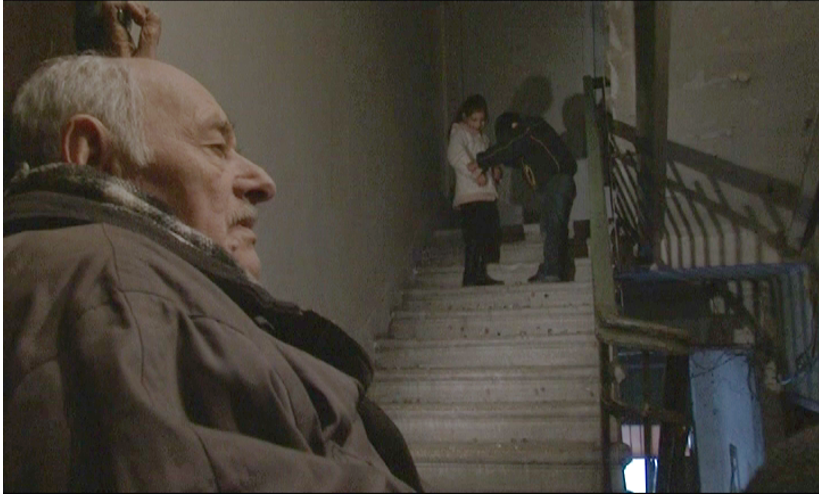
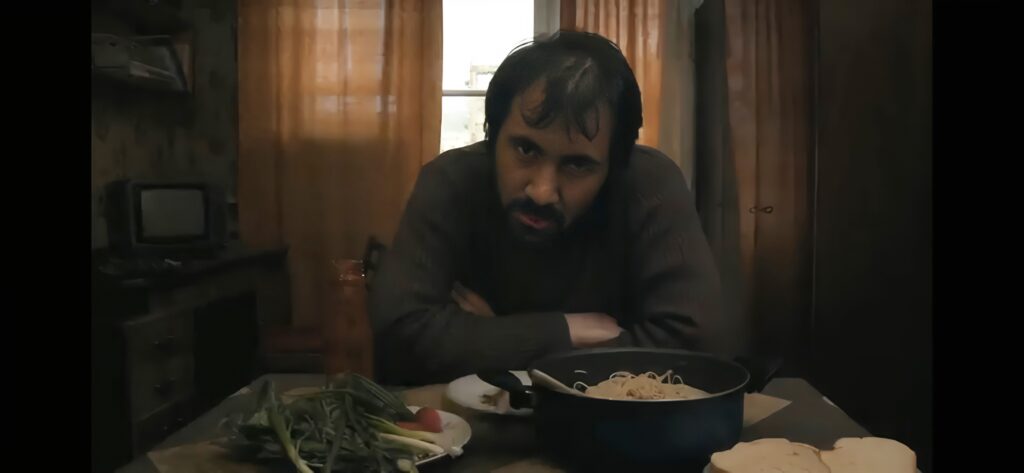
The film follows the narrative of the story step by step and tells a 15-year schoolboy’s story (the characters’ names are not mentioned in the film), who grows up in a family with difficult social and economic conditions. Alienation among the family members is depicted in the film - on the one hand, between the husband and wife, on the other, between the parents and the child but except for the child, none of them tries to overcome this estrangement. That is the reason why they cannot understand each other and misunderstanding arises between them. Although neither Revaz Inanishvili nor Givi Tukhareli identify a specific problem, the authors leave hints about the alienation between generations, which is especially evident in the dialogues.
The parents' conversation in the film leads the viewer to believe that the little boy is completely "out of control," although the film's final part proves absolutely opposite - the little boy is not at all as "unprepared" as his mother imagined him to be but rather the antipode of everything his parents attributed to him - as it turns out, the boy is very kind and generous, so much that he even planned to overwinter birds.
The film shows that the environment in which the boy (Victor Barbakadze) has to live suffers from a great loss of freedom. Against this background, the birds that he tames and brings home represent the only symbol of absolute freedom. That is why the birds become precious to this hero and it is for this reason that he tries to get closer to the birds. The boy does not treat the birds the way adult children do, who want to control everything, but instead shows love and care for the birds. The little birds are a very pure for the boy, direct and beautiful expression of freedom, the freedom that he has come so close for the first time in his life thanks to flying creatures. That is why his mother kills the birds - she deprives her child of the most precious and important thing, freedom that most adults do not give to children due to their ego-driven intentions and which has become so alien to adults.
It is noteworthy and interesting that the similarity, in this respect, between Revaz Inanishvili's Givi Tukhareli's student film and Ken Loach's film "Kes" (1969) is very large and noticeable, since in both cases the main characters are 15-year-old teenagers who find solace and freedom in birds in an oppressive environment of adults and in both cases this freedom is taken away from them by their family members - in Ken Loach, Billy's brother kills a hawk, while in Revaz Inanishvili’s story, the mother does this in front of her son. The rebellion of these two boys is not loud, however, in the case of both heroes, it is impossible not to see how such a system, rules, including a difficult economic and family situation, have a depressing effect on the child, as if it “makes” the little person even smaller and in the future turns him into what he instinctively fought for in his time – an adult devoid of empathy and emotions, sometimes heartbroken, who has broken ties with his own childhood. Interestingly, the French writer and pilot Antoine de Saint-Exupéry also wrote about this: “Everyone who is grown up was once a child, but very few remember it.”
“Birds' Over-winterizing,” in which dark colors dominate to highlight the problem under discussion, is not just a sad story of one teenager. This is a film about the invisible but all-encompassing forces that suppress freedom and carefreeness in a child. This screening clearly shows how social pressure, family alienation, and adults’ harsh intervention become the mechanism that clips a little person’s natural “wings.”
Nato Mtsariashvili