In everyday life, people often think that quitting is not an option, that only the weak choose to escape. It seems like there is an explanation for this at a glance – someone always preaches that you need to be strong, to overcome all difficulties like David against Goliath, but in reality, starting life from a clean slate requires just as much courage as continuing on the path.
Escapism, which speaks loudly about such aspects and boldly explains the situation to us, was something I noticed in cinema a long time ago because people need hope and want to find this hope within themselves and then dare to take a step.
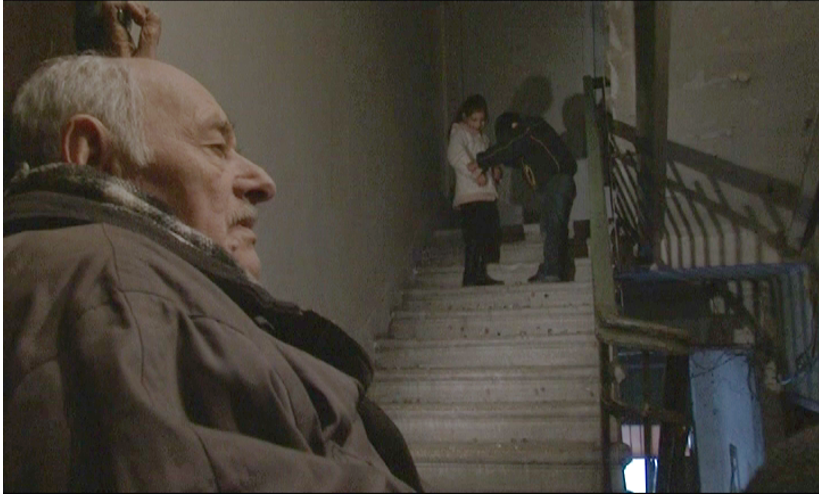
Elene Sheklashvili’s student film, “Leaving” (2024), tells the story of the smallest, yet most important period in three people’s lives, in which each of them feels the need for change. Sometimes, even one push is needed to get up and turn life upside down. This push is the last straw because you want to put an end to the unbearable, horrible everyday life that you accidentally let into your life and it has taken deep roots in you and you cannot and will not get away from it. The first character of the film, a young man is in a similar position, he suddenly disappears from the environment at his own birthday party, although he should be the main one, his family and friends are toasting him and he is only physically with them.
His mind has been occupied with something else for a long time. That's when this boy decides to go. He enters his room and packs his bag. Despite the fact that he is going far and for a long time, he only packs a few necessary items in his bag - those distant pictures, which intensifies his decision even more.
As the boy leaves the yard, he accidentally drops a picture, which is found by another hero of the film, a young boy, who is also under the same pressure because the static reality and the same daily rhythm are driving him crazy. And similarly, on that simple, unremarkable day, while doing household chores, he realizes that he has had enough. He slings on his back a bag he packed long time ago and leaves. On the way, he enters a local store to buy cigarettes and as a sign of farewell, gives the cashier a potted flower and a picture that he had recently found on the way.
The boy leaves the store and meets a girl at the door, who is the third and last character in the film. Like the others, she is already on her way. She says goodbye to her beloved friend, tells him about her feelings and tells him that it is better to get out of here before she too becomes a woman and mother, whose everyday life is one big nonsense. This is precisely where her motive is evident, in which going is not an escape but the beginning of something completely new, where she will have time to understand and listen to her own true identity. At the cash register, before she takes a cigarette, the girl notices a picture that she admires and the salesman gives her this picture as a gift. Thus, an invisible thread is tied between the characters. Invisible and accidental, which they do not know about and, most likely, will never understand despite the fact that all three are going to the same destination.
All three of them suddenly appear at the right time and in the right place. Somewhere at a small station, they get into a small van and go far away. The road is deserted but it seems that it is quiet and quietness is already good. The moving shots of the car are very similar to Abbas Kiarostami's famous film, "The Taste of Cherry", which also carries a heavy emotional background and feeling.
The shot continues. The city is far away, thus, the old endless rhythm must also remain somewhere there, as a memory in the layer of the mind. From the moment the three of them get out of the van, the only thing that will matter is that they find a home within themselves.
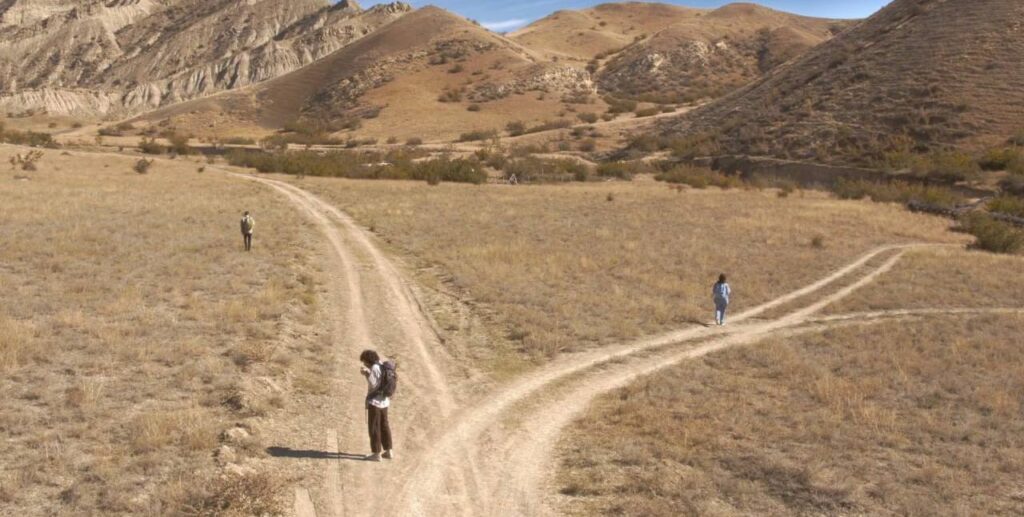
All three of them are at a crossroads. All three of them are going down different paths. On a path that is not even a road, it is just a path that they have to follow themselves. All of this is very understandable, and at the same time very metaphorical because it is related to human psychology and the philosophy of life, which is a familiar but inexperienced feeling on the one hand.
The film leaves the viewer with hope that there is always a way out. Even though the characters have not met each other, there is a kind of feeling that their energy motivates each other.
It is interesting that similar topics have always existed in cinema since its origins and that existential issues do not lose their relevance even today because cinema is directly related to man, to the study of human relationships and nature. The invisible connection between familiar or unfamiliar people is often the strongest impetus because when faced with a dilemma, a person consciously, even unconsciously, always pays attention to the other person's choice, to the other person's way to be calmer. People feel each other's energy and this is nothing but humanity.
Sophio Chitaladze