Contemporary Georgian cinema is often a reflection of the country’s topical social problems. One such film depicts a poignant portrait of how a person tries to introduce their world to a foreign guest while dreaming of escaping from it himself.
The film starts with the simplest situation, a meeting at the airport but a single lost business card turns the entire action into a platform for comic and dramatic misunderstanding. This is a story about the ritual of hospitality, which becomes an expression not of joy, but of deep inner despair. Georgian hospitality certainly is a phenomenon deeply rooted in Georgian culture. It is much more than a simple etiquette. A guest is traditionally considered a “sent by God.” This belief elevates the act of hospitality to an almost religious duty. Hosting a guest, regardless of his identity, social status, or nationality, is a matter of honor for the family, the region, and the country.
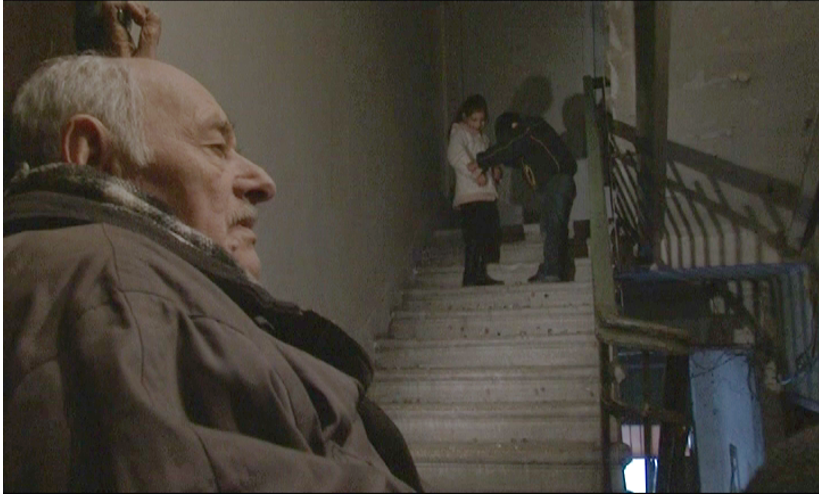
Tamar Tavadze’s student film, “Dreamland” (2014), is a kind of sincere and painful picture of modern Georgian life, which is put together in one day and one short adventure. The film focuses on the relationship between a driver and a German guest. Although the main character meets the guest accidentally, against the background of the problem of identification, he still tries wholeheartedly to perform the highest ritual of Georgian hospitality. This is a series of scenes where the driver enthusiastically endears himself to the guest in Georgia despite the language barrier (which is also a symbol of the cultural barrier): invites him for coffee, wine (he even gives him a bottle as a gift) and to try traditional cuisine in a restaurant. The driver’s introduction to his homeland to a foreigner is a noble, albeit somewhat desperate demonstration of Georgian culture, an attempt to paint an ideal image of the “dreamland” for the guest.
The climactic, most poignant episode of the film takes place in a restaurant, when the driver is open to a foreign guest and tells him about his own existential problems. He talks about emigration, unemployment, and the lack of jobs in Georgia. This monologue, which probably turns into only incomprehensible sounds for a German, is the the main message of the film. The behavior of a Georgian expecting help from a stranger he met just a few hours ago really reveals a naive belief in the omnipotence of a “stranger.” Despite his adult age, family and children, the driver acts like a small child who expects care and a solution to his problems from his parents. He cannot take responsibility for his own life and relies on an external force, the embodied symbol of which is the German guest sitting opposite him.
One of the most poignant and symbolic moments of the film is the double interpretation of the concept of a “dreamland,” which is understandable to the viewer due to the behavior of the driver. When the driver introduces Kakheti to a foreign guest as a dreamland, he is trying to fulfill the role of an ideal host. The name Kakheti in this context is an expression of national romanticism. This is the image of Georgia that we are proud of and that we want foreigners to see: wine, hospitality, authenticity. This is the outer facade behind which the driver’s different inner world is hidden. As the film progresses, this patriotic statement comes into complete contradiction with the driver’s inner desire and existential motivation.
The film “Dreamland” effectively uses this duality to show that homeland often becomes a painful conflict for a Georgian person: we love and are proud of our cultural heritage (Kakheti), but we can no longer live a normal life there. The driver is a person who is forced to sell a dream (Kakheti, wine, tradition) in order to gain the opportunity to go and achieve a real dream (the West, a job, stability). This contradiction gives the film a deep dramatic charge because the driver is not only a host but also a passive seeker of an escape from his own country.
With her film, the director draws attention to another problem of modern Georgia - emigration. It does not seem to be its central topic, however, as it progresses, it is noticeable that this topical social problem has become the subject of Tamar Tavadze's interest. The driver's attempt to charm the foreign guest with his enthusiastic hospitality is a manifestation of his desperate desire to receive some kind of help in leaving the country in exchange for his own culture.
“Dreamland” asks painful questions: what is a “dreamland” for a Georgian? Is it Europe or America, where there is work, or Georgia itself, where, despite sincere hospitality, people constantly want to escape? The film exacerbates the feeling that the country whose culture we so eagerly share with visitors is no longer our own refuge.
Salome Gogoli