A particularly important place in a person’s life is full of those emotions that most often are killed within themselves – be it envy, regret, doubt or something else. At the same time, they are precisely such intense emotions that allow a person to see his own actions from a broader, more generalized perspective and then find himself facing a dilemma. Split personality, the struggle with his own identity and just the study of the foundations of man have been issues around which cinema has revolved since time immemorial. Examples of this are Bergman’s dreamlike “Persona” or Lynch’s mystical “Mulholland Drive” etc. Unfortunately, these circumstances have never been fully studied and will never be studied since human nature is the most complex, difficult and foggy and can lead us to the darkest places.
Ivane Begiashvili’s student film, “Dialogue by the Lake” (2022) revolves around it. The director does a good job by showing us his vision. The film is based on the short story “Conversation in the Dark” by the famous Japanese author Ryunosuke Akutagawa. This is a fundamental element of the film since it is especially difficult to turn the inspiration from a strong primary source into an independent work of art but the director managed to do it. He speaks not from Akutagawa’s world, but from his own, very Georgian and eclectic environment, where a similar problem arises.
On a snowy and barren, lonely road, a young boy (Noe Macharashvili) tries to “hitchhike” his way. His first attempt is successful and the driver (Andria Vachridze) gets out of the car, moves his child from the front to the rear car seat and only then begins to talk to the stranger. Their dialogue is confusing and tense. It seems that these two strangers are very familiar to each other but there is no comfort between them; on the contrary, the tension increases. The boy traveler with a bag wants to get to the lake, the driver gets upset when he hears it and explains that he has a long way to go. After an uncomfortable long pause, we can see how these three people travel in the direction of the strange lake, which is often a symbol of mysticism and mystery in real. The longer you watch the film, the more confused you become because the dialogues between the driver and the traveler (actually nameless characters) are completely unclear. It seems that the boy's words mean a lot to the man, even too much.
The splitting of the personality is exactly what happens in Akutagawa’s story. A person’s self talks to its own version, as ego and alter ego. In Begiashvili’s film, this is exactly what happens – the driver in the car talks to himself, someone he met on the way because he needed verbal validation from him. The film also has an additional character - a small child, who can be compared to the purity and innocence that Akutagawa’s main character or even superego so often mentions. This might be the main character’s childhood, which still has some purity left and this is the reason why he looks at the situation from afar, with surprise and disappointment. The child does not make a sound, only suddenly appears in the shot with a thoughtful look and the viewer might also be tense along with the main character, as if he is ashamed.
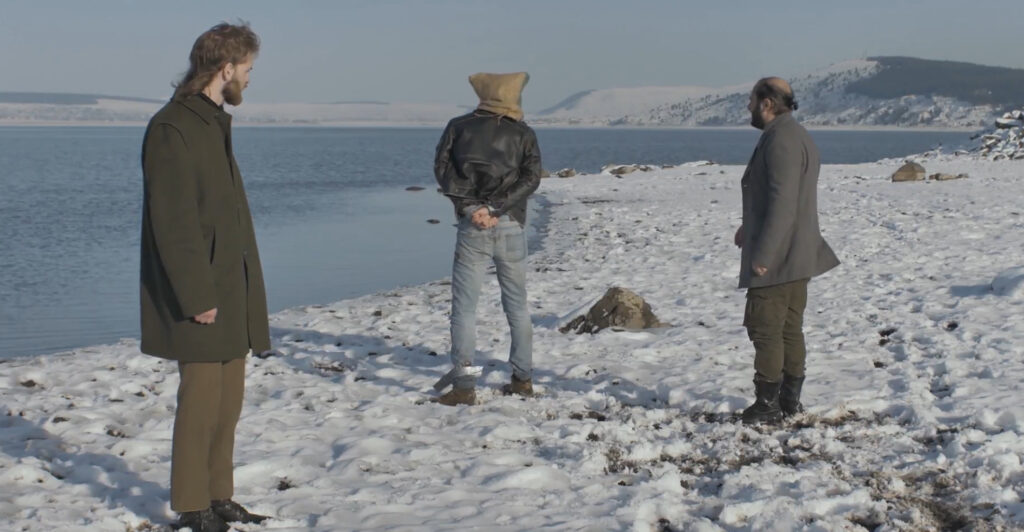
In the next scene, the driver faces a moral dilemma again and takes out a tied up man from the trunk after some hesitation. His face is not visible because he has a sack on his face. The driver has to do everything alone – he has to drag this tied up man to the lake shore alone and end his life alone but the victim does not give up so easily, he uses any opportunity to escape and does not lose his vitality. After some more hesitation, the finger touches the trigger and the man with the sack on his face turns the white snow bloody, a heavy smell permeates the snowdrifts and the feeling of emptiness grows. At this very moment, the young boy disappears as if he had never been there. Only the driver and the child stay there. The driver runs towards the car, runs away from this darkness and does not even look at the child, he is still ashamed of himself. The child chases him, but to no avail. Finally, the child also stops. With this, the author leaves the viewer with a small spark of hope or, conversely, twists the main character into a spiral of psychological drama and leaves him in emptiness. This cathartic state is enhanced by Bach's musical accompaniment, which is the most accurate finding for a morally terrifying and at the same time emotionally empty moment.
It can be said that the main character killed not someone else with his inner allegorical sounds but himself after regret and heaviness. The director does not offer the audience a specific definition of this but leaves space for thought. He managed to make precise accents. A dialogue took place on the edge of the cliff, although less verbal and more psychological but together with the main character, the viewer went through the darkness that this character had created for himself.
Lizi Gaprindashvili