
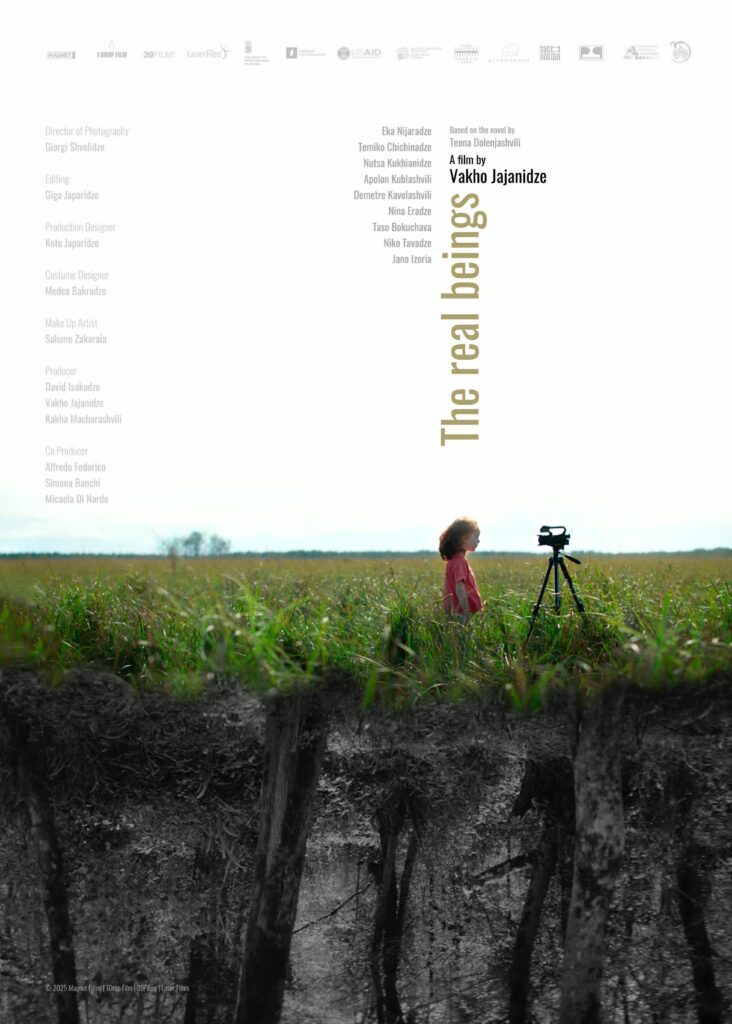
At the 26th Tbilisi International Film Festival, the young Georgian director Vakho Jajanidze made his debut with the film “The Real Beings” (2025), the script of which was written based on Teona Dolenjashvili’s story. The author worked on this project (a Georgian-Italian co-production) for six years.
The film tells the story of two holiday-maker families at one of the resorts. They meet at breakfast, when it turns out that they are old acquaintances of each other. Due to the unpopularity of the location, they are the only ones vacationing at this hotel, so they spend time together. The families are standard – husband and wife with their children. They spend time together playing, swimming, and sunbathing. There is only one exception to all this – this is Tengo, one of the husbands, a cameraman for “Discovery,” who has come to photograph those places along with his vacation. Only he does not join the “adult” fun of his wife and her old acquaintance. The environment is calm, unremarkable, but beautiful. Only children would make noise about the plain greenery, lakes and swamps, but this is not so.
One of the main plot lines concerns the relationship between the young children of these two families. Datuna is a fan of computer games, in which a craving for violence is clearly visible, while the girl, Bebe, is a nature lover. She collects shells, watches the environment and is always in full observation. Due to their interests, they do not often contact each other. This happens only when they become witnesses to one big secret, and even this dialogue is simply conducted with their eyes.
The director tries to explore the behavior, desires and emotions of people in midlife crisis and their family members throughout the film. The relationship between Nika and Tengo's wives, Lana and Keta, resembles a kind of competition in which there is no winner. Their old acquaintance does not prevent the start of the competition that develops later in the film and everything goes to the point that Keta sleeps with Lana's husband. Without any passion or emotion, as if this is revenge against her own husband or an old acquaintance.
In this mysterious chaos, which flows silently, Nia, Lana and Nika’s eldest daughter is completely out of place, for whom flirting with the local ranger and later having a carnal relationship becomes entertainment. She is also speechless, uncommunicative and secretive, like her parents. During the day, the only thing that matters to her is seeing the ranger who is practically is her father’s age. Throughout the film, it is seen in what crisis both families are. The main problem is the loss of emotional connection. It is likely that they have come there to solve this problem, to start the boat that is stopped, but it turns out that, along with the change of environment, they reveal themselves and create the swamp in which their children are drowning.
“The Real Beings” are embodied in the aesthetics of “slow cinema” which is a familiar and interesting approach for the director. For him, the story told through the camera is more important than the one told through the actors. The characters’ conversation in the film includes pre-planned questions and answers, which is why their dialogues are meaningless, although at this time the operator tries to tell us through the camera about topics that are not discussed, but are felt in their relationship. With slow and, in some cases, stretched shots, the author strives to make the viewer feel the tense and gloomy atmosphere that develops in the story.
The film cast is truly enviable. The main and secondary roles are played by such actors as: Nutsa Kukhianidze, Apolon Kublashvili, Eka Nizharadze, Temiko Chichinadze and Nika Tavadze. Their intersection creates an interesting contrast, considering that each of them has gone through different acting schools, which further highlights the characters’ individualism. The most outstanding of them is Nika Tavadze’s transformation, who plays the role of a ranger in the film. It is impossible to recognize him in the very first shots, because everyone knows him by his characteristic appearance and speech, although in this role he does not speak and his appearance has also changed significantly. He is completely adapted to the environment and, without saying a word, appears as a character who evokes negative emotions in the viewer.
It is difficult to say anything about Vakho Jajanidze’s work, because this is his first full-length film. He is now developing as an author, and “mistakes” are absolutely permissible because the film shows not only the research of the story but also that his directorial training is underway. In this case, the director appears as a kind of conductor, an intermediary between the directors he likes. The concept of the work itself is very similar to the film “The Swamp” (2001) by the Argentine director Lucrecia Martel, where the action does not take place at a resort, but in a large house. Even the characters are inspired by this film, which creates the feeling that the viewer has already seen Jajanidze’s work. However, the author's desire is to create an "art house" type of film (like those made by Lav Diaz or Bella Tar), a deeply philosophical film with long shots, although the director gives more food for thought than is necessary, and the length of some episodes is sometimes boring.
The main artistic problem of “The Real Beings” is the difficulty in perceiving its content or its general misunderstanding. The fact is that instead of food for thought, the film leaves the viewer with many question marks, the answers to which must be found not in themselves, but directly with the director, because only from him can one understand why some characters stopped appearing in the film or why the narration of a particular story was left where it was. Because of this, it is difficult to understand what he is saying and to say that the film turned out well. Nobody likes incomprehensible stories, but it should also be noted that this confusion is also caused by the fact that the author is trying in every way to introduce new film symbols into Georgian reality, which will make the story more profound and expressive.
The directorial debut, one might say, has been made. Despite the confusing plot, the potential of what the author can do is visible. For this the cinematic language he speaks is enough. His visually distinctive work offers us a new vision of the theme of family crisis. The director boldly chooses the complex style of “slow cinema,” which indicates his seriousness and desire for deep research in art. Although the plot of the film turned out to be too subtle and difficult to perceive in some episodes, this complexity is the result of the author’s intense creative search. Any great director has had a difficult stage in his career, when he searched for his own handwriting, searching for those directorial techniques that were inspired by his favorite authors, and Vakho Jajanidze’s efforts are aimed at finding this authorial handwriting, even if it is rough at first. This debut is a solid foundation for the director to be able to harmoniously combine visual mastery and narrative clarity in the future and take his own distinguished place in Georgian cinema.
Saba Makharashvili


