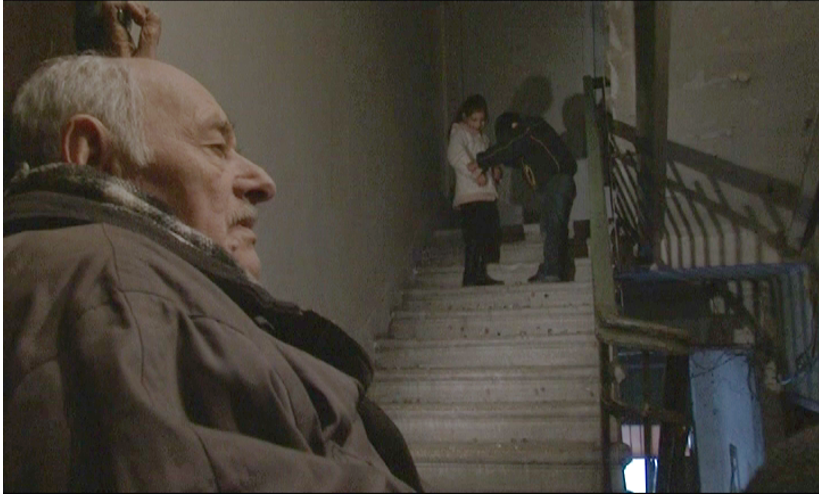
Ivane Begiashvili's student film, "Dialogue by the Lake" (2022), based on the motifs of Ryunosuke Akutagawa's short story "Dialogue in the Dark," makes the process of watching it more interesting. Nonetheless, there is a feeling at the end that the film misses something and that the director deliberately left the viewer in this unusual position. This raises the question - is the story presented real or is it a tightly packed illusion?
From the very first shot, a snowy road and a young man walking along it are visible. Within a few seconds, a car stops on the road, from which a man and a child get out and the impression is created that they are father and son. Suddenly, a strange dialogue takes place between the driver and the young man walking on the road, which raises suspicions. They look at each other for a long time, as if they are distant relatives, and then the young man gets into the car and lights a cigarette on the way. The driver also lights one. It is noticeable that the aura is getting heavier - classical music is heard in the background, which significantly intensifies the moment.
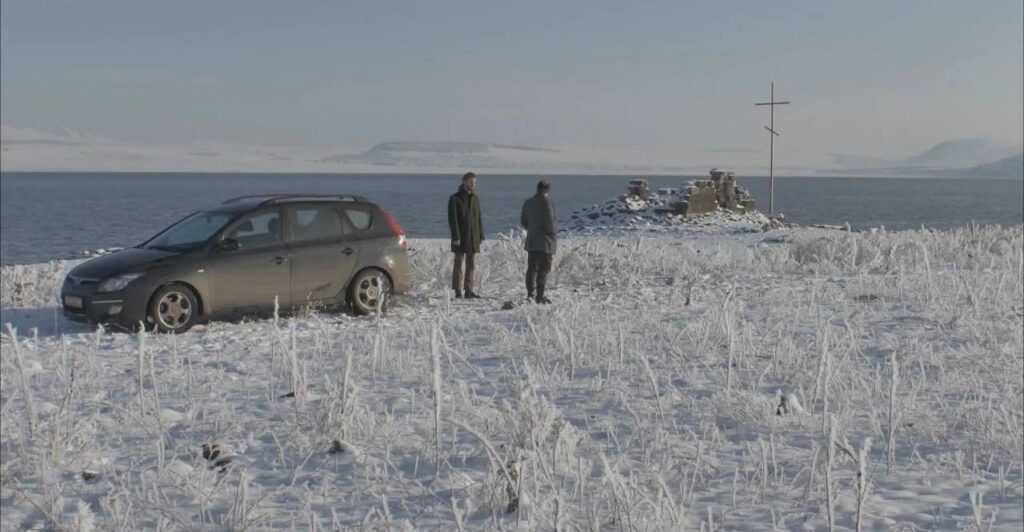
The car stops at a snowy lake and there is only cold around. The young man, without looking up, addresses the driver and tells him that he thought he was different, that he was lazy and useless. It is noteworthy that the nameless driver is the complete opposite of the nameless passenger. His appearance is more grotesque, as if he has a heavier character. They do not fit into any pattern, although one thing is obviously clear - they know each other, this is not a random meeting, this is not an insignificant location, and it is already vivid that something must happen. Something, necessarily dark and mysterious, because the lake is associated with all this in the same way as a harsh, cold winter day.
Suddenly, a sound is heard from the trunk, which sounds like the sound of a pig being slaughtered, although in reality there is a person there. His face is not visible and the reason for his condition is unclear. The driver quickly takes out a gun and tries to shoot the prisoner taken out of the trunk, but he runs away. The driver catches up with him and, under the influence of the boy, shoots him. The prisoner falls to the ground, the driver runs away. Everything is visible in the general view: the car, the body, the driver, the child, the lake and the dogs. Everyone is visible, but not the boy passenger. He disappears as if he did not exist. The driver runs away again and gets into the car, knocks on it and drives away. He drives away, leaving the child behind. The shot ends, and then the entire film.
In his works, Ryunosuke Akutagawa often mentioned and explored the dual nature of man and his morality, which were directly related to his inner self. At the same time, he analyzed the personal crisis and the desperate search for truth, which made the author's thought process relatively understandable. Everything in life has a connection and a price, which is why it is interesting to discuss this situation because it is more complicated than anyone thinks.
The passenger might be a phantom, an immaterial consciousness that lives in the child's mind, and the child, in turn, seems to live in an endless, dangerous dream, and everything that happens is only fear.
The psychology of a child is the most virtuous and interesting, because his helplessness always raises doubts that something so terrible and thought-provoking could be swirling in his consciousness. Indeed, there is nothing more terrible than fear that eats away the soul, especially when you are a child and have to live with the feeling that you will be abandoned someday.
Or, perhaps, everything is the other way around and the main character of this story is not a child but a driver who is struggling with the obstacle that drives him crazy, makes him think, and everything that is seen in the film is an allegory of the reality in which he exists mentally.
Like other student films, this film is not distinguished by its original style of filming and editing, which is not a tragedy at all. Nevertheless, for a similar plot, it would be better to use color manipulation and symbolism, which would at least answer a few questions and better understand the viewer, where the truth is that everyone is looking for.
The plot of the film is so original that it is considered a bold and interesting solution that allows the viewer to think. The film itself belongs to the category that draws you into its own world, and as a result, everything that interests you has to be solved by yourself.
It is often interesting to watch such authorial works because the process is a real task, which is sometimes easier, sometimes more difficult, and of course, this is the natural flow, because the vision is as diverse as people are diverse.
Sophio Chitaladze