Bob Dylan appeared to us as the “voice” of youth during the transitional period of the 1960s, when the gap between the new and old generations was most outlined. His song "The Times They Are a-Changin' ” became a kind of manifesto addressed to the older generation that had fallen behind the hippie revolution. This little man from Minnesota was chosen as the “microphone” for the frustration of post-war youth and the problems of the current reality. Industrialization, wars, and mass culture kept people in chaos and uncertainty. Changing times and the existing melancholic background created hopelessness and this situation makes you think about what the essence of life is and why we do anything at all? Decades have passed since then and today the same questions bother us.
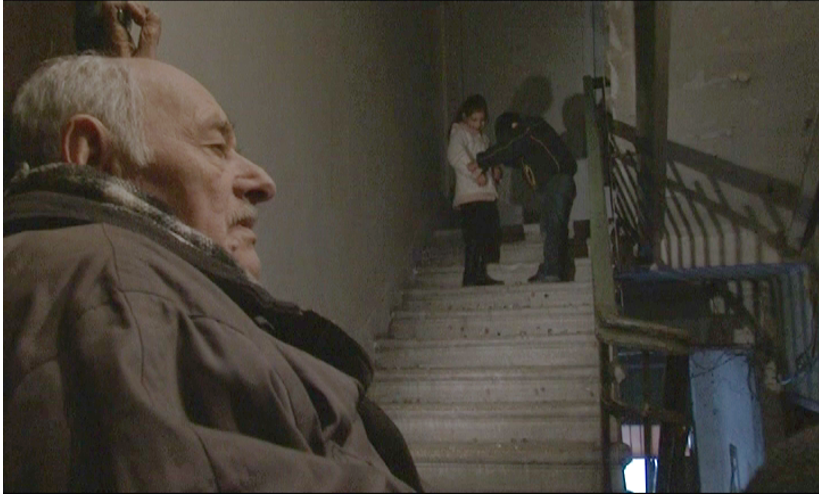
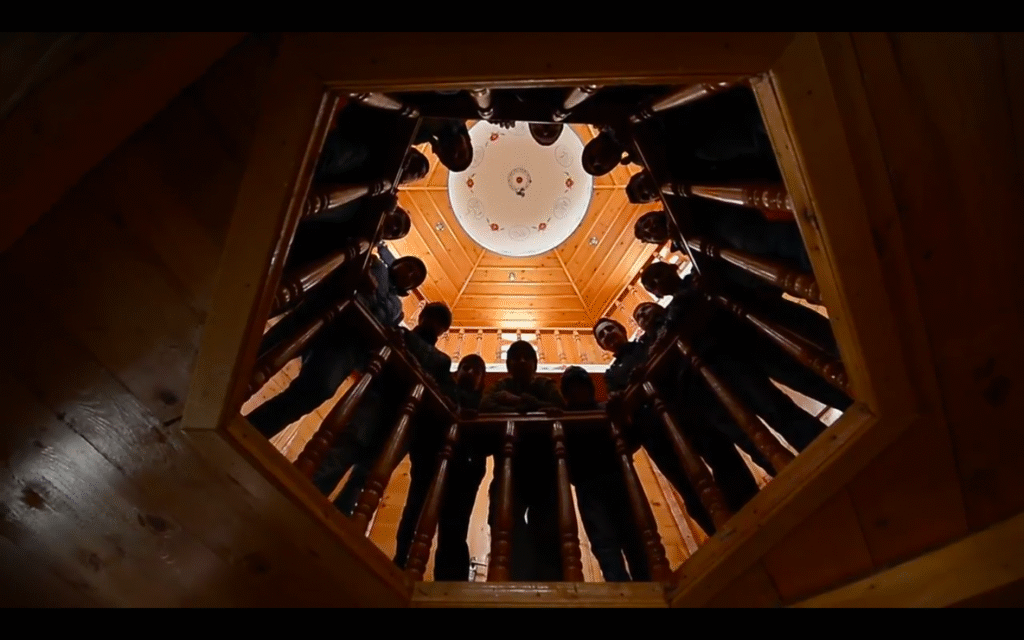
Marika Sikharulidze’s student documentary, “Broken Bridge” (2015), tells the viewer about the Muslim population’s everyday life in the village of Ghorjomi. Traditions, farming, mosque life contrast with the viewer’s modern existence. On the landscape of the New World, a culture fighting for survival, locked in a mountainous region is expressed as a call, a request for help, so that the minority of society can gain a foothold in the “New World.”
Against the background of a cold winter breeze, the village population prays in a mosque. At the same time, there are interview inserts in the film, as is often characteristic of documentary films. The population talks about its problems, primarily the difficulties of Georgian Muslims living in Georgia. They study in schools, speak in the broken Georgian characteristic of the regions but still in the Georgian language. In fact, there are Georgians with different beliefs. The purpose of creating the film also becomes clear in conversations with the population: their nationality is Georgian, and their culture is Arabic. They pray from a book whose language they do not understand (they do not know Arabic). Their existence depends on seasonal agriculture, in contrast to modern urban life.
In the second half of the film, already against the background of a sunny spring sky, the village begins to work on the land. This is not only their main source of existence, but also the only thing that a person can do there. Accordingly, the director presents another conflict against the backdrop of a time - consuming life - the youth are doomed to engage in this activity. They are brought up to work on the land. Interestingly, this is not some political-social call or religious criticism, simply a reflection of the fleeting culture of the small population of a small country, which is struggling to survive.
The contrast that the viewer may experience while watching this film is noteworthy. The director’s goal might only be to show the lifestyle of this population and the Muslim mountainous region in the Georgian Christian background but this is precisely what becomes the subject of discussion. The population, locked inside a small country between great empires, is a reflection of our own. Not only is the existence of this village population questioned against the background of modern life but also of modern man in general. Despite cultural transition and hardship, this might be a society that has found the key to life. It is true that this village population lives as a remnant of the past, without the ability to adapt to modernity but modern man exists against this background, who is devoid of culture and tradition – empty of more comforts.
Sometimes there is a desire or longing to breathe fresh air in the peaceful environment of the mountains in the exhausting routine of a big city. A change of environment might change the brutal everyday life in which we exist, the village may be idyllic without any problems, the clear sound of birds chirping seem to allow us to control our own lives. In contrast, “Broken Bridge” shows those subjects on whom we have a negative impact. The pursuit of new perfection and insatiable desires has left a specific society, which was already struggling as a religious minority. The title of the film also symbolically expresses this situation. There is a “broken bridge” between these forgotten people of society and us, which no one wants to restore because they do not consider them necessary.
Marika Sikharulidze shows this very situation in her film. She might be the “voice” of culturally forgotten people. The film creates an atmosphere despite its short length and the absence of any dogma that makes the viewer think about their own path in life. Although, at first glance, this is a simple documentary of high-mountain village life, in reality it is a manifesto that acts in opposition to modern existence: despite the cold and small land, there is an insistent desire for cultural preservation against the backdrop of all kinds of obstacles and hardships, which modern man lacks.
What is conveyed in the film may not be the director’s calculation and, in general, he did not even imagine it. Unlike a feature film, documentary cinema is closest to realism. It is almost completely deprived of emotional or moral manipulation (at least mechanically). Accordingly, even a simple student film, in which the meaning and purpose are clear, is much more meaningful than a mediocre, forgettable artistic attempt. The last section of the film is banal, and the director tries to turn the entire essence of youth into one character, although this is one of the outstanding student films that will serve as a subject for interesting discussion.
In “Modern Times,” Chaplin criticized modernity almost a hundred years ago and showed a character who could not adapt to the industrial-global world (because they did not need people like him). Behind the urban culture focused on constant innovations and profit, only an empty existence remains. People are always waiting for a savior, and in today's world, Bob Dylan's cultural symbolism of "the voice of a generation" does not exist for a forgotten society. Cinema might be the "voice of a generation," we, as viewers, might be modern-day Minnesotan curly-haired guitar-playing ones, trying to make people hear each other's woe.
Giorgi Bajelidze