
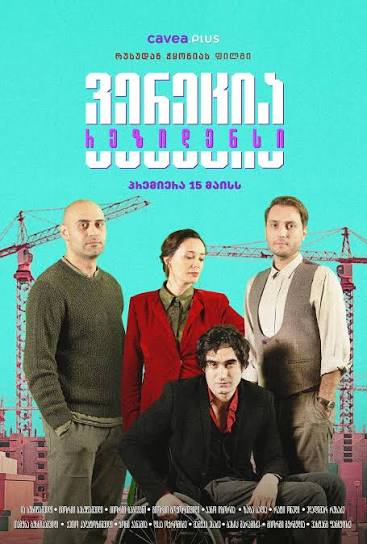
A town often keeps the stories which are born within its walls. Half-built constructions, hanging cranes, unfinished flats - all this is not just part of the urban landscape. They also reflect people's lives: expectation, hope, disappointment. It is this reality that Rusudan Chkonia's tragicomedy, "Venezia" (2024) deals with, which, at first glance, is just about the endless social construction of a residential building, but in fact tells us about human nature, relationships and moral choices.
The film's plot is both realistic and symbolic. A construction company has been unable to complete a residential complex for seven years, ironically called "Venezia." The name seems to create an absurd contrast: the real Venice is associated with architectural beauty, a city of water and light, while the film's "Venezia" is a half-built concrete space.
The flat owners are trying to find a solution. They plan to finish the construction themselves but all attempts end in failure. Finally, they are faced with the only real solution: one of the owners must give up the apartment in order to complete the construction.
This is where the main dramatic and moral conflict begins, where an important element is the topic of neighborhood. The characters are not strangers to each other. They had lived together in the same building before and had developed a certain neighborly relationship over the years. It was precisely this past experience that should create the basis for trust and mutual understanding between them. The new residential complex did not mean just a change of residence for them. It should have been a continuation of the same neighborhood in a new, more comfortable space.
However, the film shows that even a shared past does not always guarantee solidarity. When it comes to personal interests and property, relationships between people can quickly become strained. Characters who have lived side by side for years suddenly find themselves faced with a difficult choice - they must decide how to save the common project and not lose their own interests at the same time.
The gravity of this conflict lies precisely in the fact that they will have to be neighbors in the future. If the building is completed, they will still live in the same space - in the same entrance, in the same yard, with daily meetings and relationships, so their solutions do not only concern a specific problem. They also determine the future in which these people will have to live next to each other.
Consequently, the film shows neighborhood as a complex social relationship where friendship, trust, and personal interests constantly clash. It is in this tension that the side of human nature is revealed, which is most clearly visible when people are forced to share a common space and a common future.
One of the most important scenes is when the owners first discuss the idea that one of them should give up the flat. This scene seems like a simple discussion, but gradually the emotional tension increases. Initially, the characters try to approach the issue rationally. They talk about finances, technical problems, legal details.
But very soon the conversation transfers onto a personal level. Who should give up the flat? Why him? Why not someone else? These questions quickly reveal the tension that had been hidden until then. Throughout the film, the characters walk through the empty space of the building. This movement takes on an almost symbolic character, as if they are walking into their own future, which does not yet exist.
The main conflict of the film reminds us of the confrontation between the individual and the collective. French philosopher Jean-Jacques Rousseau wrote that the social contract is based on the idea that individuals voluntarily surrender their natural liberties to the collective community focused on the common good. In “Venezia,” this idea takes on a practical and painful form. Is it fair for one person to give up their flat so that others can start a life? We can also look at this issue from the perspective of social trauma. When a society constantly lives in uncertainty, economic and social hardship, this situation opposes people against each other.
The inspiration for the film was the director's own personal experience. This fact plays an important role in the authenticity of the film. In this context, "Venezia" is no longer just an adventure of one building. It is a public portrait. When the author touches on his own story, the narrative appears with an emotional accuracy that is often lacking in fictional stories, so "Venezia" does not look like just a social satire, it feels personal pain and disappointment that exist in real life.
The film's significant strength is its cast. They create characters with different personalities, social statuses, and life experiences. They are gathered in one space - a building that has not been completed for seven years. Thus, this building itself becomes a micro-society. This space seems to be a small model of the social reality where people both cooperate and fight with each other.
The film's visual style is particularly important - the unfinished walls, bare concrete, unfinished stairs, and open windows create a space that is constantly in a half-finished state; a space where the characters seem to be constantly searching for their way out but never finding it.
The director often uses wide shots, where the characters appear as small figures in a vast, empty architecture. This visual decision emphasizes the helplessness of people in front of the system. The building here is not just a living space, it also becomes a symbol of power. The color palette is mainly built on cold tones. Cold lighting creates an atmosphere that evokes a feeling of constant regression. In this environment, the characters seem to be cut off from their own lives.
Although the film deals with a serious social issue, humor plays an important role in it. The tragicomic tone particularly well expresses the paradox that often characterizes Georgian reality. People can laugh even in the most absurd situations. This laughter is often bitter but it is precisely in this bitter humor that the power of salvation is hidden.
Any interesting and formally daring film is not perfect, as a rule. Especially when the director chooses a difficult topic and a difficult form. Although Rusudan Chkonia creates an important social tragicomedy and tries to unite form and content, “ Venezia” also has certain weaknesses that affect the viewer. One of the main problems may be that the main conflict, the issue of one of the owners giving up the flat, at some points remains more at the level of an idea than turns into a fully developed dramatic process.
The audience sees the characters arguing, debating, and trying to find a solution but their personal stories are often only partially revealed. This can create the feeling that some characters remain just social symbols, rather than fully formed individuals. The film needed more time and space to reveal the characters' personal motivations so that the audience can better understand why they act the way they do.
The tragicomedy genre is often difficult as it requires a balance between comedic and dramatic elements. In “Venezia,” this balance is sometimes disrupted. Although the film revolves around an interesting social situation, its emotional climax can be relatively calm and less shocking. The audience expects a stronger dramatic explosion, a moment when the conflict reaches its maximum tension.
Along with these critical remarks, it is important to note that “Venezia” still remains an interesting experiment in modern Georgian cinema. The director attempts to unite form and content, creating a film that presents social reality from a tragicomic perspective. These raw details might give the film a human and even lively character, to some extent.
One of the most distinctive formal solutions of the film is that it is made in continuous shot. This technical choice does not only serve to create a visual effect. It is directly related to the topic of the film, the psychological state of the characters, and the sense of time. Such a solution always attracts special attention in cinema because its implementation is a difficult and risky process.
Filming in a continuous frame means that the camera never seems to stop. The action unfolds in one continuous movement, without editing cuts, which requires special precision and synchronicity from the director and the entire creative team. In this case, there is almost no room for error: the movement of the actors, dialogues, camera movements, lighting and use of space must become a single choreographic process. Even one small technical or acting mistake can mean having to reshoot the entire scene. In this respect, a continuous shot turns the film into a kind of “living organism.”
Rusudan Chkonia uses this complex form In the film, which intensifies the realistic effect. The continuous movement of the camera creates the feeling that the viewer is in that space, in that endless building where the characters live with their problems and conflicts. The viewer seems to move with them through the corridors, stairs, empty apartments.
This visual technique works especially well in films where the space itself becomes an important part of the plot. In “Venezia,” the endless building is not only the place of action, but also a symbolic environment that expresses the closed state of the characters. The continuous movement of the camera gives this space a lively and dynamic character.
"Venezia" is not just a story about an unfinished building. It is a film about the state that society often finds itself in - in constant expectation, in constant uncertainty. The characters try to find a way out, finish the building and start a new life, but it is in this process that the most difficult aspects of human nature are revealed: selfishness, fear, solidarity and responsibility.
The unfinished building here becomes a metaphor for the promises and hopes that accumulate over the years, but often remain unfulfilled. That is why “Venezia” makes us think about how we live in a common space and how ready we are to give up even a part of our personal interests to solve a common problem. The most important question the film asks is: how ready are we to think not only about our own flat but also about the house in which we all must live together when our common future is at stake?
Teona Vekua


