
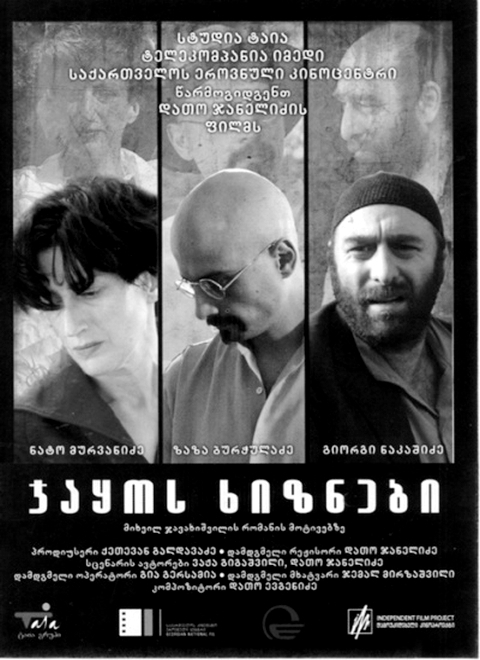
Georgian classics, national literature naturally arouse public interest and attract attention after having been transferred onto the stage and, moreover, onto the screen. This tradition was not broken when Davit (Dato) Janelidze filmed Mikheil Javakhishvili's "Jaqo's Dispossessed" in 2009. It is the film based on the novel, with a script by Janelidze himself and Vazha Gigashvili and for the first time in Georgian cinema.
The idea of "the displaced" in the novel was also used in an allegorical form by Dato Janilidze earlier, ten years before filming " Jaqo's Dispossessed," in the film "Tenants" (based on Mamuka Dolidze's play), by tying the story, plot, and characters in a different form, however, with a metaphorical expression of the same problem.
From Mikheil Javakhishvili's notebook: I was writing "Jaqo's Dispossessed" in September-October 1924 and felt that my heart was on fire, and my soul was drenched in the blood of that time. "Jaqo is the moan of my soul."
Dato Janelidze follows one of the topics in "Jaqo's Dispossessed" – a "penetrating action" - and builds the narrative around it, creating a new screen structure of the story. The story, plot and main characters of Mikheil Javakhishvili's novel are preserved. The idea of the work is also used and highlighted. The "political" sharpness of the text is covered by the line of existence and the relationships between the characters. The film is, indeed, permeated by the "fragrance" of time, historicism and political realities but with hints and faded "colors.” The film shows the story of a society that allowed such a development of events, the threat of which always exists in any country and era, in times of socio-political change, intense cataclysms.
Time is “lost,” or rather is scattered in the film. The initial point (as in the novel) might be the 1920s, the conquest of Georgia by Bolshevik Russia, the Sovietization of Georgia and the beginning of perhaps the most tragic era in the history of the country.
The exposition part of the film uses the footage from the chronicle of the Red Army invasion of Georgia. Everyone knows well what and which events led to the establishment of the Red Terror in the country and the loss of the country's statehood. As well as what has changed in general in the life of the Georgian nation, of everyone, as in the lives of Teimuraz Khevistavi, Margo and Jaqo.
Then the boundaries of time are broken and the action moves to different generalized times, even to the present day. The history of Georgia in the post-Soviet period is also shown and what can happen when people lose the main purpose - freedom, independence and spirituality.
Just as Mikheil Javakhishvili's "Jaqo's Dispossessed" is not a sample of documentary prose, a historical work in the literal sense, neither is Dato Janelidze's film a document of time and era, although it also includes historicism, it is a metaphor depicting the country, nation, reality and an "echo of moaning" of the nation that was taken over by the "Jaqos," tha is the oppressors.
A mental and visual contrast is created in “Jaqo’s Dispossessed:” on one side - Margo (Nato Murvanidze) and Teimuraz (Zaza Burchuladze), graceful in appearance and manners, finely spoken, modern, educated, but internally empty, emotionless, with dull eyes and indifferent, and on the other side - Jaqo (Giorgi Nakashidze), full of life, physically and spiritually strong, healthy, cunning and lively-eyed - are three poles intertwined (as fate once brought them together and connected them). Obviously, this connection is formal and not internal. It is not real. It is forced. It is not a love triangle either. But rather, a fatal unity of people ensnared in a trap.
It seems strange but the only one in this trio who is driven by human feelings (admittedly, negative ones), who “resembles” a person, is Jaqo. He loves life and enjoys it. Work, feasting, eating make him happy. He has a wife, children, and his family is increasing. He loves to control people. Influence them. He has a passion to make his own what previously did not belong to him, was inaccessible - Margo, property, home, the family names of Khevistavi and Kaplanishvili, inheritance and power obtained by force and fraud. He is given everything by a new time – fate. New time is Jaqo’s time, a weapon that he skillfully uses.
Teimuraz is smart enough to understand from the very beginning what is happening between Margo and Jaqo, he knows who and why took the Khevistavi family’s valuables, how the things lost from the house ended up in Margo’s hands. But he doesn't notice anything and doesn't react to anything, because he no longer has the strength (he might not ever had it). Because he prefers it that way. He feels safer and calmer that way. That's why he acts as if nothing happened. He knows that Jaqo has taken what was his and what wasn't allowed and hasn't let it go. And he himself gives him the right to use it.
Dato Janelidze's Margo and Teimuraz have turned into ghosts. Incorporeal beings. And soulless. Lost in an empty world. Lost in space and time. They don't even understand each other anymore. It might not have always been like this. Once upon a time, Margo was interested in a relationship with Teimuraz despite the inner coldness and inertia, she liked him, perhaps even loved him but the love has disappeared, the passion and the support she hoped for have vanished, so she seeks refuge with Jaqo, to at least receive from him what she could no longer find in her husband and think pragmatically about the future and physical survival.
The energy of life that Margo and Teimuraz lack and Jaqo possesses in abundance, their coldness and detachment, create a contrast with the sun-drenched shots, as objects, people, places in light and shadow.
The environment, sometimes shrouded in greenery and sometimes glowing with gold, the landscapes of autumn and newly blooming nature create a mood of external peace, coziness and stability. Everywhere you can feel the warmth and power of the sun that shines down on the Khevistavi family estate, and the gentle flow of life (which is expressed in the tempo-rhythm of the film events) and what has befallen the film's heroes (society) become heavier and more oppressive against this background.
Everything is filmed with Gia Gersamia’s (the great master) hand-held camera and creates a lively, dynamic picture of life. A completely unadorned and transparent image, not forcibly aestheticized but distinguished by its own subtlety. With contrasts and alternating overexposed shots.
Such a shooting style and montage arrangement; the environment, the types of characters (many of the film's participants are non-professional actors, local residents), stylized costumes, without specific characteristics of the time (artist Eka Maghalashvili); Davit Evgenidze's original and differently sounded and transformed folk music, which intensifies the colors of mystery and tense, dangerous atmosphere along with dramatism - gives the film the appearance of reality and unreality, the concrete and the abstract.
Dato Janelidze's "Jaqo's Dispossessed" ends with Jaqo and Margo’s church wedding ceremony. And not the way it is in Javakhishvili’s novel. Margo is still a beautiful bride, perhaps a little sadder than she was years ago, standing next to Teimuraz in the same church (and whose footage is revived in Margo's memories at the beginning of the film). The newlyweds will start a new life, and Teimuraz is attending his own "funeral."
This is Teimuraz's choice. “Do not fear your enemies. The worst they can do is kill you. Do not fear friends. At worst, they may betray you. Fear those who do not care; they neither kill nor betray, but betrayal and murder exist because of their silent consent.” (Bruno Jasensky. "The Conspiracy of the Silent").
It is also a fact that the meaning and message of Mikheil Javakhishvili's "Jaqo’s Dispossessed" are not limited by either temporal or geographical dimensions. In it, in any era or state formation, one can discover and raise new facets and new problems, identical issues of processes taking place in the past and present. This is confirmed in every new case of rereading the novel, staging a new version of the play (without it, practically no season has passed in the Georgian theater). And it was proven once again with Dato Janelidze's "Jaqo's Dispossessed."
Lela Ochiauri


