What is human life in the modern world if not relationships filled with emptiness and a longing for the glorious past, saturated with nostalgia and sadness, but what is the “glory” of the past or why was childhood sweeter than the present?!
Nia Zhvania’s student film, “Rewinding” (2023), deals with these topics with a light and characteristic aesthetic that, reminds us of a commercial genre film at a glance, in terms of color scheme and editing style but at the same time manages to establish an emotional connection with the audience and accurately convey to the viewer the situation of three young friends.
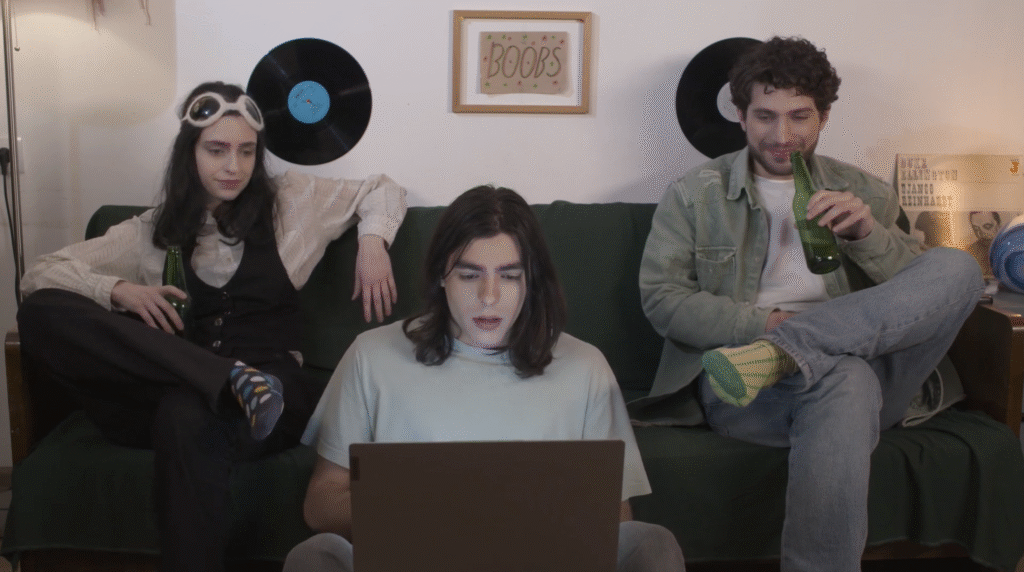
Data, Tazo, and Tekla are close friends, but you can’t really call their relationship the best. Data is immersed in professional activities and studies, Tekla is detached from reality working towards financial independence, and Tazo is a young man looking forward to spending time with his friends. Their lives seem to be very different from each other, however, they still manage to find time for each other. This is very similar to the reality in which we all live now.
We, humans find it most difficult to correctly distribute our time and priorities in the cyber era. The virtual world takes up so much of our time in the real world that we seldom have time to spend with our loved ones. That is why actively finding time for friends is a real dedication today, which can be attributed to idleness and lack of prospects but why can’t we call it, on the contrary, the correct arrangement of priorities. However, in this reality, people’s priorities are mainly related only to career advancement and financial strength, which is also difficult to justify because life has changed its course, people had to get involved in a strange, fast-paced flow after the Soviet dogmas, where it is not so easy to find a way. When it's Data's birthday, he seems to be immersed in a whirlwind of nostalgia and recalls his childhood, a time when even a little was sufficient, when just being together was enough for fun. The film seems to narrate with similar ease what is so close and painful to the viewer.
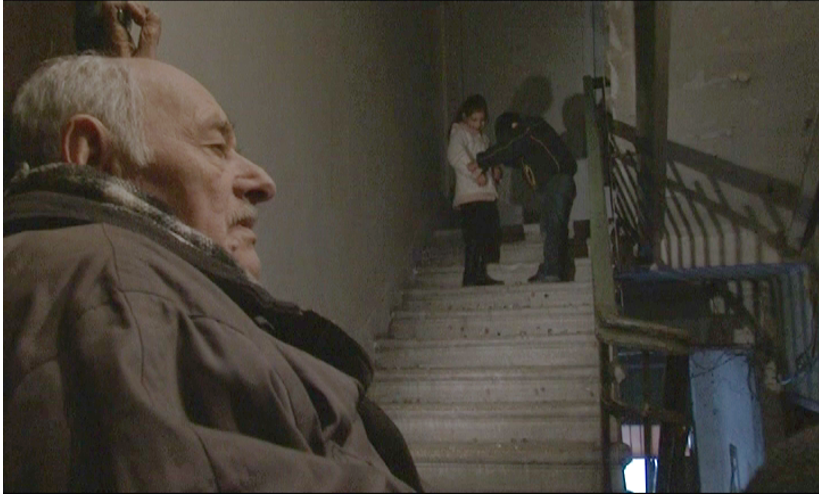
The cameraman sets up a static shot. The entire film is made from almost one point of view, only during the shots of the past do we see the camera's movement or unknown spaces. The film really has its own character, which is appreciative for the student director. Nia Zhvania created her own aesthetics with this short film.
It is easy to realise how these three main characters represent archetypes. They also remind us of real people in our lives. Each one has their own characteristic elements and traits, they are a generalized image of the “Gen Z.” The script is directly proportional, despite the fact that the dramaturgical structure is broken internally and we travel to the past and reality, everything is still easy to understand for the viewer and what is being said is clear. These are the main components that a student work should meet. Its structure and aesthetics blend well with each other. The acting of the young actors is noteworthy. It may seem overly theatrical at times, but they manage to remain naturalistic and portray their characters full of problems naturally.
The film reaches its climax when it becomes clear that the jubilee Tazo is going to his mother in emigration and is also planning to settle elsewhere. This causes a collapse in the friendship. They seem to realise now that everything must change, that their life will no longer be the same as before. At this moment, the dramatic significance is not only the sadness and nostalgia that pours out like ink in the audience due to their separation, but also the courageous step that this hero takes. Tazo's character appears to us as a person who is in constant expectation. He is waiting for his friends, for the love of his life to appear, for the development of the current situation in the country and happiness, although this expectation was clearly in vain. At this turning point, he takes the pen of his life in his own hands and begins to write, act and change, which will naturally lead to the cessation of this endless expectation. His step may not be right or successful but the main thing in life is to try and use every opportunity correctly. This is also one of the film messages - to direct one's youth correctly. It is a taunt and a reproach of modern Georgia at the same time because what could be sadder than the youth who have emigrated, are stuck in their own country without any prospect or waste their energy on someone else's land.
The test, which he fills out online for the sake of friendly fun, is a symbol of their life together, when they recall memories of the past and boring memories turn out to be precious to them at first glance. In reality, even “doing nothing” with your loved ones is fun but whether this is a step back in time on the path of self-development is one of the rhetorical questions of the film. How happy Data, Tazo and Tekla would be if they could go back in time, to Data’s childhood birthday.
“Rewinding” is a very mundane and realistic film about our everyday lives and the problems that youth constantly faces. How many times have we longed to escape from the present day and go back in time, sometimes to avoid it, sometimes even to repeat moments but, unfortunately, reality is much more direct and harsh. Sometimes you need to go back in time, to return to the era where azure and carefreeness reigned.
Lizi Gaprindashvili