
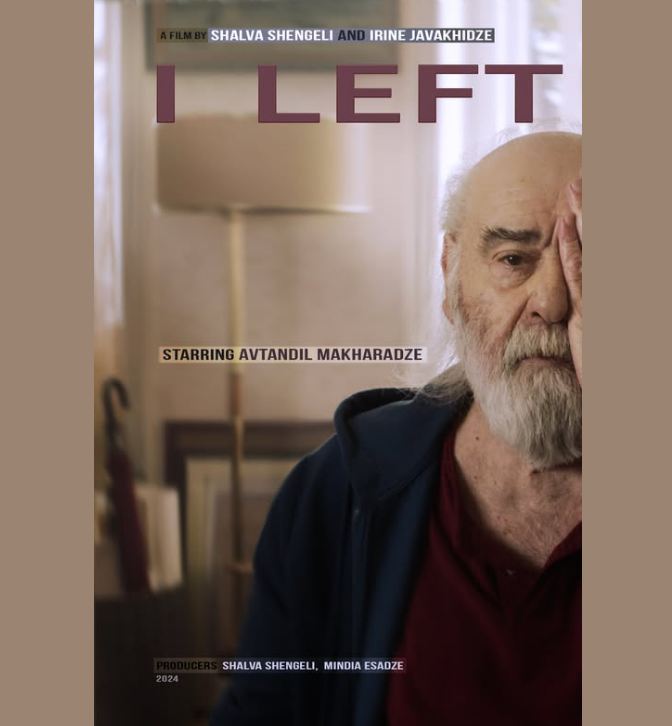
“Have you ever had a bird fly from your hand? Have you ever felt that lightness? That’s the thing… My grandfather shared it with me. I still remember that flying up. I felt such happiness, that…. it seemed that I was also soaring into the sky. At such a time, you feel the whole of your body the movement of your soul…the motion of free soul…” – Avto Makharadze’s character tells his students in Shalva Shengeli and Irine Javakhidze’s short feature film “Complete Emptiness” (2024).
75-year-old professor Berdia Lomsadze supposedly teaches art history and has not missed a lecture for thirty years. “The artist who remembers this feeling with his whole body and then shows us this feeling and emotion in his work is a creator and this is creativity,” he explains to the two students in the large auditorium – a young couple who are more interested in each other than in the lecture.
This film is an attempt to convey such a feeling and emotion, the script of which is based on the motifs of the novels by the great Italian writer Luigi Pirandello (screenwriters: Irine Javakhidze, Shalva Shengeli). While watching the film, one is reminded of Pirandello’s topics or characters who free themselves from limited reality, try to escape from social roles, search for their true “I,” their identity, and in these existential searches sometimes reach absurdity or even madness.
Berdia Lomsadze is like such heroes. He had a similar experience to Bernardino Lamis, a professor of religious history who gave the best lecture of his life to the wet robes hanging out to dry on the chairs in the auditorium (Pirandello, The Cathar Heresy).
The camera tries to be sometimes objective, sometimes subjective, and to show us the world through the eyes of a professor with impaired vision, but such a world is blurry. Berdia is willful, consequently, seeing in this way is his choice. Despite the persistent requests of his irritated sisters, he does not go to an eye doctor saying “I can see what I want to see,” he replies to them. Moreover, the professor has glasses, but he only wears them when he has to record the attendance of his students in his notebook at the end of a lecture. However, he clearly sees a man running happily through the streets with his arms outstretched, and Berdia can even describe the minor details of his clothing and the precise expression on his face. He also notices a brand-new red motorcycle (at the beginning of the film, this motorcycle is attached to the roof of a car and the camera captures it as if it is flying away).
Flying or the movement of a free spirit, is what attracts and enchants Berdia the most and he is not at all bothered by the difficult relationship with his sisters, the conflict with his boss or the ignorance of his students. He talks to his other half, depicted in a black-framed photo hanging on the wall, as if he were alive, but he finds it difficult to talk to his only and most beloved daughter, who has fled abroad and is in contact with her father through a computer screen.
who has fled abroad and is in contact with her father through a computer screen. The film does not have a traditional narrative, where all cause-and-effect relationships should be visible. Here, the narrative straddles the border between tragic farce and poetry, which is also facilitated by sophisticated imagery. A glass of purple wine stretched in the rain, cracked eye-glasses left in a puddle, a red umbrella, a photo of a father and son that is repeated in reality and many other details give the film an impressionistic mood, giving it the qualities of a poetic-philosophical sketch. The film artist, cameraman, and costume designer (and directors) are like-minded people.
The film has different titles in Georgian and English (in English, “I Left”). The Georgian title, “Complete Emptiness,” reminds us of an excerpt from a letter by Albert Camus, which he wrote to his spiritual friend, the poet René Chard: “When I feel emptiness inside me, I read your poems and fill myself to the brim.”
Emptiness is filled differently for everyone and this is very personal. The film feels personal to each member of the creative team, and the “movement of a free spirit” is important to them too. In reality, Rezo Esadze used to tell students about the bird that flew out of his hand, among whom was the co-director of the film, Shalva Shengeli. Avto Makharadze’s hero, played with amazing skill and delicacy, also seems to resemble Rezo Esadze in some way (especially where he stands on a chair like a child caught in a crime). At the same time, Avto Makharadze’s character does not resemble any of the 30 or so characters he has embodied in cinema alone. Without any exaggeration, with minimal means, this actor shows a person’s inner world, the movement of his soul.
In the opening credits of the film, the authors tell us that the work was inspired by people who teach us something, sometimes how to live and then suddenly disappear and, unfortunately, we realize too late that we thought we knew them while they were with us.
Berdia Lomsadze’s students also fail to realize how they are missing the opportunity to become witnesses of the professor’s candid conversations, the fruits of his 30-year observation and knowledge. The authors remind us of Winston Churchill’s words: " if instead of making a political speech I was being hanged, the crowd would be twice as big." Actually, the hero of the film, turns these words into reality – the professor is being waited in the packed auditorium but he follows the path that is drawn on the large board. Perhaps this is what Pirandello writes about: “I imagined that I could become another man and live another life” (Pirandello, novel “The Retired Matthias Pascal”).
The film’s soundtrack deserves special mention – minimal, precisely selected music and sounds that create music. The natural and ordinary sounds of raindrops, street noise, whispers, a vacuum cleaner, footsteps or a motorcycle merge into one great music that enhances the mood. Sound and image are in harmony with each other.
“Complete Emptiness” won the Festival Prize in the Best Screenplay nomination at the Kobane International Film Festival in Germany, and the Best Short Feature Film award at the Cinematic Motorfest in Modena, Italy, and the film’s lead actor, Avtandil Makharadze was awarded the “Honorary Prometheus” at the 26th Tbilisi International Film Festival.
Ketevan Pataraia


