
War was invented by people to revenge. When it begins, it destroys everyone and everything around. It doesn't matter which side is right. It brings only corpses, ruined cities and pain. There are no winners in war - only losses and wounded are counted there. The buzz of bullets remains in people's memory for a long time. The most bitter is the war between brothers: it feels like you are cutting off part of your body and bleeding.
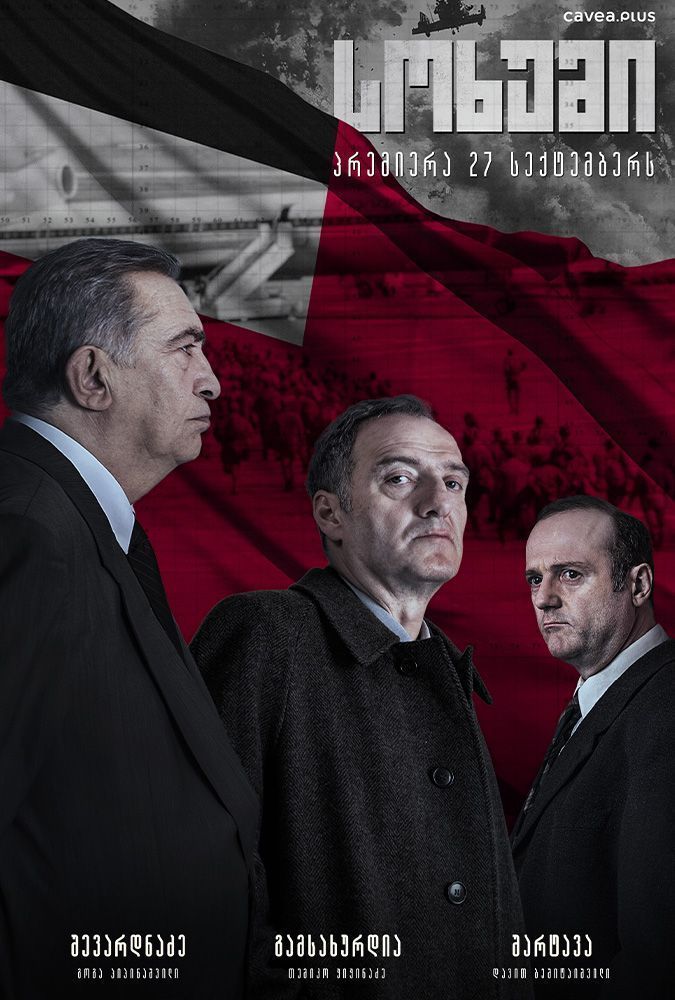
Giorgi Barabadze's film, "Sokhumi" (2025) tries to convey this merciless and devastating national tragedy onto the screen. Many films have been made about the Abkhazian war and directors have always avoided taking a position. In this film, the Abkhazians are clearly the villains and their brothers’ bloodshed is their responsibility.
If Sokhumi falls, nothing will help this country. And so it happened: the city fell and Georgia plunged into chaos of misunderstanding. The film clearly shows not only the front line but also the political turmoil inside the country. Uncertainty and accusations are intertwined. It seems that the country is simultaneously at war outside – with the real enemy, and inside – with its own leaders.
For Zviad Gamsakhurdia, Eduard Shevardnadze was a Russian agent, and in Shevardnadze’s eyes – so was Zviad. The only fact was that in this uncertainty people were dying, even family members were turning on each other, and no one had any excuse. Who were Zviad Gamsakhurdia and Eduard Shevardnadze? Pawns of the Great Russian Empire on the main chessboard.
The film does not have one main character. This is the exception when the main thing is not one or two characters but an event. War is the main character here: it is merciless, it knows neither age, gender, nor nationality. When Sokhumi fell, the pages of Georgian history trembled. Those who did not surrender, those who were not afraid of being shot, died. Every action was injustice and a lifelong crime. Some died physically, and most died spiritually. Those who escaped war, had difficulty adapting to society and were ultimately destroyed.
Zviad Gamsakhurdia knew that they would kill him. They even warned him – “Wherever they catch you, they will hang you there,” but he was not afraid. He hoped that they would help with the army. This hope turned out to be nothing more than empty words – no one came to help and Sokhumi was effectively abandoned to the separatists. Shevardnadze fled Sokhumi. In theory, it became clear who the traitor was but the film still leaves the final verdict to the viewer.
The director chooses a clear, subjective position from the very beginning: he does not explore the political or ethnic reasons for the outbreak of the war, does not go into historical details. The Abkhazians are presented as aggressors and a hostile force. Despite its bias, this narrative choice, accurately reflects the collective memory and open national wound that the war participants and their families still live with today. The topic is sensitive and complicated (Georgian policemen are mentioned as the first victims in the pages of history), the inscriptions on the walls “Abkhazia is Georgia” often remain just a sign. This raises a difficult question: if we ever return to Abkhazia, will they want us to be back? The answer to this remains unclear to this day.
The fall of Sokhumi is not just a military catastrophe – it is a psychological and emotional devastation, the wave of which swept through the entire country. Zhiuli Shartava and the young soldiers’ death create one big symbolic narrative about how a state can leave its citizens virtually defenseless. You watch the film and cry. Not because of the plot but because of the story. Abkhazia is still an open wound for everyone, which will probably never close.
It is also painful that there is no single “evil side” in the war – people did not have mercy for each other even within the Abkhazian tragedy. The film indirectly reminds us that everything is sold for money in chaos: humanity, friendship, love, kinship, and finally – even oneself. Not only does war always destroy the borders of countries but also internal moral frameworks and no ethnic group is immune to this.
The most difficult episode is where Georgians are presented as outright traitors. When Nikita is taken to Bogdan's father, the father says that Nikita's mother is Georgian and Georgian blood has taken its toll. That is why he is a traitor and does not even consider any other option. For him, betrayal is not a choice - it is like a genetic verdict. This scene especially painfully shows how humanity is destroyed and how ethnic identity becomes the main basis for guilt.
It is also sentimental that Niko’s role is played by Andro Chichinadze. When you watch Andro, you realize that it is not necessary for bullets to be fired at you, you are still at war. It is just that this war destroys you slowly and for a long time. In terms of content, "Sokhumi" is similar to Zaza Urushadze's film "Tangerines," however, unlike "Tangerines," which does not feature war scenes, “Sokhumi” is more directly about the devastation. “Tangerines” tells the story of an Estonian Ivo living there, whose son was killed by a Georgian at the start of the war. Nevertheless, Ivo pushes his own emotions aside, puts humanity first, and tries to reconcile the wounded Chechen and Georgian under one roof. This film image is like light and hope, the hope that the situation will someday be resolved. The Estonian’s house resembles ground zero – the area where a truce should be made.
“Sokhumi” is also formally minimalist. When it comes to such a topic, technical analysis – the composition of the shot, the complexity of the editing, the colors become secondary. In the film, the camera primarily observes emotion, not the illusion of heroism. The color palette is subdued – gray and muted tones reflect the physical and emotional damage of the city. Compositions and editing follow a neutral, natural rhythm. The director has well calculated the gravity of the topic on which he shot the film. The main thing here is the scale of the tragedy itself, although it should be noted that Barabadze has not said anything essentially new with this film that others have not already said.
It is clear to everyone that the shadow of Great Russia is not just a story of the past. Russia does not leave us to this day. The same imperial logic, the same struggle for influence, the same “chessboard” continues to function. In this reality, the fact that Andro Chichinadze himself is in prison today sounds even more symbolic and painful. This seems to indicate that you do not often know what fate awaits whom in such a country, who will turn out to be the next “figure” to fall under the pressure of the system.
The film shows us what it's like to live in a divided, lost country, a place where you never know what's coming. The film's ending is as uncertain as today's reality: you don't know what kind of day tomorrow will bring or how to breathe in a country where peace is only a desire, not a condition.
Barbare Kalaijishvili


