There are pains that time cannot heal. They only disappear in silence, turn pale and stick like needles into people's bodies from time to time. Similarly do collective traumas as well, hidden from us from generation to generation, completely devoid of emotions. Do many people remember the catastrophe of forced displacement, Muhajirism, which took with it the fate, future and happiness of thousands of people? However, there will always be people who cannot escape these traumas, who will live with this pain and take it upon themselves, dragging these tragedies on their backs.
How do the pains of the past control us? How deep does a wound have to be to force us to serve the conditions promised years ago? When the trauma is so immense that forgetting it seems to be accompanied by the disappearance and denial of the entire past, an oath (and sometimes a taboo) becomes a survival mechanism, as if it should make us forget the entire tragedy and make our lives relatively easier. It is precisely the expression of these indestructible, mysterious emotions that is the content of Goderdzi Sharashia’s student film, “Tambia” (2018), which echoes the terrible tragedy of Muhajirism. According to legend, the rebelled and killed people were thrown into the sea during the exile and the fish began to hunt them. The terrified Muhajirs swore never to eat fish again. The descendants of the Muhajirs still keep their oath today.
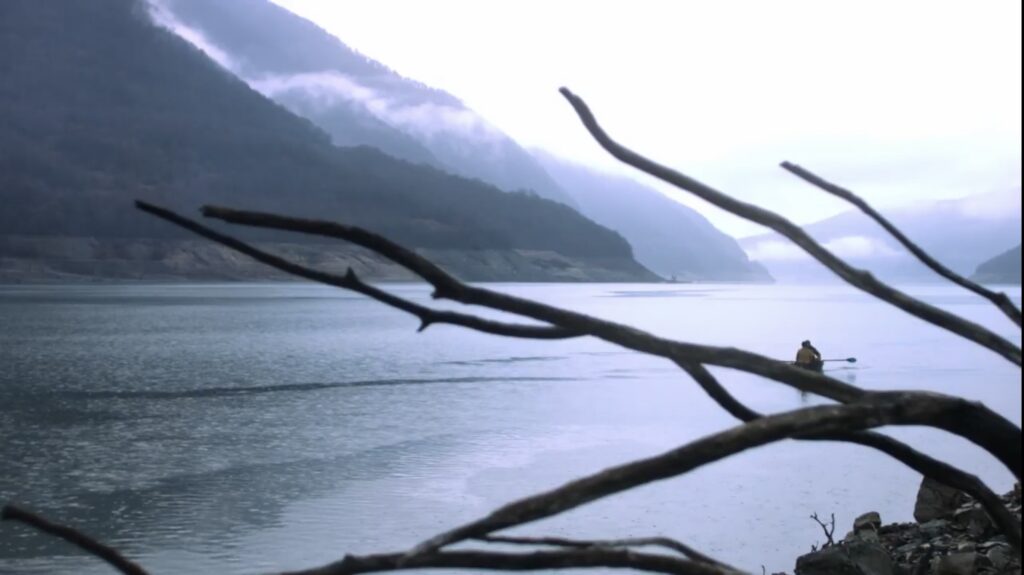
From the very first shot of the film, the director makes us feel that as long as the trauma of the past is alive, reality will also be difficult and cold: the gray environment, the cold, the endless, bottomless sea and the old man, with his monotonous, boring everyday life. It seems the environment itself becomes a character, a huge cemetery of collective grief and there is the sound of the old man in the background firing a gun, directed at the fishermen who make a living by fishing. The shot is not a simple threat: it is a kind of alarm, an extreme measure by which the old man rejects his pragmatic present. At the very beginning of the film, the morality seems clear. The moral obligation dictated to the old man is much stronger than any instinct for economic survival. It is here that the main question is asked: what is heavier - the need to survive or ancestors’ blood-sworn vow?
However, the unexpected narrative change is quite exciting for the viewer. The fishermen continue fishing and the old man no longer physically interferes with them. This turning point in his behavior occurs when he learns the fisherman's Abkhazian name. The Abkhazian name becomes symbolic bond for the old man. It is the sudden realization that he is fighting not a stranger, but a descendant of the same tragedy, a person with the same roots as him. The old man refuses to engage in physical confrontation, realizing that his true goal is not to punish the fishermen but to save his oath and preserve his memory – including for those who carry his own historical burden. Instead, he begins a soulful song. This song becomes the main emotional focus of the finale, the most powerful form of transmitting cultural and historical memory. The song is a lament for the Muhajirs, an articulation of pain, which the old man expresses with his own voice instead of the sound of a gun. In this way, the old man seems to say to the fisherman: “I will not shoot you anymore, because you are a part of me, but do not forget what is buried in this sea.”
In this tense drama, the characters are more functions than individuals: the fishermen represent the pragmatism of the present, obeying the laws of hunger and survival, while the old man is a living memorial, a physical embodiment of trauma. The old man’s daily ritual – the ban on fishing – is not a simple material interest, it is the preservation of historical memory at all costs. The director sharply depicts the moral abyss that separates these two generations. The film does not offer a simple answer to the question of what is heavier – the need to survive or the vow made in blood. It forces us to admit that the moral obligation dictated by collective trauma may indeed be stronger than economic instinct. It is this insurmountable contradiction that makes the film so tense and reflects the eternal dilemma that all communities with a difficult historical past face.
“Tambia” is distinguished by its minimalist, laconic cinematic style. The director avoids dramatic overstatement and instead uses long, alienated shots that lend the work a documentary-like precision. This neorealist approach reinforces the impression that the viewer is not witnessing a fictional story, but a lesson in historical memory. The cold color palette, dominated by gray, blue, and dark tones, creates an atmosphere of constant tension and sadness. In this heavy visual aesthetic, the sound of the old man’s gun, and ultimately his song, becomes even more stark and impressive – the film thus proving that artistic restraint often produces a much stronger emotional result than expressive drama. In addition, with its dramatic minimalism, small number of characters and silence, it once again emphasizes how personal our traumas are sometimes and that some tragedies are so deep that only those generations who directly carry this burden can resolve them.
The film thus offers us a difficult but sublime conclusion: physical reconciliation with the past is impossible, but it is possible to transform it into a common pain. The old man found a way to keep his oath not by prohibition, but by cultivating memory, thereby eternally reminding his descendants living on the coast of the bottomless weight of the sea. “Tambia” is a difficult but necessary spectacle, presenting the burden of migration not as a political problem, but as a human, moral dilemma.
Barbara Rikadze