What would you sacrifice for the person you love? It's an interesting and very philosophical question. All of us, the civilized citizens of modern society, avoid this question. We might even not have an answer to it or we are afraid to answer it at all. We try to control ourselves with a beautiful smile and a neatly tied tie but what happens when the socio-economic curtain no longer covers our inner reality? What will we do when we are compelled to survive?
Toma Atanelishvili's student film, "The Price of Kindness" (2021) puts this question. At first glance, it seems banal, but it is very relevant. Subsequently, this is where the idea of this film begins and ends as well as what may be interesting in it.
The essence of cinema lies in its simplicity. A good film can be made from any worn-out story and plot. The difference is in form and style. Everything revolves around the director's vision. It is impossible to avoid distinguishing the film’s cinematic language when discussing this film because the good or bad of "The Price of Goodness" depends entirely on this director’s ability.
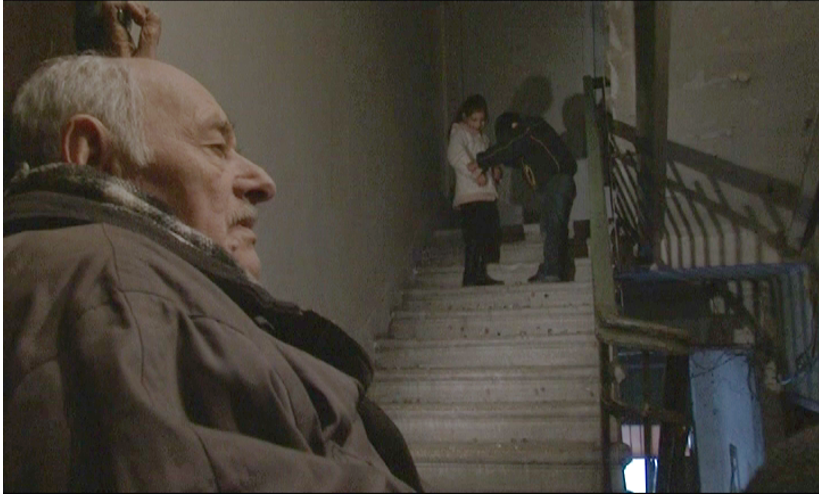
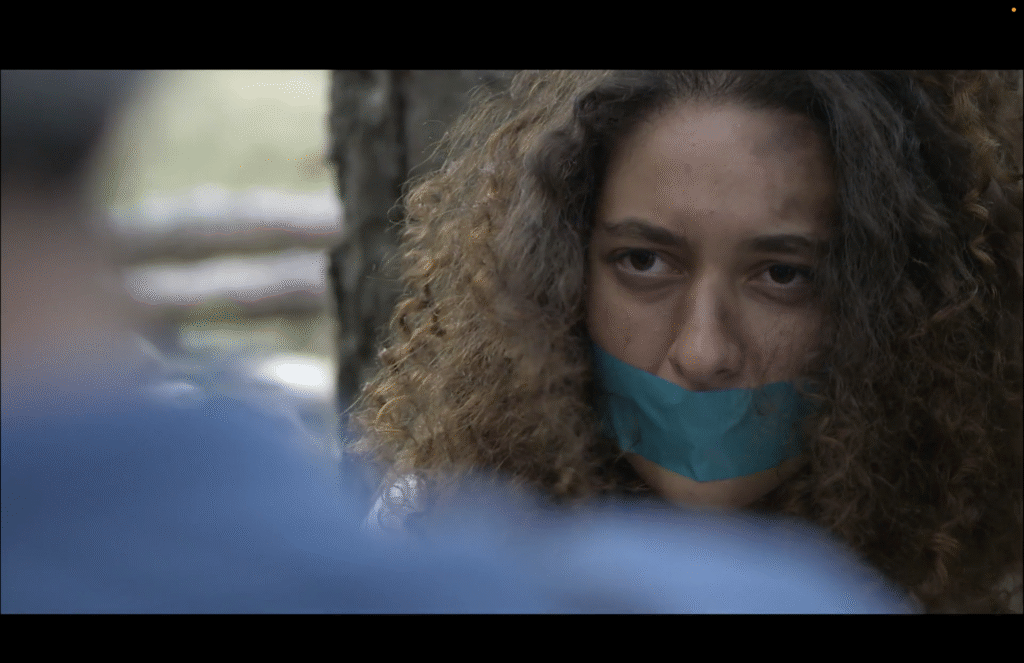
The story develops in the forest. In the first scene, we meet a young woman hiding from a masked man. The impression is created that this girl is the main character. As the story develops, the focus shifts to the criminal. To the man who, as it becomes clear in the last scenes, kills and robs people in order to bring medicine to his grandmother. This banal plot may contain an interesting film but the director's superficial approach seems like a worthless attempt.
Toma Atanelishvili creates the mood of a crime thriller in the forest scenes and he begins the film by focusing on the victim in order to play on the audience. This is an interesting echo of Hollywood crime dramas of the 1990s but it seems more for personal pleasure than for any significance to the final statement in the overall broader framework of the film. Until the last scene, before we learn the reason for the murders, the camera focus is almost on the character of the victim and it completely destroys the effectiveness of the final shots in the end.
The most important are the last shots, from which we learn the reasons for the main character's actions and the moral of the film. He commits such terrible things to help his loved one. The film seems to be trying to make us, viewers, ask, what would we do in his place. Should we judge this person accordingly? These are deep social questions about a rather interesting topic, which, unfortunately, "The Price of Kindness" does not really develop. The entire structure of such a topic depends on the depth of the character, which is nowhere to be seen in this case.
The focus is always on economic hardship and the will of man to fight it in such social dramas. In this film, the director presents the main character actually as a serial killer who deceives his victims by playing “Cat and Mouse.” game. Accordingly, it is no longer important to understand why he became a criminal. The interest in the actions committed for the so-called “greater good” leaves a feeling of at least negativity or, more likely, indifference. It appears that you are watching a simple criminal. There is no communication of a deeper moral topic anywhere until the last episode. This approach influences the effectiveness of the film as a whole. In the end, it turns out neither a crime thriller nor a moral drama. All this is due to the wrongly chosen vision. This synthesis of two different films creates one completely empty film, which even great professionals would have faced difficulty in creating it effectively.
Modern Georgian student cinema is limited to the same topics. This can be explained by the unstable socio-political situation in Georgia but it is impossible for all students to have similar interests, for all films to be built on the same ideas. It seems that directors are looking for topics that are emotionally difficult and characteristic of auteur cinema at the level of ideas and not what they are actually interested in. This situation creates a superficial spectacle, which is nothing more than a film that is called a film only by logical definition.
Thus, “The Price of Kindness” remains an unfulfilled promise, a film that deals with an extreme moral choice but dares not go through with it. The director seems only to touch the point where a person is forced to betray their own humanity but pulls back at the moment when he should make us feel the full weight of that betrayal. As a result, we can see on screen not tragedy but its imitation, actions without a reason and the reason beyond emotional weight.
This is where the main problem arises: the radical form of care is not the crime itself but the inner rupture that accompanies it. If the hero kills in order to help his grandmother, we should feel how this action destroys him as well, with slow, painful, and inevitable cruelty, but when this process is not visible on the screen, the space where the viewer can face moral choices disappears. The film no longer asks us what we would do, it simply shows us what someone else did. This difference is fundamental.
That is the reason why “The Price of Kindness” does not reach the heights that the topic itself offers. Care that turns into violence is one of the most difficult and interesting topics in cinema. It requires precision, courage and, most importantly, sincerity. Here we can see a formal and superficial attempt, where the idea is there but it is not transformed into the director’s experience.
And yet, it is more important that the film inadvertently leaves us with a question even more powerful than the plot itself. Where is the line between love and self-destruction? When does care become violence? And is there anything left that we can call “goodness” if that line is erased? Perhaps the real drama lies in the failure to surmount these questions. In this case, not in what is shown on the screen but in the fabricated silence in which we find ourselves after the film ends.
Giorgi Bajelidze