
Akhtala. The only peloidotherapy resort in Georgia. 122 kilometers from Tbilisi. According to official reports, after word spread about the healing properties of the mineral-rich mud of volcanic origin in the 18th century, a barrack-type settlement first appeared in the area, which then turned into a village; later, a sanatorium was built there which then became part of the town of Gurjaani.
According to a local legend, the origin of the lake is associated with the priest’s meeting with Christ while working in the field on the day of the Transfiguration (one of the greatest holidays of Christian canons). The priest, who violated church law, was punished by God causing the ground to "swallow” him. During the “swallow,” mud began to flow from the appearing pits. According to another version, God sent the punished priest’s wife with her baby to the safe place but forbade her to look back. The fleeing woman heard the rumbling sound, looked back in fear, saw mud erupting – “oh, mud!” (“Akhtala”) – she cried out and turned into stone. Since then, “mud boils and comes out from the ground, slush, lye…” As a continuation of the legend, it is also said that a stone that resembled a woman’s figure lay near the lake for a long time. Then it disappeared. There is a third and slightly modified version. The reason for God’s anger was the family’s violation of the fast. While visiting his parents, the pardoned son turned into stone after he had looked back hearing the rumbling of the ground and the noise of mud.
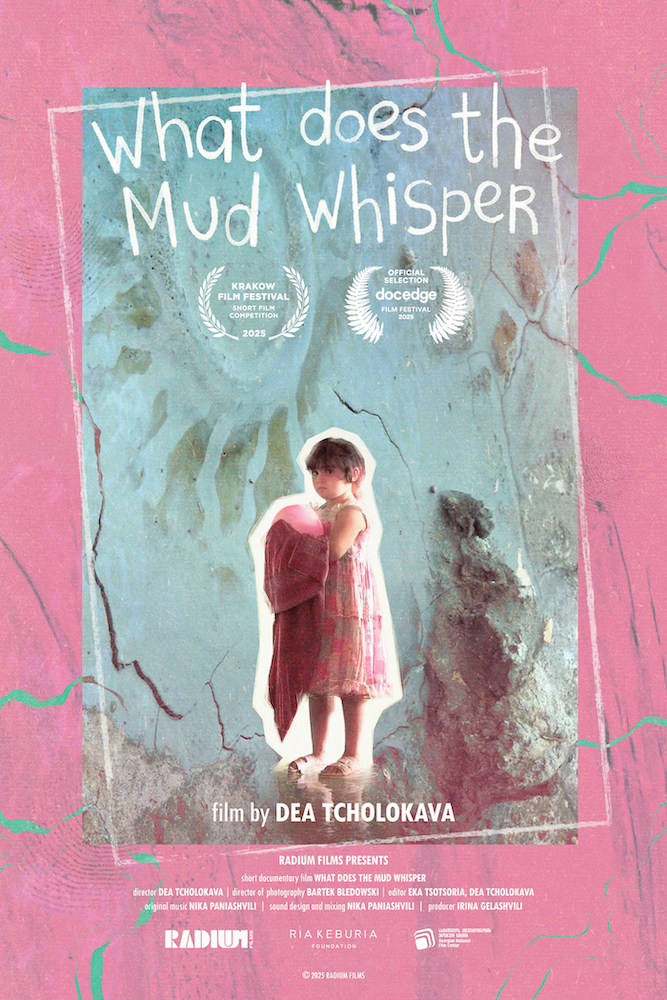
This is the very story which a grandmother tells her little granddaughter, Tako in Dea Cholokava’s short documentary film “What the Mud Whispers” (2025). Grandma, with the child lives and works on the territory of an abandoned, half-destroyed, deserted sanatorium. And it was precisely the information about Akhtala, the pre-conceived idea, what she saw on the spot and the legends that became the basis for making a film by Dea Cholokava and producer Irine Gelashvili (“Radiumfilm”).
“What the Mud Whispers” is short in content and length by the “norms” of a legend. The director breaks stereotypes, however, follows the laws of the genre and creates an artistic analogue of reality in a very real place and within its boundaries. Consequently, she intensifies the searches in the expressive direction of form as well. Reality and its aesthetic, plastic expression are intertwined. Such a form is unusual for academic documentary cinema, however, of course, not the only one and not the latest, the origins of which can be traced back to the poetic narration, metaphorical parable stylistics, the hyperbolic expression of the shot and montage of the films by Robert Flaherty, Dziga Vertov, Mikheil Kalatozishvili.
In Dea Cholokava's film, a metaphorical atmosphere, loaded with sub-textual essence and symbols, is created in a specific place and time of action, with a system of messages directed at the viewer and a sharp authorial position. Such a generalization is not formal. It is content-based.
Just like any legend, a local one is also connected to familiar characters and facts through some signs and details of representations. It belongs to a specific place and, perhaps, to a time. At the same time, it is connected to the ritual or social significance of the event.
By showing artistic images and creating the texture of the fabric of reality, the director not only gives the environment plastic expressiveness. The environment in the film is used as a means of expressing artistic vision, perception, facts and is transformed because imagination, legend and fantasy are as much a reality as the place of action and the real story, the grandmother and granddaughter’s everyday life, healing procedures or the process of “finding” mud. Legend, ethnography, reality and mythical reality merge into each other, become one, are similar.
The film is shot in black and white and monochrome tones, in which the different consistencies and saturation of mud, earth, water change both the color, texture, essence and content. This “mixture” corresponds exactly to the stylistics and nature of the film. And the shooting method, image, shot structure, their connection and narrative style seem to exclude documentary but, in practice, they are only dictated by it and derived from it.
In general, the belief in the world of deities, astral beings and mythical figures among the people (who themselves created legends and fairy tales) was so strong (and, partially, might remain so today) that this world was “brought down” to earth and had specific boundaries. This is the basis for the creation of any legend. The presence or appearance of such characters somewhere nearby was perceived as normal. They were not subject to criticism and were considered reliable. It is precisely according to the undoubted faith and “knowledge” of the locals that Akhtala mud heals everyone. And its magical power, which is associated with legends, activates new legends and representations.
In the film, the unified, monotonous and calm course of the existence of only a few people living and acting in this closed and self-contained world is not disturbed by any sharp or abrupt movement. The intra-shot movement, the alternation of shots is viscous and smooth like a mud flow. Unexciting, which is internally charged and proceeds without any special zigzags and sharp transformations (detours).
Bartek Bledowski's camera calmly and unhurriedly follows and captures the nature of this world, its artistic reflection and form and visual transformation. Dea Cholokava and Eka Tsotsoria’s editing is subject to a clear tempo-rhythm and internal order and follows the precise course of the time and form of the flow of mud, water or non-water mud. Just like Nika Paniashvili's music, which seems to emit those sounds, those beats or melodies, sounds like mud, water or nature.
In Dea Cholokava's film "both mud and ash boil and rise." The mud sometimes becomes viscous, sometimes mixes with the flow of water and resembles a river or volcanic lava. The mud sometimes dries up and turns into cracked earth. The director manipulates the image and changes the color, shape and consistency of the mass - black, gray, dark, light-colored, turning into white, dark as night. It replaces one another – mud pits, cracks in the soil, the ground, as if during a drought or in a desert, ruined, dilapidated buildings, bathrooms that no longer have water, no longer have running mud channels, and no longer have proper conditions for treatment. The washed linen, which Tako’s grandmother hangs on ropes and in which people are wrapped together with mud during procedures, has lost its whiteness from intensive use, has turned gray and aged. Like everything in this space.
In such a situation, due to inattentiveness, neglect, and violation of the climatic balance, the reserves of mud deposits are also running out. Due to incorrect and faulty economic conditions and lack of investment rules, the resort is on the verge of destruction and ecological disaster.
The only one who and what breaks the boring monotony of life and enriches and livens up the artistic, plastic expression of the film with colors is Tako, whose existence is the most justified and reliable. She steps in mud, dust, water, on the ground, on the dirty floor, but still maintains cleanliness and is looking for her friend - the mud man. Her pink flowered dress, golden, glittery sandals, pink balloon (which she also diligently cleans from mud with a pink cloth), who is attracted by the world with its reality, fabulousness, who has many questions and expects answers to them from everyone and seeks them everywhere.
Many scenes may be staged and the texts may be specially created and not organic but the characters have concrete and real faces. Typical and generalized characters that are created by short signs and generalizations of faces, concepts, views and reality.
The mud man is a real being for Tako, like Grandma, Dato or other mud miners. He hears his breathing, sees how the surface of the mud bubbles and bubbles, like a person when diving into water. These bubbles, like soap bubbles, fly on the surface, in the sunlit space.
Tako is interested in how the mud man is, how he lives, what he does. Where he is. Tako is also interested in whether Dato is afraid of snakes or sharks that he might encounter in the muddy water when he is dragging buckets of mud.
On the one hand, reality, and on the other hand, the artistic imprint of this reality, allegory. What a child understands, no one else understands, and what she sees, no one else sees. So, answer Tako, mud man! She’s waiting for you. And don’t look back.
The film “What the Mud Whispers” received a “Special Mention” at the Kutaisi International Short Film Festival in 2025 and a “Special Mention” at the Tbilisi International Film Festival, after which it also became the laureate of the 2025 “Tsinandali Prize.” The prize, which is awarded to young artists and scientists with outstanding skills, special vision and thinking, those who create today and give hope for the future. Such a condition imposes special responsibility and obligations on the winners.
Lela Ochiauri


