
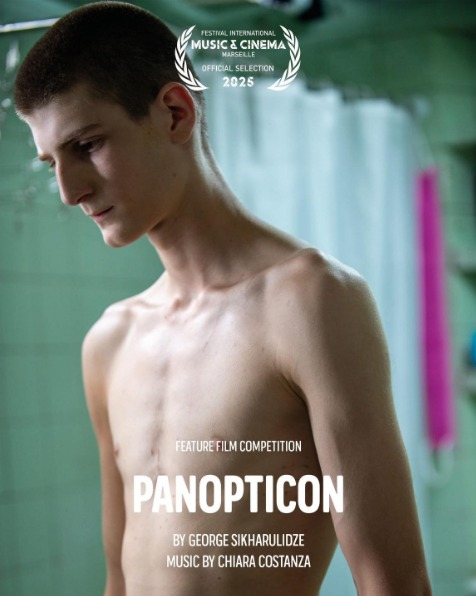
It has been a long time since a film produced in Georgia has been nominated for an Oscar in the name of Georgia. The only recent success is Giorgi Ovashvili’s “Corn Island” being shortlisted, which ends the “success” of modern Georgian cinema in Hollywood. In 2025, Giorgi Sikharulidze’s film “Panopticon” was released on behalf of Georgia, in the hope that this project would impress Americans.
The action in the film takes place around Sandro, a high school boy whose mother is in emigration and whose father is in a monastery. Sandro himself lives alone with his grandmother. He is a football player and a devout Christian due to his father’s influence, who is prone to fanaticism. He also has a girlfriend, his classmate, Tina.
The story begins with a memory card which his teammate, Lasha left in the locker room. When Sandro gets home, he opens the card and sees that, along with pornographic and Neo-Nazi videos, there is also his birthday video, which features Lasha's mother, Natalia too. Sandro is so moved by this that he masturbates to this video. Ironically, he begins a friendship with Lasha, which brings him closer to Natalia.
In "Panopticon" the entire plot is built on the moral struggle of the main character between spiritual and carnal passions. For example, his age and body in every way indicate that he needs a sexual life, however, his moral side, which is shrouded in religion, hinders him in every way and makes him an absolutely confused being. He does not know how to distinguish between good and bad to the point that he does not understand what behavior is right. It is acceptable for him to rush into an Arab club to defend his nationality, however, he considers touching his girlfriend with his hand during a kiss to be immoral. Added to this is the fact that Sandro develops serious feelings for Natalia, which makes this confusion about life all the more intense and aggravated. The film often shows his dilemma between religious life and the real world, during which his choice leads to the worse at every step.
This film can be considered a kind of study of an 18-19-year-old boy, who is attacked from all sides by life and does not allow him to follow the path he wants, to be completely truthful in his emotions and desires although this does not happen.
The film, which began as a research, turns into a purely moralistic film very soon, where the judgment of society begins with the effect of generalization. Added to this is the "negative focus" characteristic of this philosophy, which means that all the characters in the film are bad. Not only do they have flaws, but they are also morally low. There are no good people. Sandro is animated by hiding his desires, his friend Lasha is a criminal prone to violence and Sandro's father is a religious fanatic and psychological manipulator...
All this is done through demagogy, and the director seems to be looking down on his own created characters, because in every episode the context is like this - “look how badly they behaved,” which makes the film incredibly uncomfortable for the viewer because it seems like a “parent” is publicly scolding “his child.”
Added to all this is the fact that the film is not cohesive at all. Several topics are so intertwined that the viewer cannot understand not only how to untie the film knot but also where each topic is tied. The whole message of the film is not visible. In the end, should we have hope for the future? What kind of behavior is good or bad? Does religion help us in life? In the end, the director criticizes all aspects of social action but does not offer us a solution. He appears to us as a teacher who gives us a problem but does not tell us how to solve it.
It should be said that the film is a breakthrough in every part and this is most likely again the fault of the director's unformed position. However, he had such a high-class cinematographer at his side as Oleg Mutu (a person who has worked with Sergey Loznitsa and Cristian Mungiu), whose cinematic vision in European cinema is surprisingly different and expressive. However, this is how it happens. When the conductor is inexperienced, even a high-class musician will have difficulty playing correctly. The main topics for him became such directorial techniques as: nudity, kissing, masturbation and religious fanaticism. He had to use all this as a carpenter uses tools to create a beautiful work. Here we can see the opposite. The social confusion and disorientation that he described became an excuse for the director to speak boldly about these topics. This made the film a poor interpretation of all the films that have been made on this subject.
Here, one cannot fail to mention Data Chachua’s acting. He portrays the main character, Sandro. These are his first steps in "big cinema" for him. Until now, Georgian viewers know him from the TV series "My Wife's Girlfriends" and "Changing Signs." Many recognized this role as a good start but I think that this just does him a disservice.
The format of the series allows the actor to develop the hero's character, with its nuances, over a long period of time, while cinema does not allow this luxury. The actor has to do everything in an average of 2 hours, and the performer of the main role could not cope with this task. First of all, his character was speechless. In any emotion, it seemed that everything was done with great effort and basic training. In addition, he, as an actor, did not contribute much to the essence of the character because there is a feeling that he only says the text, according to a specific context and emotion. His body language is also not natural in any way. It is very robotic and rude. The episode where Sandro attends his father's ordination as a monk should have been the emotional peak of his character but the running, tears and facial expressions with which he plays this role are artificial. There should have been much more emotion in it because his character loses his parent, who was the only emotional support he could talk to freely. He is left alone in this big world, where no one is on his side. At such a time, we can see Sandro, whose tears are worthless to the audience because he cannot arouse enough emotion in them.
“Panopticon” became the favourite to represent Georgia at the Oscars. At least, that’s what the Georgian delegation considered necessary. After watching the film, the audience wondered what other people would think of Georgians after watching this film, in which the director tells the story of a society that he himself views from a high moral pedestal. If they didn’t think so, the author tried to fix everything with the finale, where Sandro’s catharsis was supposed to happen but as in the entire work, here too, nudity was simply for the sake of nudity and nothing more. Even the foreword by philosopher Giorgi Maisuradze failed to fix this.
This film is an insult to the Georgian audience because the director perceives them as small children who have a lot to learn and the basis for this is the film’s didactic tone. Where it is always clear what the author considers right and what is wrong. Giorgi Sikharulidze's research has grown into moral demagogy, which has turned the film from interesting to terrible.
Saba Makharashvili


