
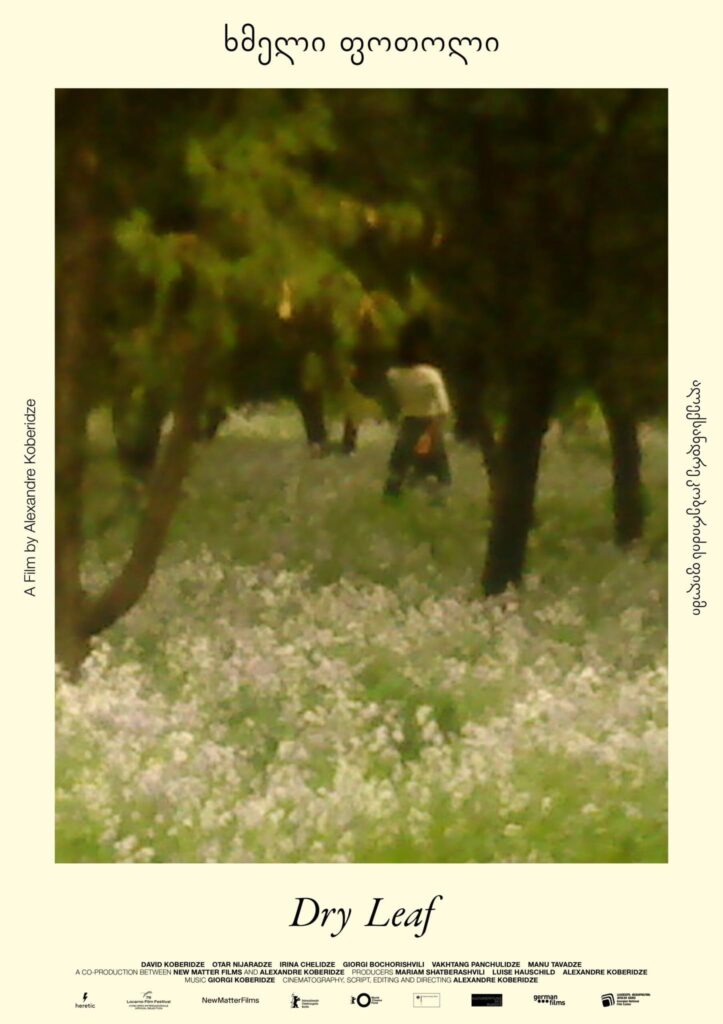
Nothing special or absolutely “nothing” seems to happen in Alexandre Koberidze’s film, “Dry Leaf” (2025). This story has neither a plot nor a classical dramaturgical structure but a solid and clear “internal” outline and an unusual structure. It is unlike anyone else and does not repeat anything “from the outside.” It is light and bright, though involves many problems – personal and universal.
Reporter Lisa leaves her parents a farewell letter and disappears. It seems that she has neither reason nor conflict at home or at work – the sports magazine “Skhivi…” And after waiting for his daughter to return home for several days the father – Irakli sets off in search by car along the roads that Lisa, who is on a business trip, should have traveled to the villages of Georgia to shoot football fields.
The reason why and for where Lisa left home, and why she left her father a message with various codes and strange hints (how it is possible to find the house where she currently lives), is revealed only in the finale. And the father, who has always understood Lisa perfectly and can also decipher her code, finds her. And the mother, together with the father, calmly adapts to such “escape” of her daughter and waits for the “day of seeing” – in the hope of meeting at New Year.
The reason itself gives the film a new direction, meaning and context – the demolition of the Sports Academy – becomes a metaphor for destruction, loss, broken ties with the ground, the past, the present and the desire to start life from a clean slate. As in previous films, Aleksandre Koberidze burdens the course of the main events, the extreme, the personal, with the line of current, ecological, social problems in the country. And creates a new model of the world and cinema, different and unique, governed by its own rules and not subject to others. It has a unique way and form of artistic expression. With a set of "infinite signs" that turn into symbols.
The film is a co-production of Georgia and Germany. The script, cinematography, editing, direction and voiceover of the narrator belong to Aleksandre Koberidze, the main role – the father – is played by Davit Koberidze, and the episodic roles are played by: Irina Chelidze, Manu Tavadze, Otar Nizharadze, Giorgi Lazarishvili, Davit Jincharadze, Vakhtang Panchulidze, Giorgi Bochorishvili, Nato Gelashvili. These people create parts, fragments, and character details of a group portrait of society.
Most of the other characters are invisible. Even Lisa's friend Levan accompanies Irakli on his journey and talks to him. Some characters, to whom the father shows his daughter’s photo, appear for a moment in the distance and soon disappear, some speakers are not seen at all. Only voices are heard, during short and one-type dialogues. In very short phrases and in a deafening tone. The unexciting course of the narrative is interspersed with light humor, by placing the characters, their actions, and their lines in peculiar angles. Also by the fact that the characters are invisible and sometimes not directly visible in the shot, even when Irakli “meets” and talks to them.
The film was shot and recorded with a “Sony Ericsson” phone (just like “I Wish Summer Never Came Again”). The image is poor quality, out of focus, faded and aged like a picture or an illustration. The “poor quality,” unsophisticated, unprocessed, naturally recorded sound sequence turns into the same sounds of a blurry image. The “inner voices” are also joined by short comments from the narrator behind the scenes. The same fragmentary inserts. Said calmly, unemotionally, and “from the outside.” Such a solution, such a method makes the story, the characters, the originality of the world natural, direct and intimate.
Irakli's journey begins at the Boris Paichadze monument at the "Dinamo" stadium and moves to sports pitches scattered across Georgia. Forgotten, abandoned, time-worn and empty football pitches. From some only goalposts remain, from others only one door and one goalpost and some have been completely demolished to build a new hotel.
Along the way, it becomes clear that Irakli is traveling in a world where only children live, in or near stadiums “in real.” They live and play football everywhere, even where there are no more stadiums. Apart from children, dogs, cats, horses, cows, buffaloes and "nature's gate," there seems to be nothing alive here. And despite the fact that this is an empty space, almost devoid of people, it is still full, moving, intensely saturated - with signs, colors, landscapes, details, fragments, the "faded" sunlight of autumn and the gentle tempo-rhythm of life, to which stativity and dynamics are given by the variability of the quality of objects and images. Supernatural, at the same time reflective of the truth of life and speaking with new artistic forms, beyond documentary description.
Aleksandre Koberidze returns to the principles of the visual solution of cinema, focuses on it and creates a cinematic object in which the defining feature is the poetic, plastic expression of the world. "Dry Leaf" is a monumental painting, a fresco or a panorama. With expressive and mystical shots. The image combines the color and depth, infinity and mystery of the Impressionists, Japanese painting and miniatures, Utamaro’s light ephemera of and Hokusai’s airy landscapes. The lightness and airiness of color, stroke, silhouette. It combines the infinity, continuity and non-interruption of the cyclical peculiarity of nature, the volume and scale of which, geographical or territorial boundaries, are not measured by ordinary standards. Aleksandre Koberidze, as a true storyteller, sees and captures life in such a frameless, surreal, alien and attractive style. In it, one can see the peculiarity of eternal, inevitable existence and even the smallest features of everyday life, existence.
Father's journey is long but not annoying, not tiring. Instilling peace and happiness. You have neither obligations nor worries. You follow and it seems that you are in this space too. Part of it. A participant and observer. You are attentive, so that you do not miss anything and in the meantime, your memories, feelings, associations begin to act. Those living and revived sensations that are born when you find yourself somewhere in a similar environment. Sometimes you will see a river, sometimes a field flower, sometimes a bush, a tree, sometimes a spring, sometimes a stray dog and grazing cows, sometimes an old ball, sometimes you will look at the landscape, “the distant dawns of the evening” where “the distant sky scatters foggy thoughts” and “the leaves are flying in the wind…”
David Koberidze – an unprofessional actor – is distinguished by his naturalness, immediacy and non- artificiality. One gets the impression that he is “depicting himself” and the invisible director simply follows him and takes wherever Irakli goes and what he does and says, as he pleases. David Koberidze freely, boldly and openly overcomes the boundaries and barriers of the film and the roads, in order to achieve the main “promise,” which should bring people relief and, by confronting fate, salvation. And Irakli is no longer just Lisa’s father – he is generalized to the image of a father.
The second magician and hypnotist, who participates in the atmosphere of the film-fairy tale and sacredly revives, strengthens, makes every shot or sensation intense and captivating, is Giorgi Koberidze, whose music (as in other films by Aleksandre Koberidze and independently) with its magnificent melody, pauses, silence, very quiet and extremely pure sounds, transparency and cyanosis of vowels, light and drama, creates a magical field of "dry leaves," like nature, the existence of which is a confirmation of the existence of the world, like the rustling of the wind or the rustling of grass or leaves. The music is of the same tone as the colors of the grass in landscapes and stadiums – as if faded, withered, tinged with yellowness and redness, imbued with inner charge and sadness, as it does in “autumn days,” when “the meadow turns yellow, the pasture turns yellow…” and “the leaves fall continuously from trees”…and when the sun turns gently golden.
"Dry Leaf" is a term used in football to describe a specific type of kick. In such a situation, the ball begins to spin around its own axis and flies in an erratic, unpredictable trajectory, like a leaf that abruptly changes direction as it falls from a tree.
In turn, every leaf, visually and in essence, goes through the stages of any spiritual life – from birth to death – and gradually changes texture and color. All the leaves that “glitter in the sun, follow the winds” and the leaves, whether natural or graphic, in various stages of withering and drying, from time to time “fly” into shots of “Dry Leaf” which itself is like a leaf that the wind, or time, “tear off from the branch” and it also falls somewhere nearby. And if a strong wind blows – very far away. The artistic structure and genre composition of Aleksandre Koberidze’s film are built on such “blows”, directions and trajectories.
Perhaps the father's journey, and that of Lisa's before, is a metaphor for another, even more distant "journey." After being cut off from the ground. Like death. Perhaps the daughter's departure means such an "other" departure. The beautiful change of spaces, the transition from one dimension, from one world to another is perceived quite substantially, as in a myth. The director's stock of associations is rich and multifaceted. Even a beautiful dream can turn into a turbulent obsession. If it is repeated. Perhaps what happened was the father's dream. "The dream of the sun" and nothing else. Everything is permissible.
The reality of the film is above the real and the fixation of this benchmark becomes one of the defining, facilitating conditions for the transmission of metaphorical reality in plastic forms. Just like infinite time, or the infinity of time within the film's shot (the film's running time is 3 hours and 06 minutes, although it could have been a little less), as the solidity of the axis of penetrating action, which has a direct connection with the language of parables, metaphorical, figurative speech.
These – seemingly familiar and many times seen – ordinary, but enchanted places, spells, witchcraft and other such things are loved by Aleksandre Koberidze, he clearly believes in their existence and reality. More precisely, this is exactly how he sees and perceives reality – in such colors, shapes, “focus.” And, first of all, he himself is happy on this fabulous journey. And when the film ends, you feel that you do not want to say goodbye to the places you have already become accustomed to. You also “discover” that your eyesight is “coming back,” your gaze is straightening and that reality “hasn’t changed.” You also feel more clearly what a beautiful fairy tale or dream you were in. That you had such a strange dream, expressed in this way by the director’s thoughts – about freedom, which confronts the contradictions and limitations of the outside world. Because, as it is known, a new day will bring happiness to those who have been resistant.
If an artist lives in a child, then his personal world, his art is bright, alive and free. A child truly lives in Aleksandre Koberidze, perhaps a little stubborn and restless but kind and hopeful, who loves animals, nature and children, who you can trust and if you follow him on a journey, he will not leave you, will never get tired and will not get lost like a guide.
Aleksandre Koberidze is already among those directors whose films are awaited. The public “categorically demands” or looks at it with suspicion – that all his works “must” be no less than their predecessors. Will they be? This is what happened in the case of “Dry Leaf.” Then, at the 78th Locarno Festival, the film received the FIPRESCI Prize and the “Special Mention” of the jury; at the Bangkok Festival – the Grand Prix; at the Tokyo FIlMeX – the “Special Mention” and the Student Jury Prize. It has been released on screens and at festivals in Latin America, the USA, Japan, Germany, Switzerland, Serbia and many other places. It has been shown in cinemas in the USA since March 2026. It was also awarded the Golden Prometheus for Best Feature Film at the 26th Tbilisi International Film Festival. The international jury of critics ranked "Dry Leaf" ninth out of the 50 best films of 2025 according to a poll by the British Film Institute.
“Dry Leaf” continues its festival and distribution journey. And since this film has naturally “disappeared” from the author’s creative life, the time has come for new expectations from Aleksandre Koberidze – what will he shoot, about what and what will his next film be like? Where will he deviate, which roads and which places will he visit? What nets will he weave around people, dogs, cats, horses, places, cities, villages, forests, stadiums, houses, streets, mountains, fields, rivers? What elements will he call out? What magic will he summon? What kind of tale will he tell?
Lela Ochiauri


