
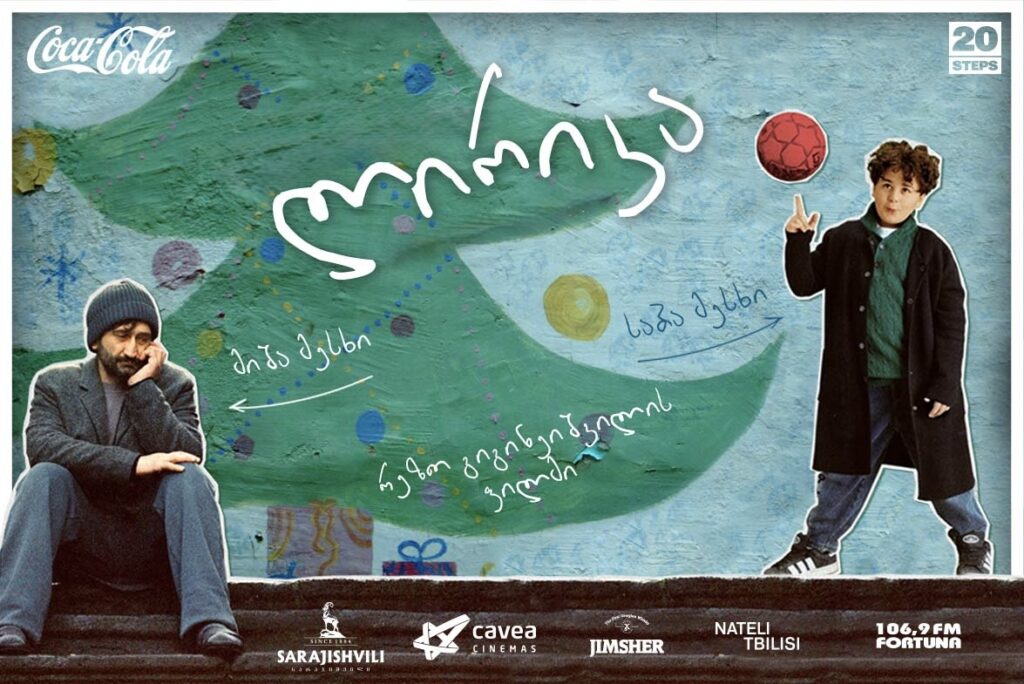
The city is gray in winter. The noisy streets leave a feeling of emptiness and people feel loneliness more acutely behind the lit windows. The New Year is a new beginning for many people but there are ones for whom it is just another hard night. It is this sad atmosphere that is reflected in Rezo Gigineishvili's film, "Lyrics" (2026).
The main character, Misha (Misha Meskhi) is pitied by everyone for his wasted talent but he doesn't need this pity for anything - he just wants a reason to believe in the essence of life again. New Year here is not just a date, it is the opportunity for a new life. This is also visible in his eyes: there is still hope in his tired gaze that everything is not over yet. The main thing is to have the willpower and not return to drinking.
It is easy to become addicted to alcohol in Georgia. Wine culture in the country is excessively romanticized. A glass or two a day for someone means nothing and that's where it all starts. This is clearly seen in the street scene, where Misha turns his back on wine and the dissatisfied men standing nearby call him a wretch. Society is often unable to see the line between tradition and attitude, which further complicates the awakening process. There is an emotionally difficult moment when he goes home to change his clothes and realizes that the door lock has been changed. He seems to have been got rid of, no one needs him, even his mother has given up on him.
He had a wife but she left him when his life got messy. After that, no one remembered him, now Saba appeared in his life as a beacon of light, a boy he met in the street, who might remind him of his childhood. Saba has never seen the sea, the sea is a symbol of the freedom and space that Misha needs so much. Misha's real chance of survival appears in his relationship with Saba. The once successful football player was destroyed by a chaotic life but now he might still find himself - not as a player, but as a coach, even he can be a role model for someone.
One of the most powerful episodes of the film is the dialogue of a n unknown mother and her son. Here it is clear that addiction is a choice. The old mother has only one ring left on her finger, which her son will probably soon sell for alcohol. He does not want treatment - he sometimes names the New Year as the reason, sometimes Christmas too. He prefers to drink with friends and consequently, denies himself once more.
The film shows that no one can save an addict if they themselves have not made the choice. No one can be forced to wake up in a rehabilitation center. It turns out that these people once decided to be in the darkness where they are now. However, they also have a chance, even if they want to escape from there for a moment. The director does not show the heroes as just helpless victims, they themselves are responsible for their own decisions.
"Lyrics" asks the question - why do people become addicted? Often they run away from something or someone. They try to hide from reality, pain, loneliness or the past. Sometimes they think that they will never lose control and will never become addicted themselves. This self-confidence is their mistake. It is difficult to say exactly whether addiction is a disease or not. It is more like the path that a person chooses to cross the road of life. Everyone is faced with a choice and thinks which direction to go, although some choices gradually distance a person from himself.
The heavy emotional background of the film is ideally complemented by the music of the band "Tamada." Its sound, a synthesis of electronic music and Georgian folklore motifs, organically blend with the urban depression of Tbilisi. "Tamada"'s work seems to echo the main message of the film: the road from home to the sea of dreams always ends at the nearest beer bar, where "beer is matched with vodka" and reaching the sea becomes impossible for years.
The title of the film, "Lyrics" acquires a special ironic and tragic meaning. The director hints not at sublime feelings but at the medicine of the same name, which is a means of self-destruction and escape from reality in this environment. The title is a kind of metaphor for the illusory peace in which the characters are trapped - this is a stupefaction that suppresses the will to act and postpones the encounter with the sea for an indefinite period. All this further exacerbates the main topics of the film - wasted time and that "sea" which is somewhere nearby and waiting for the heroes to no purpose.
In Georgian culture, "lyrics" is often associated with the moment when inebriation reaches its peak and excessive sentimentality, an oath of loyalty or nostalgia for the past begins. "Lyrics" in this context is an illusory emotion that awakens only during alcoholic or drug inebriation and disappears immediately after awakening. The director thereby emphasizes the ugly side of "table romanticism" that makes a person lose the ability to adequately perceive reality.
This condition, in turn, has become a kind of generational pain for Tbilisi in 2026. “The Lyrics Generation” is the code name for those people who are “stuck in time,” unable to find their place in modernity, and whose only solace is chemical or psychological isolation. In this sense, the title is both a diagnosis and a verdict for those lost people whose lives have been torn between real action and narcotic illusion.
Loneliness is a person’s path to himself. The atmosphere of the film is especially heavy and sad. Misha remains completely alone even against the background of the New Year’s noise. People are celebrating in the city, the streets are illuminated but Tbilisi is still lost in the cold and gray colors. The city also seems to repeat Misha’s inner world. The bleak winter days further intensify the loneliness and silence scattered in the streets. Tbilisi is not just a location here - it is the emotional state of the film. Old buildings, cold streets and New Year’s noise mix with each other and create the feeling that people live next to each other, but in reality they are very far from each other.
The director filmed many famous people in the film: the Arveladzes, the Sukhishvilis, Dato Evgenidze, Murman Jinoria. He might have accordingly wanted to show the atmosphere of Tbilisi, but this could have been done with unknown people, so this is more of a marketing calculation. Individual episodes, such as the Indian courier who delivers the wrong order, were not necessary by the film.
The film's cinematic language, despite its strong atmosphere, does not always work evenly. There are scenes where the environment and symbols really fit Misha's inner state well, especially the winter Tbilisi and street episodes, although in some sections this atmosphere becomes too monotonous and even repetitive. The city seems to constantly remain in the same emotional state and loses its dynamics over time, which is why some scenes become less impressive than they could have been.
Another problem is that the film only touches on some topics superficially and does not fully explore them. This is especially felt in the secondary characters’ relationships, where conflicts and emotional lines begin but do not develop to the end. As a result, the viewer gets the feeling that certain stories remain only "hints" and not fully understood lines. Despite the idea and social background, the film fails to maintain depth.
The film's finale is open. The lives of the people in the rehabilitation center now resemble the silence after a storm. The chaos of the past is left behind, and now, as it is a new year and the bus heads off in an unknown direction, this silence is a pause for reflection. This is a time to realize that salvation is possible, and this might be a new beginning for Misha and the others. Ultimately, the answer to the question, what will happen next? - depends only on their choices.
Barbare Kalaijishvili


