Poetic cinema is a cinematic approach and style that focuses on the use of visual aesthetics, emotional resonance and symbolism rather than the rational logic of narrative. It tries to create on screen a feeling that is close to the feeling one gets when reading or listening to poetry, where the content is often conveyed through metaphors and associations rather than a clear plot line. The essence of poetic cinema is that it places image above narrative. It is a cinema where metaphor, allegory, intense symbolism, atmosphere, rhythm and mood play a central role. As a poet, the director uses camera, editing, sound and color to create a cinematic language that does not directly tell a story but rather suggests its experience.
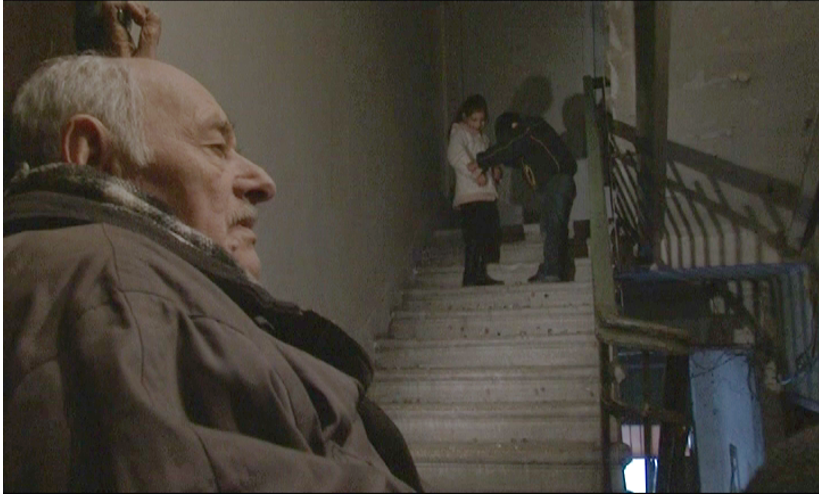
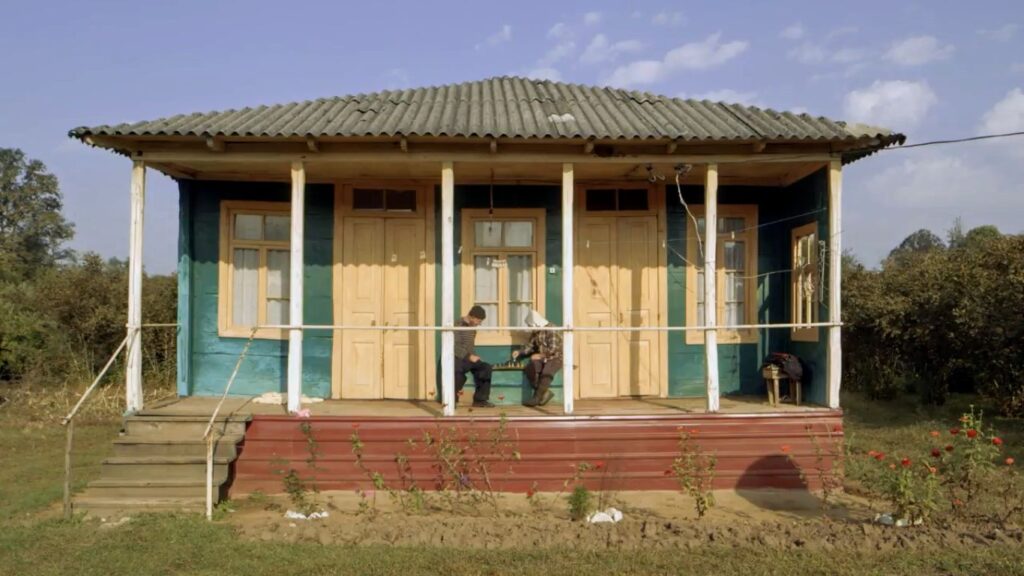
Nika Arakhamia’s student film, “Millstone” (2022) tells the story of a father-son’s distant relationship. The film is built on the contrast between the village where the father lives and the city where the son is. The director creates a meditative portrait in this way. The part of the father, which depicts the village routine, is shot with excessively long shots, simply perceived as a senseless increase in the running time instead of the slow flow of time. The attempt to achieve authenticity is reduced to visual decorations but the character’s emotional depth is lost in this monotony. The father is more of a functional element than a living person.
As for the son’s storyline in the city neither does it evoke emotions in the viewer. The urban chaos in which his work and love problems are conveyed is so general that the character’s drama does not get close to the viewer. The depiction of the complexities of personal relationships is cinematically weak and seems to be introduced only to contrast with the calmness of the father’s segment, creating a superficial thematic contrast. There is little sense of real conflict or strong emotional connection between these two worlds. They flow in parallel. At the same time, the moment of their intersection is also weakly staged, which makes the film fragmentary and never-ending.
It is clear that the director had certain structural ideas, which, unfortunately, are conveyed too clearly and directly. The title of the film, “Millstone” unambiguously refers to the cyclical nature of life and the unstoppable flow of time. This metaphor is made even more visible by the frequent use of a calendar. Both father and son repeatedly mark the days that have passed on the calendar. This element, which might be a symbol of time and hints at expectation almost like a finger pointing without cinematic subtlety, informs us that time goes on and both characters are in expectation. True poetry hides hints, but here, unfortunately, the director openly declares what he is saying.
The director’s attempt to create this short student film with the aesthetics of poetic cinema unfortunately ended in failure. Poetic cinema requires that the image rise above the narrative and create emotional metaphorical layers. However, the visual contrast used in this film between the village and the city did not become poetry but remained a simple alternation of shots.
The director tried to create a short film about the father and son relationship with the aesthetics of poetic cinema, however, it overall remains superficial. The majority of the film, namely the episodes depicting the son’s life and the extended shots of the father’s routine, fail to create depth or offer any metaphorical language. The son’s love drama and work process are too generic, while the father’s everyday life remains boring due to the lack of dramatic content. But the film has two strong pillars. These are the visual quality of the village scenes and the final metaphor. The rural landscapes are undoubtedly the strongest aesthetic side of the film. The cameraman skillfully uses natural light and shot composition, which turns the rural environment into a real and memorable visual background. It serves as a kind of redemption against the background of the failed poetic attempt. The good use of these landscapes makes us think that the director could have succeeded actually in poetic cinema if not for the incomprehensible lack of plot and emotional energy.
The only powerful and truly poetic moment of cinematic language is the film's finale, where the father's death is conveyed not through direct drama, but through the stopping of a millstone. This is a brilliant metaphor that symbolically stops the father's routine time and life simultaneously. The stopping of the stone becomes the end of the continuous, eternal movement that conditioned his existence. This powerful, wordless image justifies the director's claim to poetic cinema but it comes too late, , unfortunately. It is preceded by a part of the film in relation to which such a profound ending loses its meaning.
The director's ambitious attempt to elevate the plot to the level of poetic cinema failed due to structural decisions (such as multiple long-term concentrated viewing of the calendar, superficial narration of love affairs), nonetheless, the film still leaves an impression of the director's great potential.
"Millstone" is a clear example of how a student can still demonstrate cinematic thinking despite the oversimplification of symbolism and the primitiveness of the plot. Strong visual talent (as manifested in the rural landscapes) and the discovery of a brilliant final metaphor (the stopping of the millstone) demonstrates Nika Arakhamia's understanding of what it means to speak in images. These moments point to future success as he learns how to maintain poetic tension throughout the length of the play, to make the plot more interesting and to eliminate overly obvious allusions. Ultimately, “Millstone” is an important step for the young author, who already knows where to look for symbols but is still learning how to avoid making them too obvious.
Salome Gogoli