
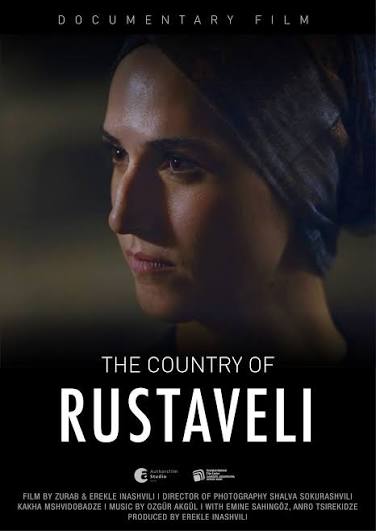
A mystical setting by a campfire, in the forest... With her eyes closed, an elderly woman is reciting "The Knight in the Panther's Skin." The listener she has is also one - a woman as well, young, amazingly beautiful and with veiled head. Being silent in untimeliness, they seem to be trusting the magic of words... This could be any era - from Rustaveli’s time to the present.
This is the scene that begins Erekle Inashvili's documentary "The Country of Rustaveli" (2023). The woman who recites "The Knight in the Panther's Skin" in the film is a word-perfect, a German teacher from the school in the village of Orpiri in Imereti, 75-year-old Anro Tsirekidze, a living legend who has loved the poem since her youth and can recite all 1669 of Rustaveli's verses by heart.
The young lady listening to her is Emine Şahingöz, a German linguist of Turkish origin with Caucasian roots. She has come from Frankfurt to get to know Georgia, the country where “The Knight in the Panther’s Skin” was written. The film observes her journey and simultaneously asks the main question: how or to what extent does Shota Rustaveli’s “The Knight in the Panther’s Skin” live on in modern Georgian reality?
The film is a Georgian-German co-production. The screenwriters are father and son, Zurab and Erekle Inashvili. This film is the last project of the famous Georgian documentarian Zurab Inashvili (he died in 2021), but it is the debut work for Erekle Inashvili, who previously worked in Germany as a successful designer and art director. That is why this film has a special, personal meaning for its director.
This emotional attitude is felt throughout the entire 68 minutes. The Georgian hosts also emotionally approach the conversation with the German linguist. Emine has Rustaveli's aphorisms recorded on her phone: "The lion's whelp is equal, be it male or female," "He who seeks not a friend is his own foe," "To win a good name is better than all wealth," etc. Each time she chooses an aphorism, she goes and looks for its confirmation in modern Georgia.
Indeed, what is left of Rustaveli's world after almost 900 years, from merits, and values in his country? Today, are these still the same people? Emine researches this and walks in different environments, meets different people. The film is a study of Georgians and Georgia from the outside, from a foreigner’s perspective, which allows the viewer to look at their own traditions and values from the side. Emine's Georgian respondents gladly agree to the conversation, because they are already used to foreigners liking them, showing special respect and attention, they love it when others are interested in Georgia, Georgian culture and are worried about what foreigners think of them. Emine is talked to with great enthusiasm on the street or on the bus, in Tbilisi, Telavi or Kutaisi, at school, in the market, in a nightclub, in Imereti or the Pankisi Gorge, in the mountains or in a bar. They are people of different types and tastes, who quote “The Knight in the Panther’s Skin,” choose it, discuss whether “The Knight in the Panther’s Skin” can be modernized, whether it is sacrosanct or not... And although they talk about the poem throughout the film, the film is not about it, but about the country where this poem was written, which is also confirmed by the perfectly chosen title.
Emine Şahingöz is not just the host or narrator of the film, she is the real main character. It is through her eyes that we can see our country. She knows the poem and does not know Georgia. That is why Shalva Sokurashvili and Kakha Mshvidobadze’s camera follows Emine so closely. We can see her amazing, oriental beauty, self-control, kindness, intelligence, and we realize that she herself resembles the character of “The Knight in the Panther’s Skin.”
As the director says, the idea for the film belonged to Zurab Inashvili. He has made excellent documentaries, where the author researched and introduced us to large groups of society: modern youth, men who move to Turkey for work, women, Germans living in Georgia... and he did this with great love. This attitude is felt in "The Country of Rustaveli" - both inside and outside the shot. Not only ethnic Georgians, but also people of other nationalities living in Georgia "get excited" at the mention of "The Knight in the Panther's Skin". Such best episode is Emine's visit to the Pankisi Gorge, where she talks to high school girls in the schoolyard on the topic " The lion's whelp is equal." The girls are Muslims, just like Emine, they are not Georgians, but they are real citizens of Georgia. The audience sees how close and native "The Knight in the Panther's Skin" is to them, how freely they discuss this poem, love, the role of women... In general, the film has a multi-ethnic background (just like the poem). Here they speak in different languages (Georgian, English, German); they read “The Knight in the Panther’s Skin” in different languages (Georgian, German, Ossetian); young German workers in Kutaisi discuss the topic "He who seeks not a friend is his own foe” and think that this poem is part of the everyday life of Georgians. The documentary film tries to see to what extent this most important poem and its ideals (friendship, love, freedom, equality) are integrated into the everyday life, thinking, and identity of today’s Georgians.
How European are we, how tolerant are we, how similar are we to the Georgians of 900 years ago today, in the era of the Internet, social networks, and artificial intelligence? Are we descendants of ancestors with Rustaveli's ideas? - these are the questions the film asks.
Despite the fact that the film is loaded with content, it has a corresponding artistic form - a film-journey - and develops without any acceleration, sedately, calmly. Its tempo-rhythm allows the viewer to fully feel the mood and environment of each episode. This is a mosaic film, which consists of different parts from each other, but ultimately fits into one big picture. The most similar to it are the Rustaveli verses, copied by hand by 300 different people and combined, which are also discussed in the film.
Emine has explored Rustaveli's country everywhere: in the German school in Telavi, in a nightclub, in an underground passageway with graffiti-painted characters from "The Knight in the Panther's Skin," in an open-air cafe in Kutaisi, where foreigners tell him that every city in Georgia has a Rustaveli Street but Emine never asks about the country's main avenue - Rustaveli Avenue. But Rustaveli Avenue is the place where, ultimately, all paths, ideas, values, memories, and history converge. In Rustaveli's country, everything is solved in Rustaveli Avenue.
This film is a cultural study as well as a literary quest and a son's homage to his father's memory.
Ketevan Pataraia


