Family is often perceived as the safest, most protected space - a place where trust is unconditional and love conquers everything. However, the reality is much more complicated. There are moments when alienation appears even between the closest people, when the pain of the past and unfinished conflicts, misunderstandings and once unexpressed emotions destroy trust. At such times, family can become a space where love coexists with fear, and care takes on rough forms. A space where silence speaks louder and emotions that should unite, on the contrary, separate people from each other.
The topic of alienation and family relationships is not strange to Georgian cinema, however, Guram Bakradze managed to say a new word with his student film, “Dad” (2014). The images we encounter around us every day, the emotions and feelings we experience, the situations we try to escape from every day - this is what his film is all about.
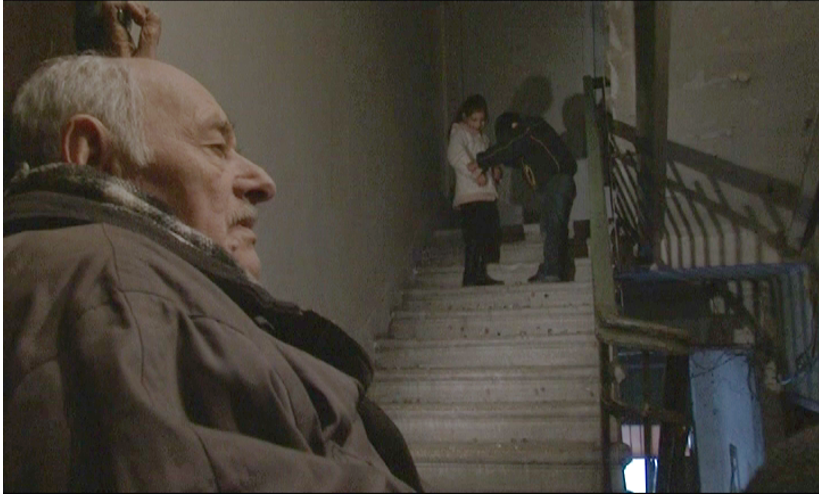
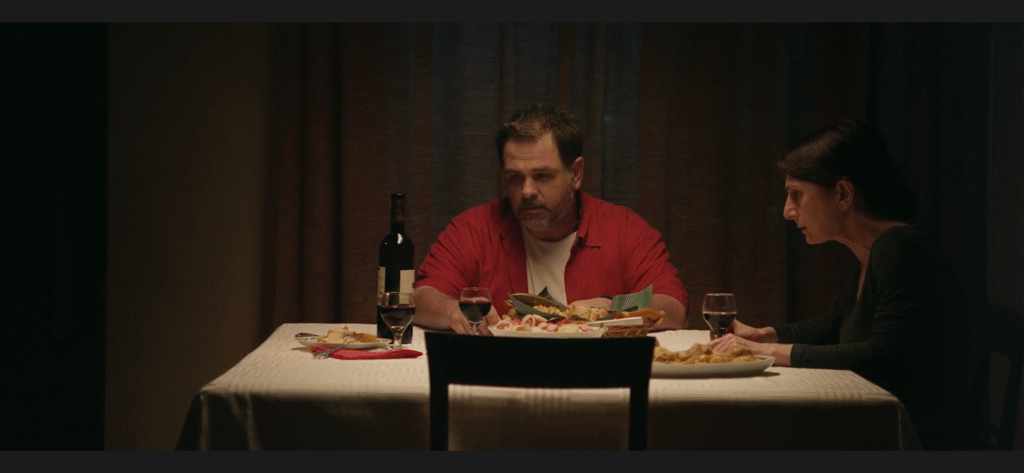
The father, Guram saved his son, took him out of prison, took care of him and with his own hands planned his future for him. He sold the factory and decided to send him to Italy, however, he does not look happy for some reason. It seems that he regrets the step he took, despite the fact that his decision was completely well-thought-out. The mother seems to be distanced from the entire family, and the son is choked by the desire for revenge and still cannot understand his own responsibilities. No sincere dialogue, only silence, drowning emotions in himself and silent sadness - this is their family, in which fear reigns - a feeling that governs all processes.
The most interesting character for the viewer is the father. The silent, frightened man, bringing his son from prison and looking suspiciously in the mirror, checking if anyone was following him. The man tensed up at the sound of the door knock and sirens because he was afraid for his son. It seems that throughout the film, the viewer understands what will happen, knows that Guram's fear was not unfounded, that this was not a simple feeling, but some kind of paternal premonition. And yet, the sound of the last shot and the woman's doomed scream scare the audience, disturb them and remind them of a very cruel reality. This shot puts an end not only to the son's life, but also to the father's last remaining illusion of hope.
“You know what? It really seems to me that you didn’t want to take him out,” the wife says to Guram. Mother and son cannot understand Guram’s fear, they don’t hear it, they can’t feel it. Is it because they don’t want to but because Guram tries to hide this fear in every way. He transforms into a man who seems to be indifferent to his son, addresses him in a commanding tone, and doesn’t express warmth – the director’s view of the man’s image from this angle puts even greater pressure on the viewer and brings him even closer to the people.
In the end, the son dies, and with him the father's hopes and disguised love die. Against the background of Guram's justified fear, the story ends, both for the family and for the viewer. There are no questions left, only emotions. "Dad" is not only an adventure of an individual family, it also reflects the crisis of Georgian patriarchal culture to a certain extent. Guram is a typical Georgian man, for whom expressing love is not warmth but taking responsibility and "patronage." He sold the factory - his social status and the fruits of his labor - to save his son, but this very sacrifice turned him into an emotionally exhausted person. His severity and distance are a mask for an inner fear that he does not reveal even to himself. The fear that his efforts are too late and that the son is already out of his hands.
Silence is not just the absence of sounds in the film, it is a heavy, physically tangible barrier that is erected between the characters. The director ingeniously uses pauses and glances to show that words have lost their value in this family. Each unspoken phrase further increases the alienation. The mother, who seems to be observing the process from the sidelines, is in fact the biggest victim of this silence.
Fear in this film is not a one-time reaction to danger, but a chronic condition that has become the characters' everyday life. The director shows us the two natures of fear: external, which is expressed in the sound of sirens and knocking on the door and internal, which is much more destructive. This is the fear of one's own past, mistakes made and the realization that even sacrifices cannot change anything. For the father's character, fear is not a source of paralysis but a motivator for action although this very "care dictated by fear" becomes the cause of alienation between family members. Ultimately, it is an inevitable premonition here - it is scattered in the air and does not leave the viewer until the final shot ends this unbearable tension with tragic truth.
The director shows that tragedy often lies not in noisy conflicts, but in that devastating silence where emotions cannot be translated into words. The father’s character becomes a symbol of a man who gave everything to save his son but was unable to do the main thing - break through the spiritual isolation in which his family had been for years.
Ultimately, the harshness of the final shot is a kind of awakening for the viewer. This is not just the end of life, it is the shattering of the illusion that the past cannot be escaped or purchased. The film leaves us with a bitter question: how safe is a family where love has been replaced by fear? After the last shots, only emptiness remains and the realization that the greatest prison is not behind bars but in the souls of people who have lost their way to each other.
The film's visual solution - faded colors, narrow spaces and static shots - further exacerbates the feeling of claustrophobia. The viewer becomes not just an observer but an accomplice in this family captivity. The camera often lingers on the characters' faces, where wrinkles and a tired look say more about their past than any dialogue could. This visual asceticism emphasizes the spiritual dryness in which the characters live.
Barbara Rikadze