
Public opinion and family mentality have always been and will be to a certain extent a determining factor in the formation of a person, especially in a society for which it is important to be attached to conservative values, such as adherence to traditional family, cultural and religious rules. In addition to scrupulously adhering to these rules, an important role in such a society is played by what will be said about him, how he will be evaluated and judged. People of this type constantly experience the pressure of the “invisible” eye because they know that some of them who are preoccupied with their “observation” try to adapt to their standards and not go beyond the established norms that people have set for each other. Such social pressure results in humans’ development of the ability to self-discipline, which French philosopher Michel Foucault refers to as the "trap of visibility" and discusses on the example of Jeremy Bentham's prison model, "Panopticon."
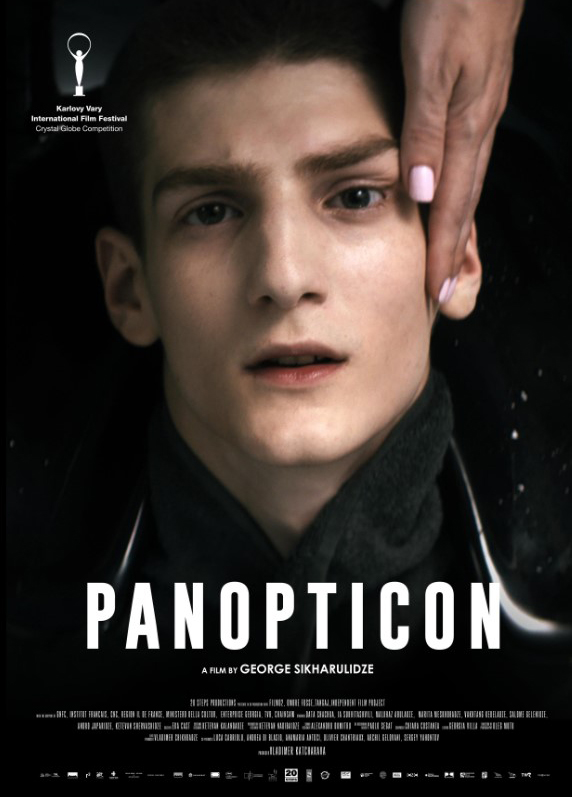
Bentham's prison, "Panopticon" is designed in such a way that the warden constantly watches the prisoners housed in the arc-shaped building from a watchtower in its courtyard. Thus, they never know when they are being watched and therefore never have the opportunity to relax. Giorgi Sikharulidze's film, "Panopticon" (2024), is also a kind of metaphorical image of this prison model, in which the main character Sandro (Data Chachua) is an object of constant observation - a "prisoner," who is periodically watched by his "warden" father’s (Malkhaz Abuladze) eyes, obsessed with religious dogmatism. Like a prison inmate, Sandro's freedom is also restricted, and the authoritarian upbringing method hinders his development as a free person. He cuts his hair like his friend Lasha and begins to act like him, because his personal identity is disappearing somewhere and he has no choice but to become someone else.
The film describes Georgia in 2018. The main character, 17-year-old Sandro, lives with his grandmother and father, while his mother has gone abroad to take care of an elderly person and has little time to communicate with his son even in virtual contact. Meanwhile, Sandro constantly experiences their deficit and is torn between two different views and ideologies while the support of his parents, friendly relations with them and healthy communication are important at this stage for him. One is his generation with whom Sandro has to be; his classmates and football teammates are more free and open to expressing their feelings and emotions. The other environment, where Sandro constantly has to be disciplined, is the religious laws imposed on him by his father. He constantly reminds him and tells him to go to church and not miss prayers. The confrontation between conservatism and liberalism runs through the film's narrative as the main line.
Initially, when one of the "harmful" teammates takes Sandro's cross off the hanger in the common bathroom and hangs one of the team members' "flash drives" in its place, Sandro becomes interested in secretly invading someone else's personal space and starts watching it at home. Along with the pornographic videos, he also comes across videos of Lasha's birthday, where his mother - Natalia (Ia Sukhitashvili) appears in the shot and this is where Sandro's secret intimate longing for her begins, his indifferent attitude towards the religious "rituals" imposed on him by his father, and, according to his age, the path opens to his secret sexual fantasies.s
The film constantly emphasizes that a teenager’s physiological needs are inevitable and therefore, Sandro's hero cannot suppress his excessive libido with any religious exhortations during his puberty. Moreover, such restrictive and limited methods of upbringing may even take more aggressive forms, which is also evident in Sandro's case. The hero's actions, movements, gestures, facial expressions, and timbre of voice are so oppressive that he constantly experiences the guilt caused by his "wrong" actions. His friend's mother, with whom he has a desire for intimacy, is a resurgence of his subconscious. Sandro constantly experiences the loss of his distant mother. He wants to have a mother by his side like Lasha does, to whom he can talk and hug.
Why does the object of his sexual fantasies become not his girlfriend, but his friend's mother? Sandro believes that sex with a girlfriend is not allowed and should only happen after marriage. In this case as well, the director focuses on the consequences of the brutal invasion of his psyche and the formation of his wrong mentality.
This hero is constantly being under surveillance by someone or something. He is watched by icons hanging on the wall, by his father, who periodically suddenly appears in the shot when he does not expect it and systematically reminds him how to behave. The most important invisible supervisor is his own complexed “alter ego”, of which he himself becomes a prisoner. He is not alone with himself even when the icons hanging on the wall “watch” his “unruly” actions. At the same time, he tries to escape from his father’s pressure, self-discipline and stubbornly do what does not fit into conservative norms, secretly, constrained, and obsessed with a sense of guilt.
Sandro is always in a struggle with himself as well as with his friends and family. The attempt to overcome self-imposed stereotypes, at least something or someone (mother or own already formed complexes) does not give the means to be freed from dogmas. At first glance, we may be a little surprised by a similar upbringing method in relation to today's situation, when the modern generation has already been freed from modern upbringing methods and religious fanaticism through social networks. They have nothing to do with humanism and the good things that true religion serves.
The father's line is one of the most important factors in the film. For the boy, the father, who should be the authority and, in many cases, the exemplar (as the primary male role model), is lost and presented to the child totally useless being. Despite the fact that each character is interesting in their own way and each of them has their important burden, the main characters are still Sandro and his mother.
Everyone has the right of choice. When Sandro's father chose a religious life, it was his decision but dictating his son that he should be in a religious framework is a crime. The father's fanatical views are already reaching their peak when he refers to Sandro as possessed by demons. The director emphasizes the father's foolishness and raises the question of what is better, Sandro still growing up under his father's supervision or distancing himself from him, so as not to become a prisoner of his dogmas. The father, who is indecisive in his decisions and does not know exactly what to do despite his age - to become a monk or to continue his secular life, draws attention to the weaknesses of those men who create a family, have a wife, children, but still remain infantile. Such men always teach their children but they themselves lack the strength of their opinions. Children, like Sandro, get lost in society and then follow their father's footsteps. In Sandro's father’s case, his hesitation in choosing between secular and religious life is not due to the fear of his son being left alone but rather because he himself does not know what he really wants, afraid that he will not be able to bear this heavy burden of monasticism as well as fatherhood.
These characters create a whole narrative, which is in constant continuous connection with each other, just like the architecture of Bentham's prison. Although these two buildings - the prisoners' cells and the warden's tower - stand separately, they still represent a single architectural complex. Sandro's father is a metaphor for the warden of the Panopticon, who periodically controls his son's behavior and does not allow Sandro to relax, who is in captivity of his surveillance. The father fails to analyze the fact that the more he restricts him and does not give him the opportunity to give vent to his desires, the more claustrophobic symptoms will develop in him and he will try to find a way to escape, even going beyond the limit. His xenophobic attitude is revealed precisely when he is torn between two worlds: to live with religious fanaticism, systematically pray, perform prostrations, never be alone with his own body for a single moment, even when no one is looking, or to choose the other extreme, to become a rebellious xenophobic activist who aggressively tries to express his protest against traditional stereotypes.
The director draws a parallel between Sandro and Antoine, the protagonist of François Truffaut's film "The 400 Blows." When the opening credits of Truffaut's film appear on the TV screen along with Sandro's haircut, you realize that both heroes are in conflict with their environment, school, and family. Both characters evoke sympathy due to the pressure that is exerted on them, and they try to somehow escape from their oppressive environment.
The film's cameraman (Oleg Mutu) creates a "panopticon" effect with static shots. It seems that the camera lens is the viewer's eye, which is on the watchtower and persistently observes all the characters in the film, especially Sandro. And the slow movement of the camera, which secretly follows the characters, seems to become a part of their inner world and tries to penetrate their inner world, which is locked up like a prison, to reveal their thoughts, feelings, emotions, and make the subconscious world conscious. The close-up view, which lingers on Sandro's face for a few seconds, creates the illusion of the viewer's proximity to him. It seems you are not observing him from afar but rather have your ear pressed to his face and catch every expressive breath (which can actually be heard in some shots), which intensifies the feeling of empathy for the hero.
Although some of the actors' performances are unnatural and fake and some of the shots in the film are completely meaningless, Data Chachua's performance is so emotional that even if he doesn't say anything or act, each of his facial features is so expressive that it's impossible to watch him indifferently, not to accept his feelings, and not to have the words come to you which the director wanted to say.
In the final episode, when Sandro appears naked before his girlfriend and the other students as a model for drawing, the teacher gives them the task of drawing a naked body that expresses shame. For Sandro, who has been expressing shame throughout the film, his nudity in front of the audience frees him from the self-discipline that has kept him constantly in the “visibility trap.”
Ketevan Ghonghadze


