We often encounter an artist’s attempt in modern student cinema, when he tries to say no to traditional storyline and present the viewer not with a particular story but with a pure emotional state. Such works are mainly built on silence, where words are superfluous and thought is formed only through visual plasticity, observation of the environment and the revival of symbolic signs. It is often difficult to draw the line between reality and metaphor since the director does not aim at building a logical chain but to awaken those primal sensations that are sedimented in the human subconscious. It is this ambiguity and visual aestheticism that creates the unique space where each shot can be both a sign of the beginning and the end and the viewer becomes not just an observer, but a participant in this dreamlike world.
With this very meditative approach is distinguished Maria Sichanin's student film, “Paradise Lost” (2016), which captivates us from the very first shots with the tranquility of people sleeping on the riverbank and its natural, slow rhythm. The film begins with the awakening from sleep, where the characters slowly perceive their existence in a primitive environment. Despite the fact that an episode of eating fruit appears in the plot, which seems to indicate the biblical fall into sin, the director does not consciously follow Adam and Eve’s classic story but presents this act with a completely different, more physical and existential charge. A space devoid of dialogues opens up before the viewer, where the action can be perceived as a painful process of separation, although the author does not or cannot fully explain his intention and maintains narrative ambiguity.
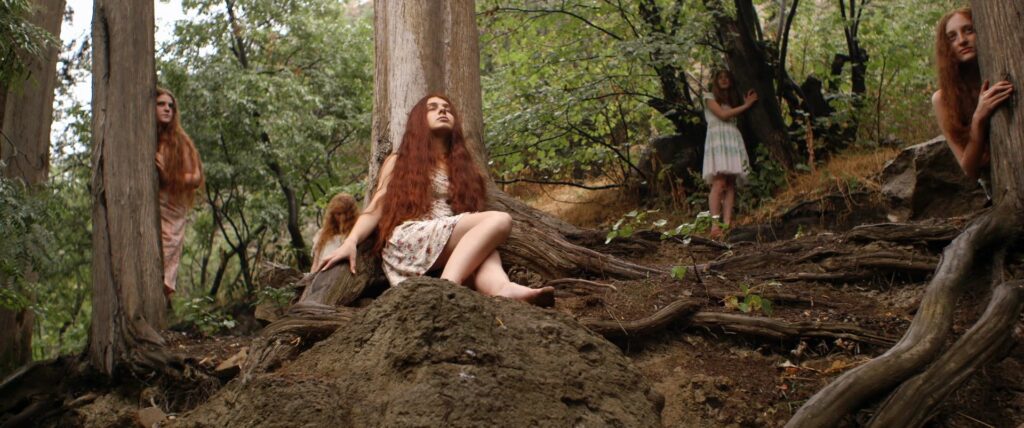
The visual language of the film is so sophisticated and original that each shot acquires an independent artistic value. The director turns nature not just into a background but into a living, breathing organism that captivates the viewer with its primal beauty. The characters’ external aesthetics attract special attention, all of them are red-haired, which creates a distinctive colorful accent in the shot. The fiery tones of their hair and the intense greenery of the forest enter into a sharp, yet harmonious contrast with each other, which gives the image amazing dynamics and depth. The mise-en-scenes are so thoughtful and compositionally perfect that they often remind us of classical paintings. This visual perfectionism gives the film a magical touch, and the beauty of nature is woven into an inseparable and impressive spectacle along with the physical side of man. Despite the film's outstanding visual aesthetics, the narrative void still becomes a significant obstacle for the viewer who is looking for a more solid content foundation beyond the shots. It is obvious that the director conceived a certain dramatic narrative, perhaps a specific human tragedy or even a philosophical parable but was unable to fully tell this story using visual language alone. The symbols that appear on the screen often remain at a superficial level and cannot be tied into a single logical chain, which creates the feeling that the form has absorbed the content. When the viewer realizes that the author has something to say but this saying is locked only behind beautiful shots and does not reach the addressee, a certain disappointment arises. Impressive visuals cannot compensate for the dramaturgical shortcomings that make the perception of the film fragmentary and ultimately unfinished.
The title of the film, “Paradise Lost” already creates an expectation that forces the viewer to start searching for biblical allusions and echoes of John Milton’s work of the same name. The title is so pretentious and expressive that it automatically suggests certain rules of the game. We are looking for the fall, sin, a lost idyll or even an attempt to return to the origins of human existence but this search does not yield anything in the process of watching the film. The parallels that the title dictates to us appear only at the level of superficial strokes and then dissipate into limpid air. This creates a kind of disappointment as the viewer tries to put the beauty seen on the screen into some intellectual or spiritual context but the director does not allow this.
The problem, when the form is much more sophisticated and large-scale than the content itself, has become somewhat of a taboo in modern Georgian student cinema. It often seems that young directors spend all their energy and resources only on the search for the “ideal shot” and achieving visual aesthetics, which, is good for cinematography in itself but insufficient for cinema. It seems that they forget the most important thing: a shot is not just an autonomous painting; in addition to providing aesthetic pleasure, it should also develop the dramaturgical fabric of the film and open a door to content for the viewer. When the visual becomes an end in itself, the film loses its narrative backbone and turns into beautiful but cold video art, where the content is captured by the form thus, the author’s intention is lost in this aesthetic labyrinth.
Maria Sichanin’s “Paradise Lost” is a work of outstanding visual aesthetics, remembered by the viewers more for its picturesque shots and atmosphere than for its clear message. Although the director failed to achieve a complete synthesis of form and content, the film still confirms the author’s talent for creating an impressive cinematic world. This is a promise that if she finds a dramatic support in the future, the director will reach true artistic heights with similar visual mastery.
Salome Gogoli