Human life is nothing but a constant expectation of something. It is a wait for the weekend, summer, new year, to start over, when a new job will appear, when you will find the love of your life, when you will go on a cherished journey, when all your dreams will come true, and it is from this wait that we exist till the next wait although the hardest thing is waiting for a dear person, who may not be far from you at all, but you constantly wait. This is our eternal cycle, a short explanation of existence. We exist from one great waiting mode to the next one because if the time comes for you when you do not expect anything, it seems that you lose your purpose and essence. As long as there is expectation, there is no hope and as long as there is hope our hearts beat more steadily and boldly.
Nika Arakhamia's student film, “Millstone” (2022) is a short film saturated with sadness. The director manages to capture the viewer's attention and arouse our interest in what will happen in the end. This is truly a merit of the right combination of the script and visual language.
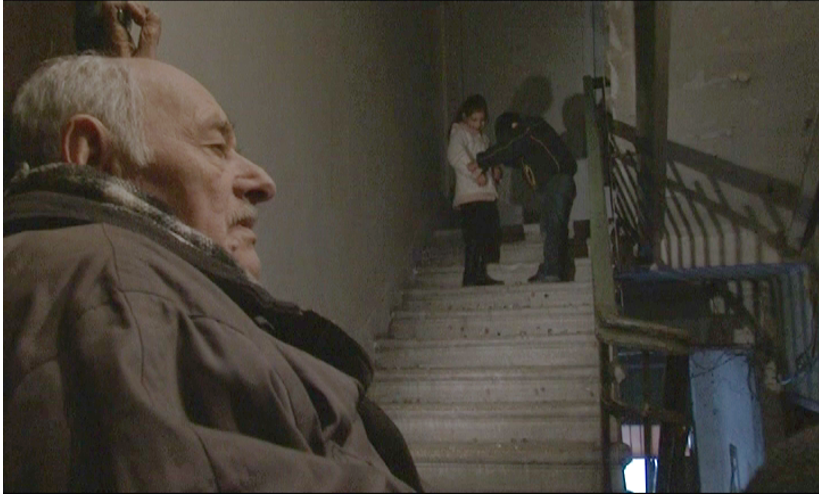
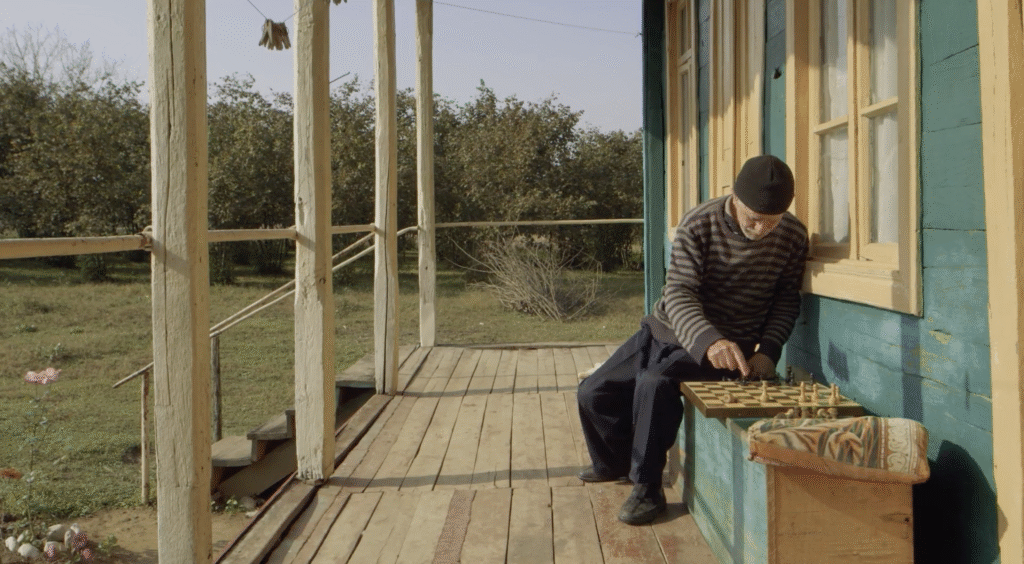
There are no dialogues in the film. The characters' words reach us silently, which further intensify this sadness and anguish. We clearly watch a man’s life who has left the village, for whom the owner is waiting in front of the apartment, probably for the rent payment, while the lost main character thinks about his beloved woman, who does not care about him much and even has an affair with another man. After some time, an excuse appears, Ilia is promoted at work, and his life changes. The woman he cared about so much now comes back to him, the owner of the apartment is no longer waiting outside, and he even lives in a better house. And what is more, he is ready to visit his beloved father in the village, who, judging by the music on the radio, is waiting for him in Samegrelo. Meanwhile, we can see how the millstone works, how tirelessly the old man works, and how much symbolism the director uses to express the weight of this character's loneliness.
The director compares life to a millstone directly, which is precisely in the aforementioned waiting, running out and slipping away like an hourglass, if we do not do something to slow it down, if we do not devote more time to our beloved ones, if we do not put our priorities and relationships above career advancement in the modern world. Many people may reject this opinion and advocate for freeing a person from all obstacles on the path of their own individual development, but how can we talk about an individual without the people around them who are close to them? Each person is formed as an individual not only by their own experiences and perceptions but also by the life lessons that not only our own heads but also other people teach us in life. By the knowledge they share with us, by the dedication and faith they instill in us, which then flourishes in the individual like an evergreen plant. As long as another person continues to water it, “a person is a day for a person,” and there is nothing more pleasant than the ability to make a person, especially a parent, happy, even with such a simple action as visiting them.
Here the director has made the right finding as he speaks directly about the Georgian character and a very urgent problem in Georgia, which is related to life in the regions and the centralization of Tbilisi. Unfortunately, only a few cities in Georgia allow for full development and even within certain frameworks. Most young people living in the regions have to move to the capital, while their parents remain in the villages, waiting for the arrival of their children.
The director uses the Soviet, “intellectual montage” by Eisenstein, where the shots quickly replace each other and indirectly convey the message. We can see Ilia, who has been promoted at work, angry with himself, heading towards the village, full of pride and expectation. Simultaneously, we can see a hopeless father who no longer believes in his son’s arrival, playing chess to himself and spending his days alone.
Arkhamia’s film, compared to other student films, may seem a little long, but not dragged out, which is an appreciative criterion in student cinema. The silent style chosen by the director is also interesting. It tells the parallel lives of two people, and we wait for the grand finale throughout the film- their meeting, although the director chooses a tragic path, the meeting does not take place, and the father, who is tired of waiting, ends up with a millstone around his neck. We can see how the corn prepared for grinding is runs out, the excitement of expectation runs out, and time, which is so precious, runs out, and finally the mill stops, stops working, the stone stops grinding, and expectation stops, hope and excitement disappear. How important it is to give time, which we may have so little, to the right people and work.
In the second part of the film, the director manages to establish a strong emotional connection with the audience, who wants to see father and son’s meeting and a "happy ending," to feel the peace and happiness of this moment, although this emotion and feeling become more intense in the audience by showing the opposite. Nika Arakhamia successfully coped with one of the main tasks, that his student work had a meaning and a message that would be understandable to every viewer. He uses the unique technical methods of cinema to do this, where directorial decisions come to the fore and the acting is more overshadowed.
Lizi Gaprindashvili