Sometimes, loneliness is most acutely felt when we are with another person. Physical proximity does not equate to connection; two bodies may exist side by side, yet an unbridgeable distance remains between them. In such a state, words lose their meaning: when truly seeing and hearing one another becomes impossible, a person gradually loses touch with himself as well.
Seldom does human withstand this soundless emptiness. One desperately tries to find something to restore, even only temporarily, this rupture, whether it be an illusion, a drug, or another person. Drugs become a surrogate for escaping reality, numbing pain, and finding an illusory peace; yet, what initially appears to be a remedy ultimately drags us into an even deeper swamp of addiction and isolation. There exists a far more severe, visceral form of addiction: when the "drug" is not a substance but another human being – when someone’s presence becomes so obsessive that one’s own existence seems absurd without them. In such instances, the other person becomes both the oxygen we need and the “polythene film” without which breathing is impossible and which suffocates us slowly.
It is just this tragic contradiction that director Mari Managadze builds her student film, “Mania” (2026), a work in which the boundaries between love, dependency, and alienation finally disappear. The narrative presents an unusual structure from the very start: the main heroine, Mania, is already deceased and the whole plot unfolds as an endless, wound cycle. The empty, hollow environment intensifies all emotions; this is not merely a sterile space but an atmosphere burden with moral and psychological gloom. The characters’ relationships are expressed not through words, but through bodily movement, gazes, and mute objects. This sense of lifelessness is further deepened by the hardened clay masks covering the faces – devoid of any features – underlying the ultimate erasure of identity and soul.
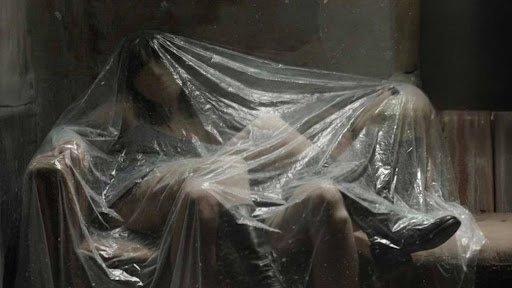
The very first shot of “Mania” brings the viewer to the edge of emotional overload. A girl’s faceless body, over-wrapped in polyethylene, serves as a visual metaphor for the suffocation and confinement that run like a vein through the film. The polyethylene simultaneously conceals, isolates, and stifles... Within this faceless space, an unexpected, visceral attempt to assert one’s existence emerges: menstrual bleeding. This allows for a multi-layered interpretation – on one hand, it symbolizes the end of childhood; on the other, it marks the painful traces of trauma, of waking from unconsciousness and the violation of the body, at a moment when the protagonist cannot even comprehend her own physical state. It is the body’s primal scream within the existing, dumbfounded world.
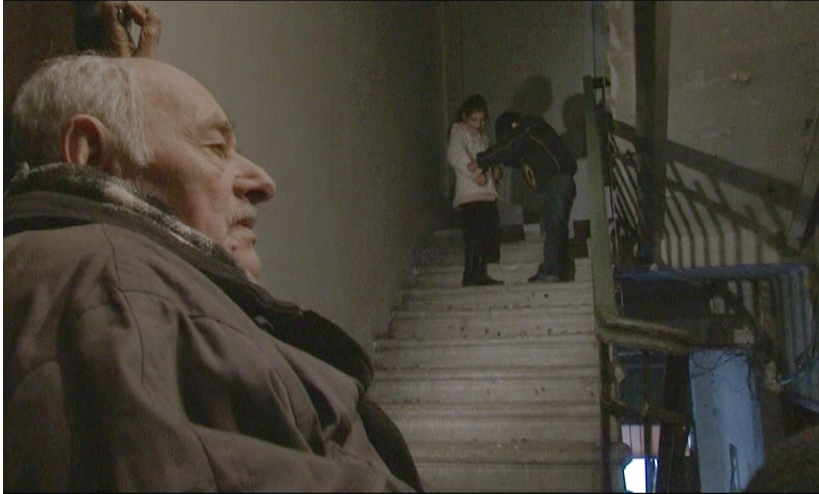
This trauma takes on a collective dimension in the following scene: the characters, sitting on waiting-room benches and suffering from gas poisoning, become a symbol of collective self-destruction. Mania walks up to one of the boys and wipes her hand on him, glancing at them in turn. With this gesture, she seems to hold society as a whole responsible for its own spiritual and physical corruption and desecration.
In the same alienated world does the relationship between the girl and the boy unfold. The dinner scene clearly reveals the Stockholm syndrome and pathological dynamic between them: Mania constantly returns to the boy who loves her unconditionally, while the girl responds only with distance, creating a perpetual, contradictory dynamic of attachment and rejection. The boy’s mechanical eating of canned food underlines the degradation dominating in their daily lives: when human connection is void of soul and warmth, existence itself is reduced to an instinctive, soulless state.
The scene featuring a beetle emerging from the sugar also reflects Mania’s inner state. Her action. Dropping the beetle into the food is driven both by the irritation caused by drug abstinence as well as the exhaustion stemming from a partner whose love is also mute and futile. This small living creature remains the only link connecting their absurd bond, yet it, too, is doomed.
After the conflict, locking herself in the room, turning on the music, and dancing becomes the girl's final, visceral escape, a moment of bodily ecstasy, from an unbearable reality. The camera’s blurring of the surroundings mirrors her internal state: the outside world loses its sharp contours, reality dissolves, and she sinks into a trance of her own making. This dance is followed by the surreal act of climbing into a box – a direct, almost ritualistic metaphor for both being laid in a coffin and returning to the womb. It is as if she is trying to flee a world where existence itself has become a form of suffocation.
The scene shifts from the box into an aestheticized space. Cold blue tones give this transition an almost transcendent, otherworldly quality – the girl seems to have finally left behind the physical environment where sustaining her existence had become impossible.
The boy only begins to realize the loss after seeing the discarded clothes and the abandoned mask lying on the floor of the empty room. Here, removing the mask is no longer merely a physical gesture; with the girl’s disappearance, the entire illusory world upon which the boy had built his own outlook vanishes as well. His weeping marks the first genuine expression of vulnerability and regret, yet it is a silent echo that comes too late.
In the next shot, where the boy sits at the table again and the camera looks down on him, the mask is fastened to the back of his head. His face remains concealed. It seems that having lost the girl, he too has found himself in that same faceless, shadowy state... In that same space, beside an empty tuna can, the beetle still lies on the table – though now it is motionless, lifeless. If it previously embodied a final pulse of life, its death now signifies the ultimate emptying of this space. The void within the boy gradually escalates into unbearable anxiety and the panic of withdrawal. In this instance, jumping from the window is no longer merely an act of self-destruction; it is a desperate attempt – born of the loss of the object of his attachment – to escape a reality where remaining without her is a torment worse than death.
The final scene fully completes the film’s composition. The boy lying lifeless on the sofa, the girl approaching him, and the polythene film once again draped over them transport us back to the very same suffocating space where it all began. It seems nothing has ended – roles have merely shifted, and the cycle continues. Life and death, love and dependency, intimacy and alienation lock together in a closed loop.
Ultimately, “Mania” leaves us not with love, but in a whirl-wheel of pathological dependency: when one person becomes an object of consumption for another, escaping that dependency proves impossible – even upon losing the object itself. Conversely, their disappearance leaves an unbearable void that the dependent individual cannot endure. That is precisely why the finale returns us to the "polythene film " – to that same sterile space where love and suffocation, longing and loss, connection and alienation become inextricably intertwined.
Thematically, the film seems to offer nothing new – the formula of human attachment and alienation has been employed in cinema countless times – yet it is precisely the author’s signature style, closely calculated visual aesthetics, and the sense of form that makes this familiar story so authentic and distinctive.
Barbara Rikadze