Throughout the history of humanity, the relationship between parent and child has always remained one of the most complex and contradictory phenomena. Love, which should be a source of life, growth, and development, is often transformed into a destructive force, especially when boundaries are violated. What happens when love for a child shifts from a sense of responsibility toward total freedom and blind guidance.
Many films have tackled this topic; however, Guram Bakradze’s short student film “Father” (2014) manages to present this universal tragedy through the lens of Georgian social reality. From the very first shot, the film offers more than just a plot; it provides a profound psychological insight into how parents, intending to “save” their children, actually do them a disservice, ultimately ruin through excessive care which they call “a survival.”
With their own hands, they destroy the future of the young, protecting them from even the slightest hardship. Yet, a life presented on a silver platter, neatly arranged and handed over, often proves short-lived and easily lost since anything valuable requires care. The film’s tension is established right from the start: a father and son traveling along a road in a car. This is not an ordinary trip; it is a chase and escape. The father, Guram, has released his son from prison, even though the son had to serve his rightful sentence. A suspicious car following them and the father’s sudden braking seem to temporarily stop the danger; yet, from the very first moments, the viewer realizes that the true threat lies not outside, but between them. A heartbeat, serving as a leitmotif, pulses throughout the film.
The scene of the family dinner upon returning home is one of the film’s most intense psychological portraits. Frowziness in this case is felt in the air. The father’s remark and strictness are immediately balanced by the mother’s position, who instinctively protects and shields her son. The mother’s such behavior is a classic example of a family where instead of acknowledging a crime, it is concealed. The problem is further deepened when his parents’ feelings toward one another and toward him is unclear for him; he neither understands nor realizes what and why is something happening around him. The father shouts at his son, forbids him from going outside, and warns him not to reveal the plan to travel to Italy to anyone, however, the boy himself has almost no sense of responsibility.
The scene of the family dinner upon returning home is one of the film’s most intense psychological portraits. Frowziness in this case is felt in the air. The father’s remark and strictness are immediately balanced by the mother’s position, who instinctively protects and shields her son. The mother’s such behavior is a classic example of a family where instead of acknowledging a crime, it is concealed. The problem is further deepened when his parents’ feelings toward one another and toward him is unclear for him; he neither understands nor realizes what and why is something happening around him. The father shouts at his son, forbids him from going outside, and warns him not to reveal the plan to travel to Italy to anyone, however, the boy himself has almost no sense of responsibility.
Any value has its start, solid foundation, something entirely absent here. The situation makes it clear that the process and methods these parents used to raise their only son. The film’s problem as well lies in the tragic mistakes made during his upbringing. In today’s reality, particularly within modern Georgian society, we frequently come across a model of "hyper-caring." Driven by social or emotional pressures, parents prevent their children from experiencing the consequences of their own mistakes. When a young person commits a crime and their parents take on the child’s responsibility, the child develops a false belief that they will never be held accountable and he will always be justified. This is a child’s cold attitude; accustomed to being assisted, they act as they please, knowing their parents are there to back them up. The director highlights this social malaise: a child’s future is destroyed not because a parent offers help, but because that help is incorrect, since such occasions ultimately end up in tragedy.
Any value has its start, solid foundation, something entirely absent here. The situation makes it clear that the process and methods these parents used to raise their only son. The film’s problem as well lies in the tragic mistakes made during his upbringing. In today’s reality, particularly within modern Georgian society, we frequently come across a model of "hyper-caring." Driven by social or emotional pressures, parents prevent their children from experiencing the consequences of their own mistakes. When a young person commits a crime and their parents take on the child’s responsibility, the child develops a false belief that they will never be held accountable and he will always be justified. This is a child’s cold attitude; accustomed to being assisted, they act as they please, knowing their parents are there to back them up. The director highlights this social malaise: a child’s future is destroyed not because a parent offers help, but because that help is incorrect, since such occasions ultimately end up in tragedy.
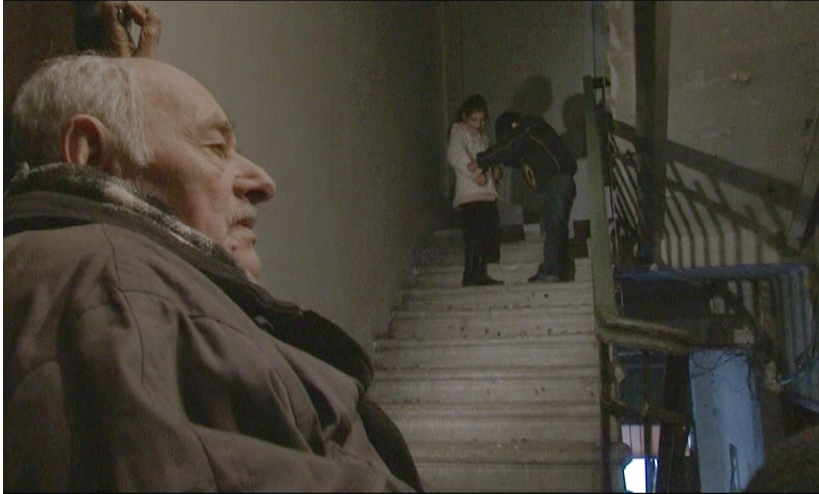
There is heard the screech of car brakes, the sound of gunfire, and a mother’s desperate scream. Such is the logical progression of events, leading to an inevitable conclusion. Meanwhile, Guram slowly closes his eyes. It is a reaction to a reality he could no longer change, as it was already too late, and to the mistakes that had driven his family to catastrophe.
Throughout the film, a sense of anticipation and fear is felt. The atmosphere is stifling and claustrophobic. Guram’s character is particularly interesting; as an actor, he is the only one who conveys, with relative naturalism, the inner pain, anger, exhaustion, and ultimate emotional devastation that suffocates his character’s very soul. One can notice this in his gaze, where love for his son battles with disappointment... The mother’s character embodies that traditional, blind maternal instinct, while the son is a typical spoiled youth. The story serves as a vital mirror for our society. It acts as a warning: saving one’s child means teaching them to look the truth in the eye, not covering up their crimes. The film reminds us once again that any attempt at salvation rooted in a "disservice" (a misguided, harmful act of help) is, sooner or later, destined to end in desperate, blind-eyed screaming.
Mariam Abramashvili