
Nostalgia is one of the most emotional and warm feelings that can make you put aside all your everyday problems for a while and get absorbed in bittersweet memories. Feelings and "shots" experienced in the past often come to mind when listening to a retro song, somewhere on the corner of an old street, when seeing the walls or balconies of a house, when hearing the intonation of someone's voice, especially when meeting familiar or once very famous people. This sad and, at the same time, sweet emotion re-induces the production of the hormone of happiness in a person and gives you an incentive to look at life more optimistically and be able to re-evaluate the past days. Nostalgic films, unlike social cinema, burden us less with topics saturated with systemic problems. They only cause strange pleasant feelings in us and you feel that you are also a part of it.
Such are the emotions and feelings evoked by director Rezo Gigineishvili’s film “Lyrics” (2025), which does not claim to be a cinematic masterpiece or a revolution in visual art. The director created a nostalgic, warm, lively and painful atmosphere with the film’s characters, played by famous actors and representatives of various fields of art, which, one might say, clearly affected the audience’s emotional mood.
The screen appearance of actor Misha Meskhi (who has not acted in a movie for almost ten years), causes joy and surprise at the same time, as the years spent behind the screen have given him new, real emotions, pain, joy and maturity, which were clearly manifested in the hero’s character, gestures and feelings.
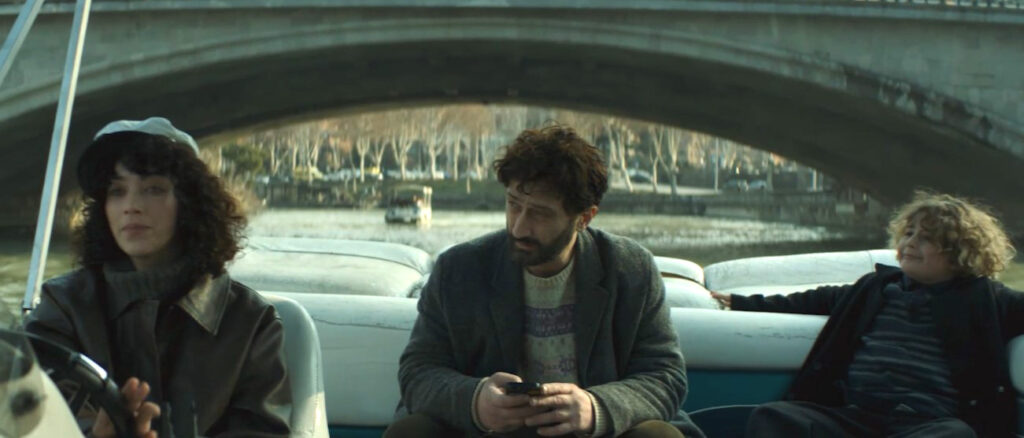
Misha Meskhi's hero Misha, who should have had a successful future as a football player, who would play in Italy, is now a broken man, wandering aimlessly in the streets of Tbilisi. He has lost his successful career, his wife, and nothing left to hold on to, which forces him to start his life over again. He leaves the rehabilitation center and, while wandering the streets, accidentally meets a little schoolboy - Saba (Saba Meskhi), with whom he seems to be reliving the childhood years he once had long ago. Some people recognize Misha on the street as the once famous football player, while others doubt his identity, he has changed so much. Misha and Saba's wanderings in Tbilisi are followed by a boat ride on the Mtkvari River and their acquaintance with a young girl, Mariam. The phone that Misha accidentally left with Mariam becomes the beginning of a new love and a new stage of life. The film reminds us that love is a feeling that can awaken a lost person and charge them with vital energy, which can’t be replaced by any number of transfusions or rehabilitation centers.
The symbol of the New Year's miracle in the film is an accident, when a courier from "Glovo" appears in the very first shots; he mistakenly delivers someone else's Christmas tree to a clinic address, and the recipient of the Christmas tree turns out to be Misha’s namesake. Misha happily keeps it. This someone else's, appropriated gift becomes the first hope that breaks the monotony of the clinic. With laughter, jokes, and the nurses decorating the Christmas tree, the main message is born - the New Year, as a chance to start a new, better life.
The film begins with lyrical music and shots. Patients are united by a common experience in an alcohol rehabilitation center, where as they await the New Year; with amazing tact and humor, the director shows the daily life of the clinic, the monotonous lives of the patients, their dialogues as they recall their life stories and use these memories to color the environment created within the walls of the gloomy, stuffy clinic, where the nurses' warm and friendly attitude merges. The film characters are lost in life, but thirsty for life, who want to restart a healthy life. Their thirst for life does not allow them to relax. The director carefully exposes the characters’ weak sides, which led them to the door of this clinic. He does not criticize, scold or justify their weaknesses. He simply leads us into their world so that we do not perceive these lost people as lepers cut off from society, but rather sympathize with them at this difficult stage of life. The author never leaves the characters hopeless. Their attempts to find strength in themselves, overcome isolation, and take a step towards a better tomorrow can become a spark of great compassion and hope for the despairing viewer. The film reminds us that “crossing up” is not a final verdict, and rebirth is always possible, as long as a person’s passion and desire to fight kills.
The actors are mostly called by their real names. Misha Meskhi - Misha, Keti Dolidze - Keti, Guga Kotetishvili - Guga. The entire Tbilisi elite is gathered in the film: Murman Jinoria, Dato Evgenidze, the Arveladze brothers and others. One of the main values of the film is precisely this authenticity of the characters. The the line between reality and fiction is erased, as some heroes appear on the screen with their professions, others are connected only by their names, and others, perhaps, by their inner world. Murman Jinoria reads poems in the clinic ward, Dato Evgenidze revives jazz melodies on the piano, and Iliko Sukhishvili also appears in the shot. These famous images give the film a Tbilisian, intimate atmosphere and emphasize that art and poetry are often the only way to survive even in the most difficult reality.
Lyrical deviations are indeed present in the film, which creates a nostalgic mood. Against the backdrop of compositions performed by Dato Evgenidze, Murman Jinoria's poetic mix creates a pleasant duet. Vakhushti Kotetishvili's poem, "On the Valley," which Murman Jinoria reads, is a longing for the plain life that was taken away from them during their stay in the clinic. They are no longer interested in grand ambitions, the complex material world. They only want the return of that warmth and the small, of simple, delicate feelings of life, love, of "Violet" - that they need to revive lost hopes and begin a new stage of life.
This is not a film intended for the mass audience. Understanding it requires not so much intellectual, but personal, emotional experience and mood. The director’s idea and the characters’ pain will be closest especially to those who have experienced a similar environment themselves or simply have the ability to irrationally perceive each shot, mise-en-scène and emotionally feel this or that episode with all their essence, to walk with Misha through the districts of old Tbilisi and enjoy familiar urban dialogues from the so-called Italian yards and winding balconies.
The visual aesthetics of the film determine its sad, nostalgic mood from the very first shots. The director rejects sharp colors and gives preference to grayish, faded blue and gloomy tones, which draw a parallel between the main character’s inner state and the lives of other patients in the clinic. The film is more of a mood film, the purpose of which is to awaken nostalgia for the past days in the viewer, where the narrow streets and colorful architecture of old Tbilisi, despite the gloomy colors, radiate a special homely warmth. It does not feel the modern urban style, crowded, chaotic streets (despite the fact that some episodes are shot in the districts of modern Tbilisi), the noise of cars and multi-story, lifeless buildings. Even a boat ride on the dirty Mtkvari is lyrical, romantic, calm and beautiful. The film slowly, gently takes you into the inner world of the main character and gradually you realize that his feelings reach you and arouse such emotions that you could not even imagine from the very first shots.
The visual aesthetics of the film determine its sad, nostalgic mood from the very first shots. The director rejects sharp colors and gives preference to grayish, faded blue and gloomy tones, which draw a parallel between the main character’s inner state and the lives of other patients in the clinic. The film is more of a mood film, the purpose of which is to awaken nostalgia for the past days in the viewer, where the narrow streets and colorful architecture of old Tbilisi, despite the gloomy colors, radiate a special homely warmth. It does not feel the modern urban style, crowded, chaotic streets (despite the fact that some episodes are shot in the districts of modern Tbilisi), the noise of cars and multi-story, lifeless buildings. Even a boat ride on the dirty Mtkvari is lyrical, romantic, calm and beautiful. The film slowly, gently takes you into the inner world of the main character and gradually you realize that his feelings reach you and arouse such emotions that you could not even imagine from the very first shots.
Some episodes of the clinic are so weak that they even make you smile. The impression is that the characters have been transferred to the hospital from “the gathering place” of the traditional neighbourhood and continue their meaningless conversations there. The audience also seems to be "squatting" next to them, listening to the monologues of these lost people, which often resemble delusions. The technical side of the film is clearly weakened here. Some shots of the clinic are too static and uninteresting, and the characters’ conversations are more like a dry television interview than a cinematic narrative. Instead of creating emotional depth, the camera, frozen in one place, slows down the pace of the film. The patients’ dialogues are sometimes so sluggish and chaotic that they sometimes lose their meaning, but it is precisely this everyday, unadorned “boringness” that gives the film a documentary authenticity, the kind you would overhear from guys who shop in the neighborhood.
The tastefully selected music adds more depth, sincerity, and warmth to the film. The synthesis of nostalgic, old melodies and modern musical rhythms, which periodically accompany the shots in the background, plays an important role in better revealing the characters’ personalities. This musical fusion is a kind of bridge between the characters’ past and present, which adds emotional intensity to the events taking place on the screen and brings the viewer even closer to the characters’ inner feelings.
The real climax of the film is the finale - the bus episode, which is accompanied by the song "I Love the Coming of Spring" in the background. This musical piece, which, by its very nature, celebrates love with the approach of spring, enhances the emotional charge caused by the expectation of the New Year in the film. The director identifies spring and the New Year with each other as a common symbol of the fulfillment of hopes and the beginning of a new stage in life. It is precisely this striving for a better future and new hopes that unite the "passengers" gathered on the bus, who are still waiting for the renewal of life despite their difficult past.
The song “Last Pour” by the musical group “Tamada,” which plays as the background to the film’s end credits, is not just a musical piece created just for effect, playing with rhythms or mixing different musical styles. This song says a lot about the film’s characters, who are completely charged with the strongest emotion and desire that a person experiences after “the last pour,” that is, after healing old wounds and starting a new stage in life. It clearly conveys the thirst to start life from a completely new page, to be recharged with new energy and, most importantly, the great hopes that accompany this new beginning.
Rezo Gigineishvili's "Lyrics" is a film that evokes nostalgia for Tbilisian relationships, friendship, and love through poetry, song and familiar faces and fills the audience that is angry at life with faith in a better future.
Ketevan Ghonghadze


