
A human is attracted by what is beyond reality, mysterious and inexplicable and he longs for becoming visible, to turn his gaze piercing and see what the “unarmed” eye cannot see.
Mankind memory stores a lot of information that is passed down from generation to generation. Memory shapes consciousness. The echo of the past reaches the present and affects modernity. A thinking person equipped with such “knowledge” starts his search, firstly, within himself (where did we come from? Who are we? Where are we going? And where do we want to go?) and sets a certain path even when he believes that fate has its own laws and plans. Later, when everything accumulates, a collision and eruption occur. Explosions create new circumstances and create unexpected constructions. The mechanism sets in motion and it is no longer possible to stop it.
This is an eternal process, and once someone sets out on the same path, they discover that nothing in the world changes - the nature of man, society, the way of existence, aspirations, action or inaction, indifference or sympathy are the same as they were at any other time; it is as unchanging as the desire to understand the world and transform something in its "orderly" system.
The viewer of Aleko Tsabadze's film "Rene Goes to Hollywood" (2010) becomes a witness and participant in such searches and journeys. The film contains dual concepts - private and general humanity, from personal emotional-psychological states - to Proustian general psychologism - to generalization as a spiritual portrait of modern society; problematics - specific and eternal, presented in an unconventional form.
With the unity of metaphors and symbols, the uniformity of images and counterpoint, Aleko Tsabadze creates a world in which reality is replaced by imagination, the past comes so close to the present that it is difficult to distinguish which time it is, which is the “real” reality and which is the “fictional” one and it is impossible to draw a line between them. The surreal intersection and “meeting” of events and “objects” creates and lets new conditions and constructions of judgment speak.
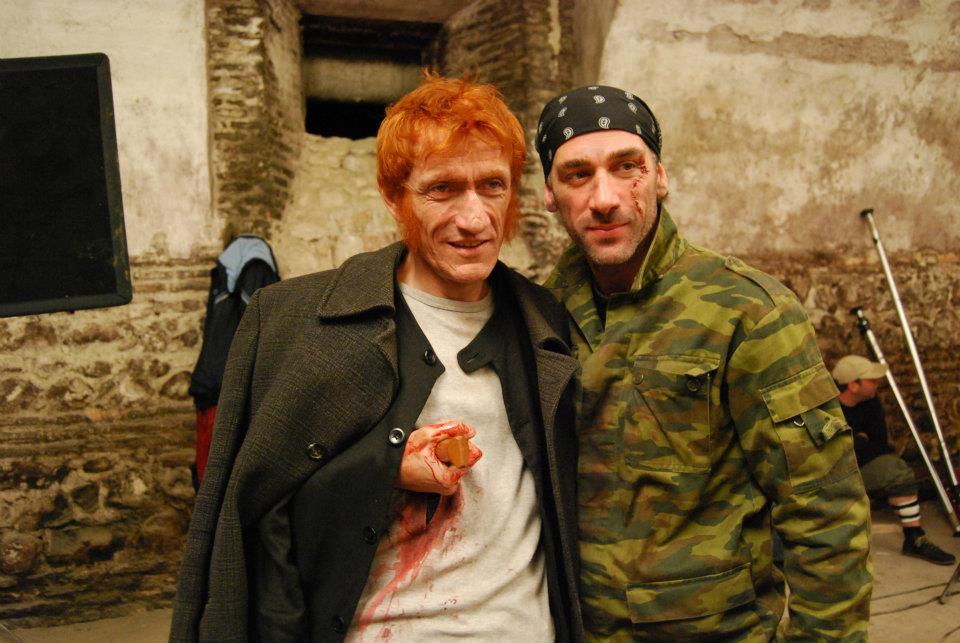
The main character of the film, Rene Dadiani (Niko Tavadze) teaches young people directing, while also works as a gas cylinder carrier, which allows him to meet different people, representatives of different layers and sections of society. To discover unknown layers of life. Gradually, he observes everything and records it with a movie camera. These shots and strange visions independently of him move into new dimensions and create a new time-space layer - in Rene's imagination or in reality. However, all this may be one and the same.
Life in the film flows in a usual, monotonous way. The life of society is not remarkable in any way. Then this solid and equal-link chain begins to break, but unnoticeably for others. Only for Rene.
What is Rene looking for - himself, does he want to meet his ancestors and solve their mystery, to understand the past or to evaluate the present? His mind, imagination, universal memory "feed" from the past - from the materialization of historical facts that once happened or the revival of old photographs; from what is happening and from what can happen. Or he might be looking for a way where there is none and is looking for a way out of a dead end that seems to have no end?!
He is trying to break through the solid wall of time and space, behind which (as in the present) many dangers await, where permanent mines are planted, which, with each new door being opened, explode one after another.
And the world is inhabited by "monsters," whom Rene calls "Yahoos" and who physically reflect the bottom of society, and in general - the state of spiritual decline and degradation. The Yahoos have taken over the city and are coming to the streets, gradually multiplying. They have also come a long way, their existence on Earth and in the imagination of people counts centuries.
In Jonathan Swift's "Gulliver's Travels," in the land of the Houyhnhnms, there live Yahoos - human-like, faceless creatures who lack spirituality. This is quoted in the film "The Yahoo Caste" by Aleko Tsabadze, which is arranged in a system of quotations (direct or associative) characteristic of postmodernism.
The past is a reconstruction of Ilia’s murder. As Rene sees or imagines the road - from Tsitsamuri to Saguramo and the tragedy of the nation that occurred on this road. The murderers are Yahoos.
It is against the Yahoos and injustice, violence, and existence without spiritual values that Rene begins to fight; perhaps with windmills or with himself or with that "Yahoo" who has unnoticeably "settled" in him.
The internal struggle escalates into physical "war" actions and becomes a metaphor for the wars that happened. Rene is alone in the fight against the world. The war is within him. Rene fights to fulfill his mission - to change society, the environment and eliminate violence; so that there will be no war. A pacifist's war for peace!
Rene's choice is to break through the wall of time by strengthening his imagination to find what once was and to find the reasons for what happened in society, why he lost his spirituality, or what is happening to him personally...
Rene is like Hamlet, as “cursed spite made him set right the time which is out of joint," to restore the spiritual balance that once existed in the world. He tries to restore the inner balance that always slips out of his hands and at the same time tightly binds.
Here, two times and worlds exist in parallel, but they are dependent on each other and mutually derived, therefore, strange as it may be, they often intersect and eventually converge at one point.
Jean-Paul Sartre writes in "The Hermits of Altona:" "It is impossible to escape from one's own prison," and Rene remains in his own captivity. He wants freedom, escape from himself, and becomes a victim of the impassability, because the walls he built himself turned out to be the most solid and insurmountable. Breaking through the barriers of time and space was not as difficult as overcoming internal contradictions and discovering new and unexpected beings in himself.
A continuous, infinite circle completes one cycle, but nothing ends. Nothing changes in the world, even from the end of the film to the beginning, from the time when Rene first stepped into a new space, which is either imaginary and illusory, or reality. There are many question marks here and, in fact, unanswered questions that first arise for Rene, and then for the viewer.
What is this strange “game” - between imagination, reality, the past, documents (the film is a peculiar interpretation of more than one real story or the story of a historical figure), fiction and mystical (unknown) functions - Rene's adventure, or the fruit of his shaken (excited) mind, phantasmagoric visions? Is the border - the edge of madness, or - the dividing line between the present and the past, reality and fiction, the conditional and the real - in a contradictory journey of knowing oneself and society, the essence of the world?
What happened in the past effortlessly flows into the present. Then, as if everything that happened a short while ago disappears without a trace, and when you, along with Rene, begin to think and almost believe that it was all a fantasy or a dream, the main Yahoo appears again - Vatsa Lertsmiseli (who was supposedly killed by Rene for his violated dignity a short while ago) and begins with his "killer” to feed seagulls.
This is precisely main in Aleko Tsabadze's film - an invitation to travel to a foreign land and the right of choice left to the viewer. And if we still don't see anything reliable, we can at least think about the fact that "Rene Goes to Hollywood" seems to be searching and ripping out from the deserted world the individual islands of the human soul that God has still preserved, that haven't yet sunk into the animal state and are trying to survive morally... However, this as well as Rene's going to Hollywood are just his wish and a useless illusion.
Lela Ochiauri


