
Georgian short films often manage to say more than films with big-budgets and long runtimes. Sometimes just a few minutes are enough to make a viewer immerse in thought. To let them think about questions that have no easy answers. Such is exactly Giorgi Ubilava's short film, "Beyond the Bars" (2023).
This is not just a film about revenge. In fact, this is a story about people who have spent years tormented by their conscience and thinking about revenge, but when there finally arrives the moment they have been thinking about for years, nothing no longer seems as simple as they could imagine.
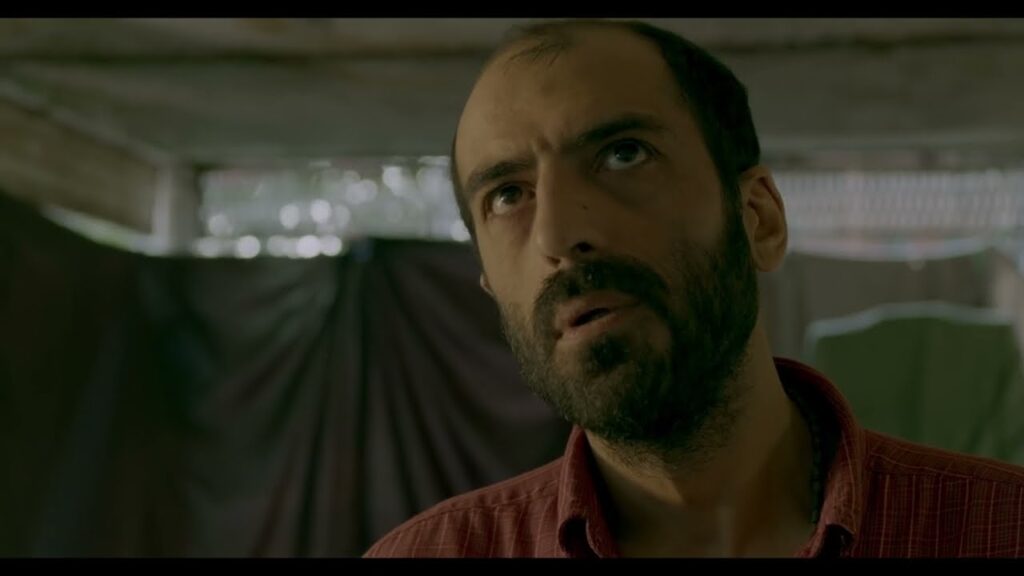
The main character of the film is Gia (Davit Khakhidze), a man who leaves jail after several years of imprisonment. From the very beginning, the viewer feels that he has only one goal left in his mind. He goes straight from prison to the house of the man (Vakho Chachanidze) who killed his son. It is interesting that the director does not even give him a name. This character seems not to be a specific person, just a "murderer." Sin, crime and pain are combined in one name.
The film creates a tense atmosphere from the very beginning. Gia's silence, the expression on his face says much more than the dialogue at their first meeting. It is easy to guess that this encounter will not end peacefully. When the killer asks the very first question - "Have you arrived for me?" it is already clear that he has accepted his own sentence. He does not try to escape or justify himself. Most of all, he is afraid for his young children.
The most powerful moment is the episode in the field. Two people stand face to face - one who has come for revenge, the other awaiting his own punishment. The killer's words become the main idea of the film: "There is no need for cold walls at all, if the mind, blinded by the darkness, thinks of nothing more than the past." This phrase seems to sum up the entire film. The director points out that a person may not be in prison, but remain a prisoner of their own conscience. Their mind, pain and life stuck in the past have proven to be a much harsher prison cell.
While watching the film, the words of the prayer come to mind: “Forgive us our trespasses, as we forgive those who trespass against us” (Our Father). It is very difficult to fulfill these words in reality. Especially when it comes to the murder of a child. The film makes us think about exactly this - is there such a force that makes a person refuse to take revenge? Is forgiveness possible when the pain never completely disappears? Without God, it is impossible to do such a great deal.
Gia stands on this very edge. Throughout the film, it seems that we are waiting for the sound of a shot. The director deliberately leaves the audience in a tense state of expectation of revenge but Gia leaves, the bullet does not fire. This scene has a particularly strong effect. Not because it is unexpected, but because it is human. Gia can kill, but no longer does it. It seems that he finally realizes that he cannot erase his own pain by killing. He may even find himself in even greater darkness. The killer's family cannot bear the pain.
Chachanidze's character has the most interesting reaction. He desperately chases Gia. It seems that death was easier for him than the continuation of life with the burden of his own guilt. The audience realizes that both people are prisoners in reality, one that of revenge and the other of crime.
The ending is very symbolic. The killer's children gather at home with a cake, the cake that Gia's friend bought to celebrate his freedom. This, at first glance, is a small detail, but it carries a huge meaning. The cake that marked freedom, ended up with the children in the end. The director seems to be saying that true freedom lies in saying no to revenge.
"Beyond the Bars" lasts only 12 minutes, but it follows you in thought for a much longer time. This is the greatest power of short films, to be able to excite a person in a short time.
Today, many directors try to load the film content only with length or noisy scenes. It seems that two hours, a lot of dialogue and an overly drawn-out plot are necessary. Ubilava's film proves the opposite. The running time does not necessarily have to be long. The main thing is to say what you have to.
“Beyond the Bars” is exactly such a work. It is moderate in almost everything: in emotion, dialogues, music and the actors' performance. They do not use excessive theatricality. Even their silence is emotional. Especially the murderer leaves an impression. Constant fear and a sense of guilt are visible in his eyes, while Gia's character is completely closed in on himself, which makes his pain even more intense.
However, despite the strong idea and emotional impact, the film also has problems. The biggest drawback is the lack of plot details. While watching, there are too many questions that arise, but there are no answers - why was Gia in prison? Why wasn't the murderer in prison? What was the reason for the murder in the first place? How did this tragedy develop? These questions were important for us in order to fully understand the characters’ pain. Perhaps the director deliberately wanted to leave everything unspecified, but in some cases this gives the film an incomplete look. The viewer is unable to fully engage with the story, because the past remains vague.
Another serious problem with the film is the sound quality. Several phrases are heard unclearly, which is especially problematic in a film like this. When the work is based on dialogues and emotional load, every word is important. The viewer should not miss phrases that can be the key to the main idea of the film.
Problems with the cinematography are also noticeable. In some scenes, everything develops too quickly. The shots change so much that you can't understand the emotion. The film needed a slower pace. More time on the characters' faces. Especially in those moments when the struggle between revenge and forgiveness is taking place. Since the main strength of the film is emotion, the camera solutions should also serve to deepen this feeling. Here, sometimes the impression is created that the director is trying to tell the story quickly and lack emotional pauses.
Despite these faults, "Beyond the Bars" still manages to fulfill its main goal, to make you think, and perhaps this is the purpose of real cinema. The film may not be technically perfect, but if a person starts thinking after it ends, this is already a victory.
That is why the title of the film is very accurate - "Beyond the Bars." Bars do not only mean prison. A person can be outside and still live in his own pain. He can walk freely, but the past can destroy him.
The film also reminds us how difficult it is to forgive. It's easy to talk about forgiveness in words, but in real life it seems almost impossible. Especially when it comes to your child. You have to be a very big person not to shoot your child's killer, let alone look at him, and yet, Gia manages to do it. Perhaps not completely, but at that moment he refuses to continue the evil. It is this moment that turns the film from a simple crime story into a human drama.
The biggest problem often lies in society itself, which teaches a person from childhood that forgiveness is weakness, and revenge is strength. Especially in our reality, where humanity is often equated with aggression, harshness and revenge, it is very difficult for a person to choose forgiveness despite the pain. There is still an opinion in society that if you do not take revenge on someone, it means that you are weak, afraid, or have lost your dignity. It is this attitude that is the most dangerous, because it keeps people in a vicious circle. One revenge is followed by another, a third, and in the end, no one thinks about where it all ends.
In reality, forgiveness requires much more strength than revenge. An angry person can easily take up a weapon, but it is much more difficult to overcome oneself. When the pain burns you from the inside and the whole world pushes you to take revenge, at that moment you refuse to do evil, this is true strength. Forgiveness does not mean forgetting or justifying what happened. This means that a person does not allow himself to fall into the same darkness that destroyed others.
In today's Georgian cinema, where we often see the same topics in the form of romanticizing cronyism, crime, violence and drugs, “Beyond the Bars” seems like a pleasant exception against this background. Giorgi Ubilava's film does not try to captivate the audience with artificial street dialogues or aestheticizing aggression. On the contrary, this is a film that focuses all attention on a person’s inner state. Its main strength lies precisely here - it is built on human emotions. On pain, regret, feelings of guilt, forgiveness and the internal struggle that a person goes through with himself. The characters here are not idealized “good guys” who prove their truth through violence. They are ordinary people who live with the burden of their own mistakes and the past. It is also especially important that the film does not show us revenge as heroic.
Art is not just entertainment, it can have an impact on society, change people's thinking and make us think about problems that we no longer notice in everyday life. The main purpose of the film should be exactly this - to convey the right message to the audience. Cinema is a very powerful tool, and using it only for shock, noise or cheap propaganda diminishes the importance of art. Real art makes a person think, looks into himself and changes for the better. That is why instilling the right ideology in art is one of the greatest responsibilities and at the same time the greatest task.
Teona Vekua


