
Modern Georgian cinema has increasingly been trying in recent years to tell the viewer not only an interesting story but also to make them think. The main thing in these films is often not the action, but a person’s environment and inner world. Among such directors is Aleksandre Koberidze, whose films differ from traditional narrative cinema. His works are distinguished by a slow pace, poetic shots and a special atmosphere. Koberidze does not try to explain the viewer everything directly. Conversely, he leaves some space where each person can understand the film from their own viewpoint.
“Dry Leaf” (2025) is just such a film. At a glance, the plot is very simple, but the more the action develops, the more it becomes clear that the director does not want to tell only the adventures of a lost son. This is a film about lost people and vanished places, about how the world changes in a way that sometimes we do not even notice.
The main character of the film is Irakli. He works at a University of Sport and leads a quiet life. One day he receives a letter from his daughter, Lisa, who writes that she is leaving home and asks not to search her. Naturally, the father cannot tolerate this. The police say that Lisa is an adult and since it was her will to leave, they cannot start the search. After that, Irakli decides to look for his daughter himself.
During the journey, he is joined by Levan, a journalist who used to work with Lisa. Together they have to visit different villages of Georgia, where Lisa used to film abandoned football fields. Initially, it seems to be an ordinary journey, but soon the viewer realizes that the film is more about a person’s inner state than a real story. One of the first details that attracts your attention is that some characters are not visible at all in the film. At first, this may even seem strange. Irakli talks to a person who is not visible on the screen, shakes the hand of someone whom the viewer cannot see and seems to be sitting alone in the car, although actually, he has a traveling companion next to him.
The director warns us from the very beginning that not all characters will be visible in this world. One of the most interesting aspects of the film is precisely the invisible characters. In contemporary cinema, the viewer is used to everything being shown clearly on the screen. Koberidze violates this rule. He makes us believe in the existence of people whom we cannot see at all. In the beginning, this seems strange, but gradually this method becomes natural. The viewer no longer expects all the characters to appear in the shot.
Accordingly, the director reminds us that many things in life are invisible. For example, we cannot see memories, but they are with us; we cannot see the past, but it still affects our present life; we also cannot see people who are no longer with us, but their traces still remain. That is why the invisible characters in the film are not just the director’s experiment. They are part of the world that seems to exist, but gradually vanishes.
Irakli's journey is no longer just a search for his daughter. Gradually, this path turns into a process of self-perception. Every new village, every abandoned field, and every accidental encounter gives him new ideas. It's as if the path has more meaning than the final purpose.
During this journey, showing the villages of Georgia becomes especially important. The director does not show us a touristy, beautiful and ideal Georgia. Conversely, the camera lens captures abandoned houses, old roads, empty fields and football pitches where almost no one plays anymore. These places are not just decorations. They themselves become characters.
Football pitches are one of the main symbols here. At first glance, they are just fields but in reality they are part of people's lives. It was in such places that children grew up, played, made friends, and created memories. Now, many of them are empty. In some places, the goal posts no longer stand, and in others, the pitch no longer resembles a football field at all.
While watching the film, you often wonder whether Irakli will find his daughter but after a while, this question becomes secondary. What is more important is the journey itself, the people they meet, and the feeling that accompanies the film.
Finally, it becomes even clearer that the topic of disappearance does not only refer to Lisa. In reality, everything that is dear to a person disappears. Lisa writes in her last letter that she did not want to see the demolition of University of Sport because she knew how painful it would be for her father. This episode clearly shows that sometimes a place is not just a building. Years, memories, people and important stages of life are connected to it. When such a place disappears, a person seems to lose part of his own past.
There is an episode in the film when Irakli asks a little boy where they play football. The boy calmly answers: “Everywhere.” This, at a glance, is a very simple answer but it is precisely in these words that one of the author’s main points is hidden. The fields may no longer exist, but the desire to play still remains. Spaces may change but no one can erase a person’s memory.
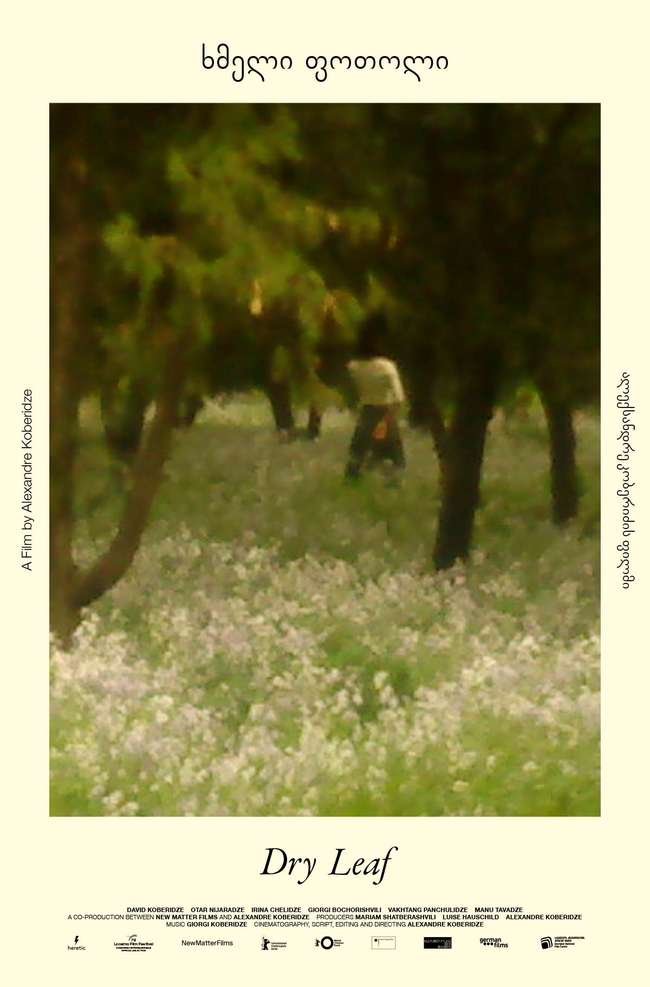
The visual aspect is also very interesting. Koberidze deliberately uses low-quality images. Today, when almost all films are shot in high definition, such a decision is unusual. At first, one might think that the image is simply poor quality but in fact, this is the director’s considered choice.
This kind of image reminds us of old video recordings. It seems that we are watching footage taken years ago that has faded over time. Thus, the film is more like a memory than a real event. Sometimes the footage is so blurry that it is difficult to distinguish details but this blurriness creates a special mood.
The depiction of nature also deserves attention. We can often see trees, fields, mountains, animals, dogs, cows, horses in the film. They are not just part of the environment. Sometimes the director seems to look at them with the same love as he looks at people. The camera is not in a hurry. It gives the viewer time to observe the wind, grass, leaves and the calm movement of animals. One feels great love for people, nature and everyday life. The director seems to say that while we notice all this, the world has not completely disappeared.
Although “Dry Leaf” is built on interesting ideas and stands out for its distinctive cinematic language, the film also has several aspects that can be problematic. The most striking of these is its very slow pace. Many episodes in the almost three-hour film are similar to each other. The characters often repeat the same actions – moving from one village to another, talking to locals and looking at abandoned pitches. Sometimes it seems that the film repeats the same idea several times, because of which weakens the dramatic tension.
The use of invisible characters is also an interesting idea, although it will not be equally convincing for all viewers. This technique certainly arouses interest at the beginning, but later it can leave an artificial impression and distance the viewer from the characters rather than bringing them closer.
In addition, we have very little information about Lisa in the film. Even though the entire plot is built on her quest, the viewer hardly knows her. Thus, it may be difficult for some to establish an emotional connection with the character around whom this whole story unfolds.
The visual style can also be arguable. The low-quality image is the director’s deliberate choice although sometimes it is so blurry that it shifts attention from the content to the technical side. Some viewers may feel that this form dominates too much and overshadows the plot itself.
The film’s experimental form, slow rhythm, and minimalist narrative require patience and special concentration. Therefore, despite the interesting ideas and original film language, it will not make the same impression on all viewers.
In Aleksandre Koberidze’s films, it is often difficult to tell where reality ends and imagination begins. “Dry Leaf” is a clear example of this. Sometimes the viewer wonders whether everything he sees really exists. Finally, another question may arise – do we even see everything that surrounds us? We might become so accustomed to our environment in everyday life that we no longer notice what is slowly disappearing. The author reminds us that the most precious things to a person are not always people. Sometimes places also have special meaning: the street where we spent our childhood; the school where we studied; the stadium where we first played or the building where we worked for years. When such places disappear, a part of our lives is lost with them.
The director also pays great attention to silence. In contemporary cinema, a dialogue often explains everything, but with Koberidze, silence sometimes says more than words. The characters stare at the road, nature, and empty squares for a long time. The viewer is also forced to follow this silence. It may not be comfortable for everyone, but it is in this silence that thinking begins.
The actors' performance is also noteworthy. They look very natural. There are no exaggerated emotions, loud monologues, or dramatic scenes. Everything develops calmly and realistically. Irakli, played by the unprofessional Davit Koberidze, is especially memorable. His performance is very realistic.
The cinematography is also one of the strongest sides of the film. Despite the low-quality image, the shots sometimes resemble almost an artistic canvas. The shots of villages, roads and fields are especially memorable.
The music is also used very carefully. It does not artificially enhance emotions but often only the sound of the wind, the chirping of birds, the sound of a car engine or the natural sounds of the countryside are heard. This further enhances the sense of reality and keeps the viewer in the world of the film for longer.
Based on all this, “Dry Leaf” is an important work in modern Georgian cinema because it speaks to us in a different cinematic language about such topics as time, loss, memory and the connection of man with his environment. It is not an easy film to watch, but it leaves the viewer with many questions and this is precisely its main value.
Teona Vekua


