
Everything in this world, like a stick, has two ends. Human life as well is a path within these two invisible points - the beginning and the end. It is a path one chooses which becomes decisive. This eternity is also evidenced by the fact that artists return again and again to this inexhaustible topic, striving to show it to us from a fresh perspective and make us rethink. ...
I always look forward to Nino Basilia’s films with great interest, due to their individuality and unexpected nature (I have even written reviews of her films “Anna’s Life” and “Person No. 2”). There is no foundation for this. Nino Basilia is not only a filmmaker but a writer, playwright, theater director too and the author of several television projects; she is interested in Eastern and Western philosophy as well as Buddhist texts, and has traveled around India and Nepal - the trips she experienced as psychological journeys. Afterwards, she felt not a desire but a necessity to talk through cinema about the sensations, thoughts and emotions connected with life and death; this led to the creation of the feature film “Phase” (2026).
For this purpose, the author has chosen the story of a young man named Aleksandre (Sandro Mikuchadze-Ghaghanidze). Abandoned by everyone in a vast world, the main hero is gripped by fear: "He is afraid of existence, afraid of doing anything as well as afraid of actually doing something." In order to overcome this difficulty, he must pass through a phase as a result of which it is possible to start life anew. The author offers us precisely such "journey" along with the character.
Aleksandre lives afar from the city leading an ascetic life in an empty hotel. Plagued by childhood traumas and numerous disappointments, he has lost the sense of purpose in life and contemplates suicide at times.
One day, a young girl named Lila (Teo Kiknavelidze) knocks on Aleksandre’s door; she attempts to convince him that she is his materialized feminine initial – "Yin" - while he represents "Yang." According to Eastern philosophy, Yin and Yang constitute the harmonious unity of the universe's two opposing energies: the feminine and the masculine. Lila promises to help him rediscover his lost joy and the purpose of life, provided Aleksandre joins her on a journey through a conscious dream.
The protagonist of the film accepts this offer, realizing that he is settled in the realm of material existence and the time has come to move beyond it. He is assisted in this by his own alter ego - manifested as a woman - who invites him to discover his true self and leave past pains behind through an astral adventure.
The female name "Lila" is a multifaceted symbol; in ancient Indian traditions, it signifies illusion or divine play. This suggests that she becomes a guide for Aleksandre, revealing how he can keep his steps with the divine order of this cosmic dance. Aleksandre comes to realize that life is a conscious journey toward death - one that he should meet prepared. As a result, a new vision of the universe structure, a thirst for knowledge and an interest in new theories awaken within him.
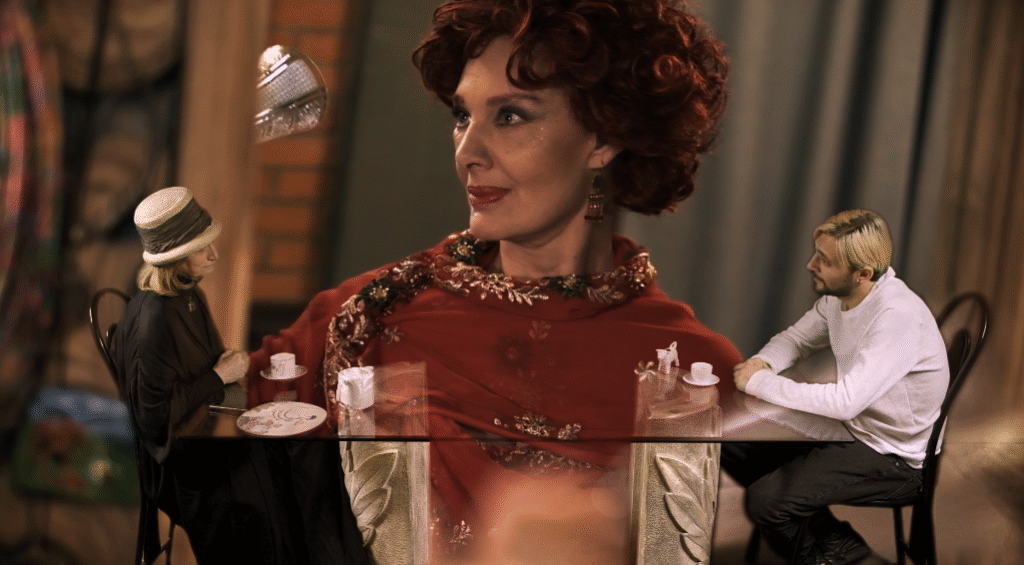
Aleksandre considers that he has nothing left to lose and accepts Lila’s proposal. On this metaphysical journey, he encounters the spirit of his late grandmother (Darejan Kharshiladze), engaging in a dialogue that becomes an existential exploration for the protagonist. Grandma’s image answers his most tormenting questions: where God is, what is hidden beyond death, what the soul’s immortality means and what his own true identity is. Grandma helps him realize his place within this closed circle - a "submarine" from which escape is impossible and where the only salvation is in an encounter with one's own self.
On the way of self-discovery, the main character is granted the opportunity to return to childhood. He seizes the chance to delve into the deepest, most hidden layers of memory and confront the traumas that have shaped his present. Through this mystical and emotional reconstruction, he reaches a pivotal decision: he begins to conceptualize the past and forgive himself.
Before making this film, Nino Basilia first wrote a screenplay for a short film based on Ilia Chavchavadze’s “The Hermit” and this inspired the creation of the feature film “Phase.” This connection is no coincidence. Like “The Hermit,” “Phase” centers on topics of spiritual purification and inner awakening. In the former, the intrusion of the feminine principle into the monk’s secluded world triggers a profound transformation. Similarly, in “Phase,” Lila’s appearance - representing feminine energy—acts as the catalyst that compels Aleksandre to step out of the "cell" of his fears and confront his true choice. In both instances, the female figure serves as a catalyst - a transformative force that draws the protagonist out of their habitual state and makes them confront their true nature.
Another intriguing figure emerges in Aleksandre’s isolated daily routine with Lila: it is his transcendental nanny, Androida (Tatuli Dolidze). Like an invisible specter, she constantly hovers near the protagonist, observing his complex psychological transformation.
It is also worth noting that the film is rich in symbolism. One such central element is a mysterious door that Aleksandre opens with Lila’s help, finding himself in the cosmic library of the universe. This is “Akasha” - an energetic-vibrational space known in esotery where all-encompassing information about the universe and human destiny is stored, and where every question has an answer. "Here lies the story of your soul," he is told.
Thanks to Akasha - the field of inexhaustible knowledge - Aleksandre realizes that he must walk his own path, a journey that will ultimately lead him to spiritual peace and his true purpose. In its metaphysical essence, the "path" stands as the most significant symbol of the film. Like a motion of a quantum mechanism - it seems to bring Aleksandre back to the basic, true reality, being lost amidst dreams and fears.
There arose a question in an interview with the director: to what extent is the audience prepared to receive such a profound and complex work? I believe that for art lovers, reflection and analysis are constant companions. Nino Basilia answers this question in the following way: the film is a psychological drama which deeply explores the characters' inner worlds and invites the viewer into a realm of free thought, where reflection and judgment play a pivotal role in shaping the protagonist's future.
In other words, the director does not leave the audience as mere observers but draws them into a space where the film demands active engagement - where the viewer must discuss the hero's actions, as if personally participating in the choices that determine Aleksandre's future.
The film’s bold visual language and graphic approaches deserve special mention. The filmmaker possesses a masterful command of modern technologies - skills acquired abroad - which are frequently and creatively employed in her work.
Although the author of the film defines the movie as a psychological drama, its profound symbolism and allegorical nature also give it the quality of a parable. The visual language of the film expands the realm of imagination, while the dialogue and text command do not let viewers to lose their attention. To encapsulate this synthesis, I would like to cite a famous quote by Ingmar Bergman, in which he draws a direct parallel between cinema and music: "Everything in life is based on rhythm, and when we create art, we must sense the inner rhythm of the work we are engaged with. At the same time, we need a precise understanding of what we are meant to think and feel—whether it be an action, a melody, a tonality, or the rhythm itself!"
Here, another great film director, Andrei Tarkovsky is worth mentioning; in his film “Stalker” the guide - the main character - leads people into a kind of "purgatory," a place where their decisions and true choices are determined. In “Phase” too, the main hero finds himself in such an inner zone, where he must make a choice that defines his very essence.
Through the significant figures introduced in the film, the author reminds us not to approach existence with an oppressive solemnity; that pain, joy, success, and failure are all part of the game and that we should maintain an inner lightness regarding them - as, consciously or instinctively, there comes a phase of awakening, discovering one's own convictions in a person's life.
In general, the grandmother’s image in cinema is no accident; she is often associated with unconditional love and a moral compass. With her help, the main character is meant to return to simple but fundamental truths - truths forgotten among the chaos of daily life, past mistakes or societal pressure. That is why, at the end of this film, it is the grandmother’s advice that leads the main character towards an unknown new life, in the direction wherever his eyes might take him.
Nana Tutberidze


