There are realities which are so familiar and daily that their injustice becomes unnoticed. We are no longer surprised by a woman who spends the whole day in the kitchen, does everything for her guests and only she stays alone with the leftovers on the table in the end. We are no longer surprised by men who sit at the table light-heartedly, drink wine, propose toasts, and forget the existence of that one who prepared it all for them. It is precisely this normalized, everyday reality that Mariam Bitsadze’s student film “The Feast” (2022) depicts but the most alarming is the fact that she offers nothing that is unfamiliar to us.
The main character is Neliko – a traditional housewife whose day begins when she goes to the market and continues with the preparation of meals. She tries to make the table as aesthetically pleasing, delicious, and well-arranged as possible. She does everything herself, yet no one seems to notice her exhaustion in the process. Conversely, this occupation is perceived as so natural that her existence as well gradually becomes invisible. Exactly one of the film’s central ideas lies in it: the more perfect the table laid by Neliko is, the more invisible she herself becomes.
In the evening, the guests are greeted by Neliko’s husband, who is not seen on screen until their arrival. He seems to be the primary host of the household, the family’s representative and its "pillar," while the woman who has spent the entire day working to prepare the feast, remains out of sight. This small detail speaks volumes about the roles assigned to men and women within the family and society.
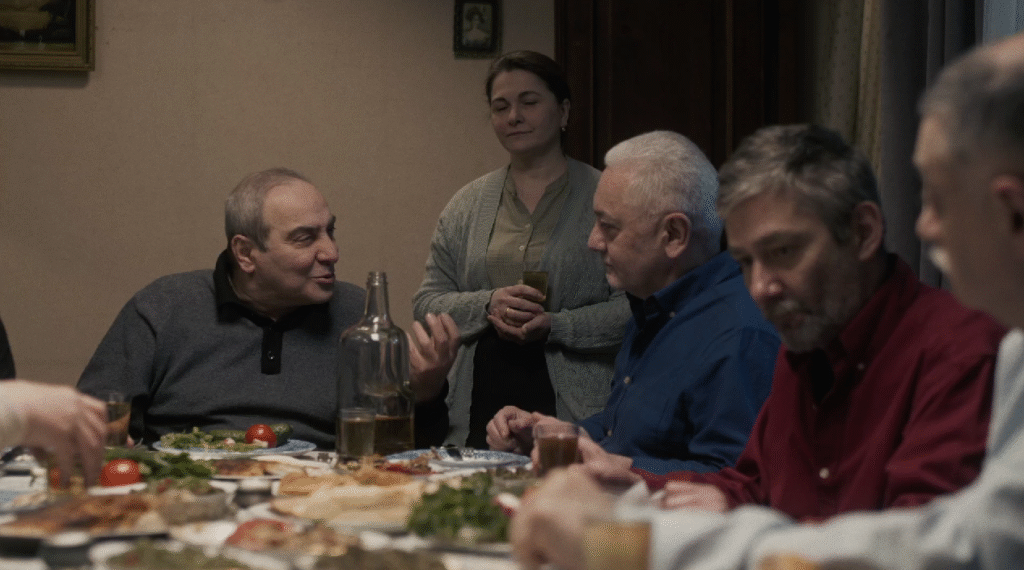
Then the feast begins with wine, toasts, laughter, and gossip. The guests discuss and criticize each other’s acquaintances. Such conversations may seem entirely pointless, yet they have become an essential part of the culture of the Georgian feast. People don’t ask one another how the host is doing; instead, they ask who else they might talk about. Meanwhile, Neliko is busy fussing about in the kitchen.
One of the most significant moments occurs when someone asks that they should wait for the person who prepared everything. This question momentarily disrupts the unspoken rule that defines Neliko not as a participant in the feast, but as the labor force behind it. However, the answer is cold and simple: for the guests, hot dolma remains the priority, and the feast continues.
This scene evokes discomfort in the viewer because we perceive something that those sitting at the table seem to overlook: the person who prepared the food and toiled all day is not even sitting among them to rest. The guests eat, drink, and offer toasts, while Neliko continues to work for them.
Her fatigue gradually shifts from physical to emotional. The camera focuses intently on her face, and it is through these portraits that we perceive the character’s inner state. In Neliko’s eyes, one can see sadness, disappointment, and loneliness. It is striking that Neliko remains completely alone despite the house being full of people.
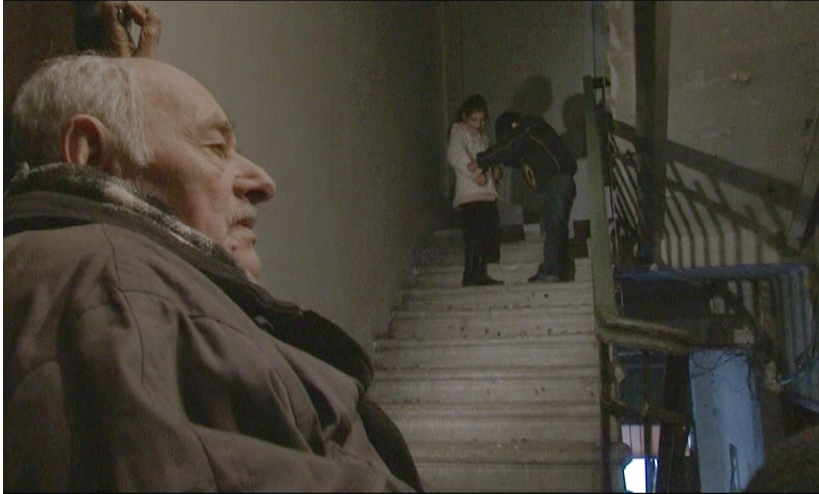
Neliko’s sense of isolation is further intensified by the attitude of her own family. At the end of the film, her son joins the table; it does not even seem to occur to him to approach his weary mother, check on her, or ask how she is doing. Like the guests, he simply requires the same things: a plate, a glass, and a seat at the table. This scene illustrates, with particular clarity, how an attitude is passed down from one generation to the next—one in which a woman’s labor is perceived as a natural, inherent duty rather than as work deserving of appreciation.
Consequently, “The Feast” is no longer just the story of one woman. The film creates a picture of a broader social reality. While Neliko may be one specific individual, her condition is familiar to many. As a mother, wife, and housewife, a woman is often so deeply tied to the act of caring for others that no room remains for her own desires, exhaustion, or personal needs.
The end of the film delivers the final blow to all of this. The feast is over. The guests have eaten and drunk. The toasts have all been made. Yet, it is Neliko who is left to clean up. Meanwhile, her husband, who had been one of the central figures at the table all evening, lies asleep on the sofa, dead drunk.
The most significant achievement of “The Feast” is precisely that the director does not explicitly tell the audience what to think. The film does not preach, nor does it attempt to neatly categorize characters as either "good" or "bad." It simply presents everyday life, leaving us to confront a deeply uncomfortable question: to what extent has all of this become normal for us?
And when, in the end, Neliko is left alone once more at the table that needs clearing, the heaviest part is precisely that her solitude is devoid of noise. There are no explosive arguments, tragic music, or dramatic monologues, just an exhausted woman, a scattered table, and a sleeping husband.
Sometimes, the most potent critique emerges when a director avoids explicit commentary, choosing instead to show us what we witness every day – compelling us to look reality straight in the eye.
The aesthetic quality of the film’s imagery is noteworthy; despite its raw, realistic subject matter, it remains a pleasure to watch. The visual design and the main character’s nature align perfectly with the aesthetic that is characteristic for Neliko. This student work captures a specific cinematic line, in which a reflected reality reminds viewers of their own life experiences.
Nana Mchedlishvili