Imagine opening a fridge and the bulb inside lights nothing but emptiness. Every evening, you count a small amount of change with trembling hands just to buy a loaf of bread. For most of us, this reality exists only in our imagination, who knows, some might not even imagine it at all. In parallel, there exists a social class who are so oppressed that might even exchange their problems for our daily complaints. Poverty often appear as a statistical data, a social problem or several minutes of a news program, though for a human being within it, this is a way of daily life. This might create the hardest aspect: the human does not exist in the condition of poverty only temporarily; instead, he learns to live within it.
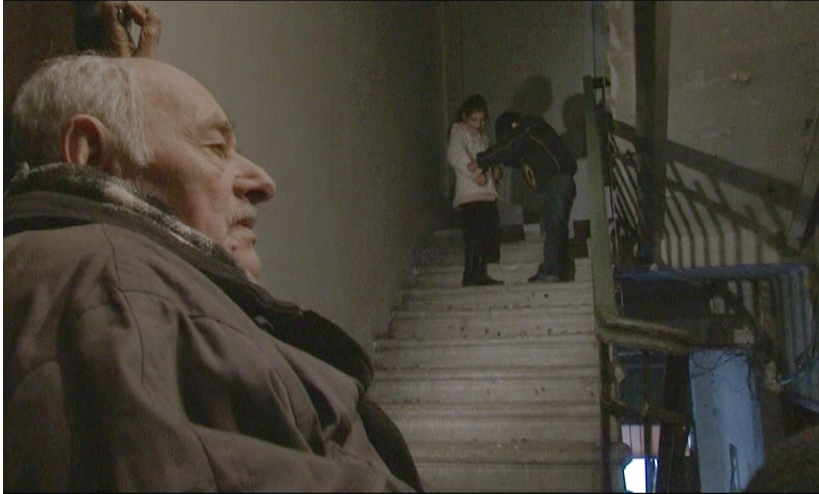
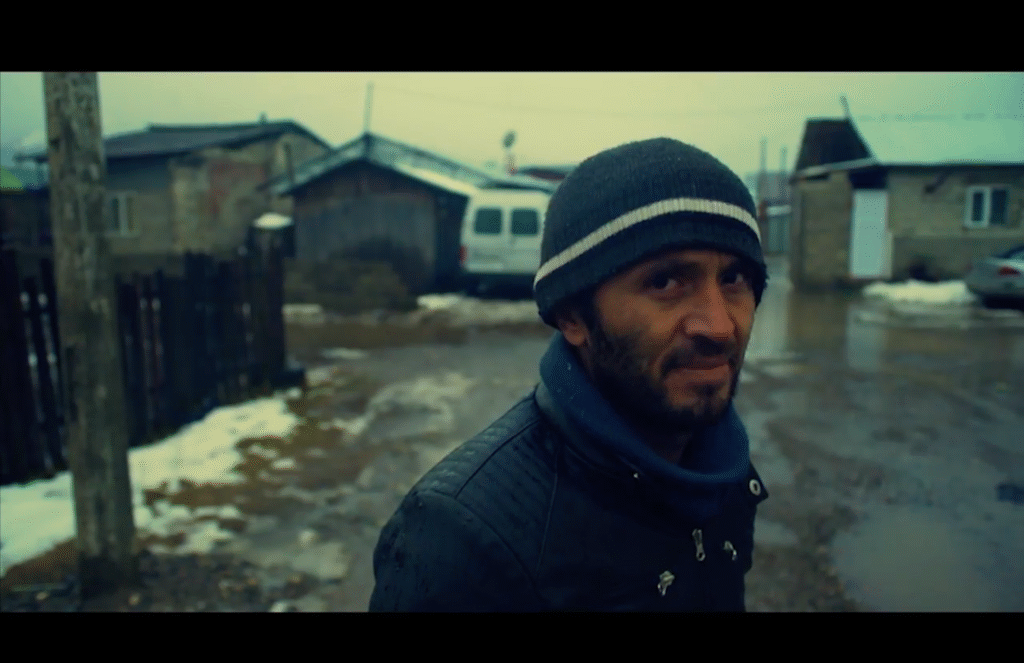
The tragedy of poverty lies in the normalization of existence. It seems that there is no escape from this life. Everything around is similarly bleak; faces are uniformly worn-out; houses, are all similarly melted away, consequently, the bitter truth of the environment has become deeply ingrained in the very flesh and blood of the mortal. In Natia Sharmiashvili’s student film “Silence” (2021), this condition is presented as a brutal state, in order to penetrate the comfort of our well-ordered minds. The film compels us to face what we might easily go past in our daily lives. A street, which we might simply call a "poor neighborhood," is presented by the director as a space of human existence, where each wall, face and room holds its own story.
The film is outstanding in this regard. The director’s camera focuses entirely on the impoverished neighborhood itself. The film starts with a long shot that follows an ugly street and finishes in the same manner; in between, there are close-ups of the people living there, devoid of any dialogue. Actually, the action unfolds without a plot. It appears that Sharmiashvili tries to revive the hardship condition for the viewer through moving images alone. Such a creative decision demands a great deal of boldness. While the scenes are clearly composed, the overall impact within this hybrid documentary-artistic style rests primarily on the underlying concept and the editing. Consequently, the significance of the film and the director’s talent here is either present or lost.
The primary challenge in this type of cinema lies in the director’s need to move constantly on the edge between documentary reality and an aestheticized image. On one hand, the camera tries not to intervene, but merely to observe. On the other, the very selection of a shot, its duration, the focus on people’s faces, and the way these elements are linked through editing – all of this is already the author’s perspective. It seems nothing is being said, yet it is precisely within this silence that the film’s message is created. The absence of dialogue in “Silence” is a decision, in which the characters no longer have anything to say since their existence is so repetitive and burdensome that words have become superfluous.
If we look at Alain Resnais’s acclaimed film “Night and Fog,” we can see that it presents the extreme limits of human cruelty through documentary shots. The film’s power lies precisely in this barbaric reality, which reaches the screen unvarnished. Similarly, the approach taken by the director of “Silence” is likely to cause in the audience – at the very least – to reflect upon and discuss the film’s tragic nature. However, there is a key distinction: in Resnais’s work, the scale of the historical catastrophe is already known, and the shots serve as a challenge to memory; whereas in “Silence”, the tragedy is of a more daily, mundane variety. There is no single, significant event to which these people’s hardship can be attributed. Conversely, the tragedy lies in the fact that nothing extraordinary happens at all. People simply go on living which is why, human faces in the film take on a special significance. They are not merely specific characters whose motivations we must understand or whose biographies we must study; rather, they become an expression of a particular social condition. Tired eyes, an stative expression, a silent gaze, and everyday movements create the impression that the camera is observing not just people, but the very image of poverty. This is precisely where the significance of the title lies: in "Silence," the individuals seem locked within themselves. There is an invisible wall between them and the rest of the world – a wall that only the camera can transcend.
Whether an idea and a "beautiful shot" are sufficient for a film is a separate issue for discussion. In any case, the gravity of poverty and close-ups of the subjects will exert an emotional impact, regardless of the overall quality of the film. Depicting hardship is, in itself, an "easy" lure for the audience's sensibilities. In a film of this nature, the key is to examine how effectively the director has managed to tell the story. A "meaningful" shot alone cannot guarantee the artistic value of a film. Otherwise, social misery risks becoming mere visual decoration – evoking a temporary emotion in the viewer that vanishes the moment the shot ends.
An ethical issue also arises here: where does the depiction of a person’s life end, and where does the aestheticization of their hardship begin? When the camera moves very close to a person’s face, the viewer seems to enter their personal space. While this might evoke empathy, it could simultaneously have the opposite effect – turning someone else’s misfortune into a spectacle. For this very reason, when evaluating such a film, we should not merely ask, "How heavy was what I just saw?" A more significant question is: what did the director do with this heaviness – did they prompt us to reflect, or did they simply arose our interest? Did they reveal a social problem, or did they merely toy with its aesthetic surface?
"Silence" becomes interesting precisely because it avoids offering a narrative explanation for this problem. The film provides no simple cause – and certainly no simple solution. There is no hero to change everything, nor is there a happy ending to suggest that escaping hardship is always possible. In this sense, the film’s realism lies in the stark simplicity of its hopelessness. Here, poverty is not an obstacle for a character to overcome; it is the environment in which the character already lives. Perhaps the greatest merit of "Silence" is that it prevents the viewer from perceiving the impoverished neighborhood merely as a backdrop. In conventional cinema, the setting often serves the characters; here, the opposite occurs – the environment itself becomes the main character. Dilapidated houses, empty spaces, nondescript streets, and tired faces unite into a single, grand portrait. Within this portrait, beyond the individual, one can discern an entire social stratum.
It is not difficult to make a film about poverty; what is difficult is depicting poverty in such a way that it does not simply become yet another familiar, tragic image for the viewer. “Silence” confronts this very danger through silence, long shots, and a persistent focus on human faces. We might debate whether these techniques are sufficient to create a fully realized cinematic work, but it is impossible to deny the sense of discomfort the film leaves behind. What is most eloquent here are the faces, the ones that have nothing to say, yet say everything.
Giorgi Bajelidze