
Times, eras, human consciousness, and mentalities in many cases may change too; yet, the fundamental character traits that have defined humanity since its birth remain constant. Some are born with a sense of self-respect, though others possess a slavish, sycophantic nature. Such individuals are prepared to get dispirited to the point of losing all human dignity by sacrificing their spiritual integrity for the sake of personal well-being. People of this type are constantly tortured with the thought of pleasing those of higher status; and if they may make a mistake in front of such individuals, they lose all peace of mind, become preoccupied by a sense of guilt, and fall into a state of panic.
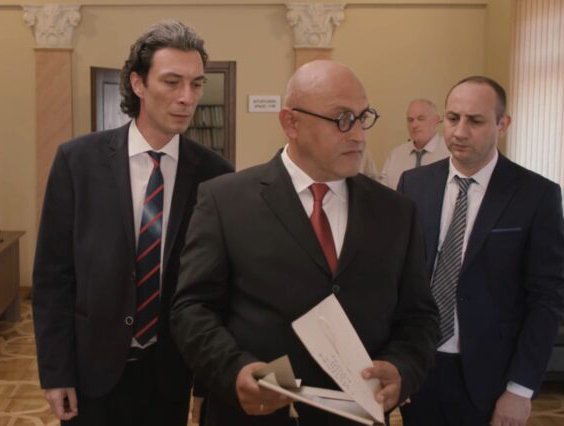
Mikheil Gabaidze’s short film “Vasomotor Rhinitis” (2024) based on Anton Chekhov’s satirical story "The Death of a Government Clerk" – remains highly topical today due to the issues it puts forward. Viewers can recognize in the protagonist (played by Davit Jaqeli) – who was "promoted to chief specialist just last month" – so many familiar (and perhaps some unfamiliar) types that once again they are reminded that the "feeble" character depicted in a 19th-century story still exists in abundance today. These individuals suffer from the same "disease" but within a completely different environment and in a different role type.
Just like Anton Chekhov, who was able to depict the greatest flaws of the human soul in a couple of pages – the film director as well perfectly captured the protagonist’s inner state, emotions, and the profound turmoil with conciseness and precision, that followed his "unforgivable" behavior in the concert hall during a symphony orchestra performance.
The characters are nameless in the film. The director refuses to give them names or surnames, a decision that immediately moves focus toward the generalization of the system and the individuals within it. It is only through the unfolding plot that the viewer realizes the protagonist – who accidentally sneezes and spits on the head of a bald man sitting in front of him – and the "victim" occupy vastly different levels on the social and professional hierarchy. Unlike Chekhov’s original work, where the high-ranking official’s status is directly stated, the film leaves the position of the man who was spat upon unspecified initially. The director masterfully illustrates his high status through a visual detail: the viewer can see his attendants fawning over him and helping him put on his coat in the concert hall foyer, a clear indication of his power and privilege. The characters’s identities are revealed only in the final credits, where we learn that the protagonist was promoted to "chief specialist" the previous month, while his accidental "victim" – a high-ranking government official – is "No. 69" (Zaal Goguadze); by designating him with a number, the director draws attention to the absurdity of the bureaucratic system.
The main hero of the film is so consumed by the stress stemming from his own "shameful" conduct that he can no longer continue his usual, peaceful life. Encouraged by his wife – who, like her husband, is characterized by sycophancy – he finds himself thinking about how to apologize once again to the high-ranking official even during sexual intercourse. While in the lavatory, he stands in front of the mirror posing and rehearsing the scene of his apology.
Such characters may outwardly appear to be experiencing genuine pangs of conscience; however, this is not conscience at all – there is nothing humane or dignified about it. Conversely, it is a slavish, fawning attitude toward those who stand above them on the hierarchical ladder. Such types of individual completely cast aside, trample their own personal dignity, leaving only material, snobbish, and anti-intellectual criteria as the sole basis for their self-assessment and perception of the world.
The character’s internal crisis and pettiness reach a level of profound absurdity when he attempts to justify his "crime" by citing a medical diagnosis: vasomotor rhinitis. He uses this physiological condition when arriving at work, a chronic inflammation of the nasal mucosa, where the body reacts disproportionately even to the slightest environmental irritant – as a defense for his actions when speaking to a high-ranking official, "No. 69." The director uses this diagnosis as a precise metaphor for the protagonist’s internal psychological state. The character responds to the outside world in a manner that reflects the symptoms of this condition: a trivial, accidental incident triggers a "psychological allergy" – manifesting as panic, fear, and stress – which ultimately leads to his death. The death, as depicted in both the short story and the film, can also be interpreted figuratively: as a metaphor for the total loss of personal dignity experienced by individuals of this nature.
The film’s narrative line also develops in an intriguing way. While the two individuals appear as complete strangers to one another from the very first shots, the subsequent scenes clearly highlight the hierarchical relationship between them. The scene involving a frantic dash down the stairs – followed by a desperate plea, in which the protagonist begs for mercy by citing the need to provide for his family – lays bare the flawed nature of the bureaucratic system. The director clearly portrays an environment where a cult of the superior, along with the subordinates' panicked fear, leads to the total atrophy of personal dignity.
This idea is masterfully realized through a visual metaphor: a turtle – which appears periodically on screen and is toyed with by the "traumatized" character – serves as an exact reflection of his inner state. Even a single-word reaction from his boss is enough to make the protagonist, much like the turtle, retreat into his own shell out of fear and absolute submission.
The visual aesthetics, dramaturgy, and cinematography directly highlight the character’s internal state, emotions, and feelings. In the scenes set in the protagonist’s home, the camera uses close, static shots that evoke a sense of airlessness and confinement. This filming technique masterfully creates a feeling of entrapment and isolation, which aligns perfectly with the protagonist’s inner state and the tense atmosphere within the family.
The composition of the shots within the apartment is so minimalist and devoid of a sense of space that the viewer can physically feel the psychological pressure weighing on the protagonist; the visual environment constricts his mind and body just as vasomotor rhinitis obstructs his airways.
Another notable feature of the film’s cinematic language is the use of mirrors: the protagonist’s face is frequently reflected in a round-framed mirror. Not only does this visual metaphor point to the character’s fragmentation and loss of identity – associated with the emergence of an "alter ego" – but also evokes the sense of a "fateful trap." While mirrors carry a wide range of symbolic meanings, in this context, they take on a lethal significance rooted in Greek mythology: Narcissus perished while gazing at his own reflection, and Perseus, in his battle against Medusa the Gorgon, countered her deadly stare by observing her image reflected on his shield. The protagonist, confined within the framework of his own fears and complexes, is unable to find a way out; the audience witnesses his end in the very mirror hanging on the wall.
The director conveys the protagonist’s inner turmoil and obsessive fixation in a sarcastic manner. The audience is initially struck by a moment of confusion when the protagonist, having arrived home, turns on the television and briefly glimpses an interview with a high-ranking official on the screen. Actually, this is a hallucinatory image – a product of the character’s deranged psyche – that now haunts him everywhere and in everything he sees. Simultaneously, scenes from the concert hall come back to life before his eyes, playing out on a screen mounted on the room’s wall. Nearby, in that "fateful" mirror, the face of the protagonist – who was promoted to "chief specialist" just last month – is briefly reflected; however, this reflection vanishes instantly, replaced by an alternative take on “The Son of Man,” a famous painting by the Belgian surrealist artist René Magritte. Unlike the original, in which a green apple obscures the figure’s face, the face in this version is entirely blank. This detail symbolically embodies the collective image of an impersonal society – an individual who, much like the protagonist, has completely lost their personal identity, dignity, and self-respect.
Ketevan Ghonghadze


