
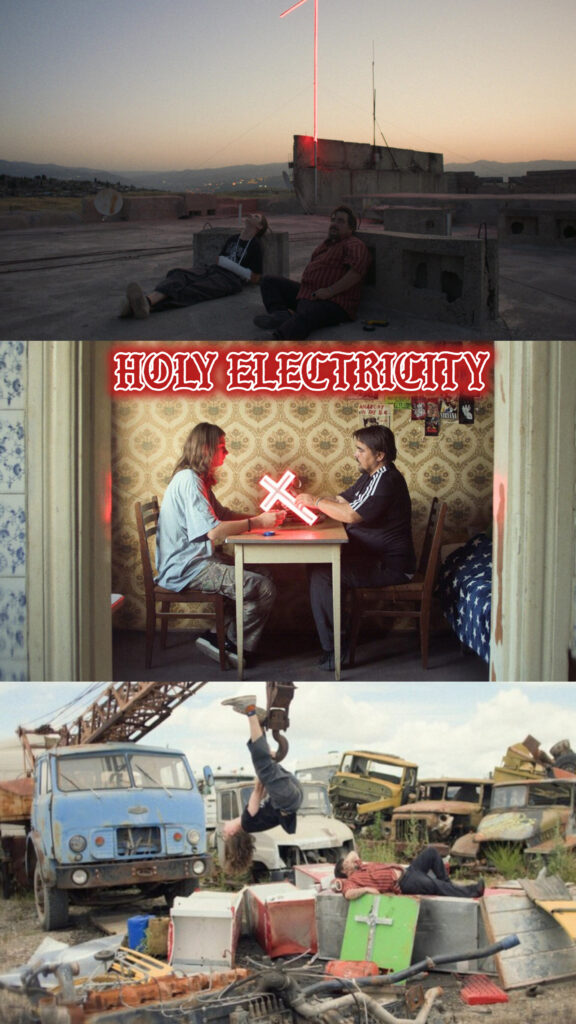
There are people for whom money is more important than the way they earn it. The symbol of the cross has been the most popular and best way to achieve this goal so far.
This ancient symbol was a guide for man, depicting the four cardinal points of the earth. Later, it temporarily became the main “scaffold” for those sentenced to death, which gave rise to the third and most important religious meaning. One might say that Christ crucifixion made a real transformation in symbolism in this regard because a means of punishment created by the enemy for the first time in history became the main accessory for believers throughout the Christian world. Constant design changes it has undergone turned into a kind of competition, who would create a more beautiful symbol. After millennia, modernity has reduced it to minimalism again, consumed electricity and created a neon cross, an object that will become the only source of income in the lives of the characters Bart and Gonga in Tato Kotetishvili’s film “Holy Electricity” (2024).
The young film director’s first major project is a real oasis in Georgian cinema with its aesthetics, cinematography and topics. The story unfolds between the cousins. A teenage boy’s father dies, after which his uncle, Bart takes care of him. Their source of income is finding and selling scrap metal and old objects. Their journey through this iron jungle is quite enjoyable. What makes this search and discovery fun is the fact that the characters themselves encounter and appreciate the “trash aesthetics” that they have around them. Such things rarely happen not only in Georgian but also in world cinema.
The environment for the characters is ordinary and unremarkable at such times but here we can see people posing near the Coca-Cola refrigerators, for whom it resembles a royal throne. There are also objects scattered around, some resembling swords and others resembling shields. In this way, the director interestingly explains their personalities, that they are not ordinary “merchants” but rather quite artistic people who realize that there is something beautiful here. That is why they find iron crosses that are important to them, then they handcraft, inexpensive, but real works of art – “neon crosses,” with which they earn a considerable amount of money.
The New Testament reads: ”Whoever turns a sinner from the error of their way will save them from death and cover over a multitude of sins (James 5:20).” The characters in this film are followers of this path. They try to make money with such a divine gift but involuntarily they also spread the name of Christ. All this happens without thinking, but at the moment of trading, the cross is not only an item for sale, but also a kind of doctrine, a reminder that a Christian person needs a cross, in memory of his deceased loved ones, or of the faith that has passed through time. All this is done not by classical missionary work but by offering a product that is full of life and color.
Such a subtext becomes even deeper when we hear the story of one of the film’s characters, Bart. All this does not appear in a single monologue or confessional text. The viewer learns all about this piece by piece. First, we hear the cousin's story that Bart chose pants instead of dresses in the childhood. Which sounds confusing at a glance, but then everything is revealed when his creditors hang him by his feet for not paying the money and read in his ID that he is a woman. They can't believe it, because everything except one thing they haven't seen with their own eyes reveals that he is a middle-aged man. The exposure of this character that he is transgender happens gradually. A party with transgender sex workers, conversations there with Gonga, although for the viewer everything becomes possible in that aesthetic surrealism, except for the fact that the uncle is biologically an aunt. For him, this is a natural thing. He himself says that God created him like this and he is comfortable with his situation, not struggling with the cross that the Lord has given him. He has never been burdened by it and has lived like a man and it seems that he is much more courageous than others.
The film is also visually very interesting. It can be said that the director's vision and perception of the shot are different from Georgian film culture. In our modern cinema, we often encounter gray, colorless, and often advertising-type shots, where the composition is made with jeweler's precision, although there is no telling what to say. In many cases, shots are created for beauty, not for storytelling. Tato Kotetishvili, who is himself a cinematographer, completely rejected this tendency in "Holy Electricity," He tried to make the shot not only beautiful and compositionally correct, but also to make each shot have a load to describe the characters or the story. We can say that the film is truly photographic in the substantive sense of the word, because we can cut out every shot like a photo and the narrative will not be lost if we put it together. The author built a compositional structure not in a pictorial manner, where there are many layers, calculated light and decor but stopped his choice on the street and natural lighting.
The only breakthrough of the film is in the final scene, where the story ends without any classical ending. The characters disappear for no reason, and the main characters are in a more uncertain life situation than they were at the beginning of the film. At a glance, the narrative was going to the point where we should see a positive ending in the lives of the cousins and their relationship, where both of them would be better off, but everything remains the same. Bart cannot pay his debts, and the teenage boy loses his gypsy girlfriend, with whom he was honest and open. His old girlfriend tries to flirt with him, but for the boy she is just a friend and nothing more. The only way out of his anger and resentment becomes a concert, where a large crowd of young people dance in a specific way. Due to such an ending, the film caused an ambiguous emotion – on the one hand, it seemed that the author sacrificed the characters for such an existence, and on the other hand, he indicated that such things happen in life and this is reality.
All in all, “Holy Electricity” is a significant step forward for Georgian cinematic reality. This film project showed that it is no longer necessary to spend time on the aesthetics of auteur cinema that have become standard and on the creation of the author’s personal experiences. It can be said with certainty that this film is a recent exemplary sample of what topic and style the aesthetics of Georgian cinema should be created on.
Saba Makharashvili


