
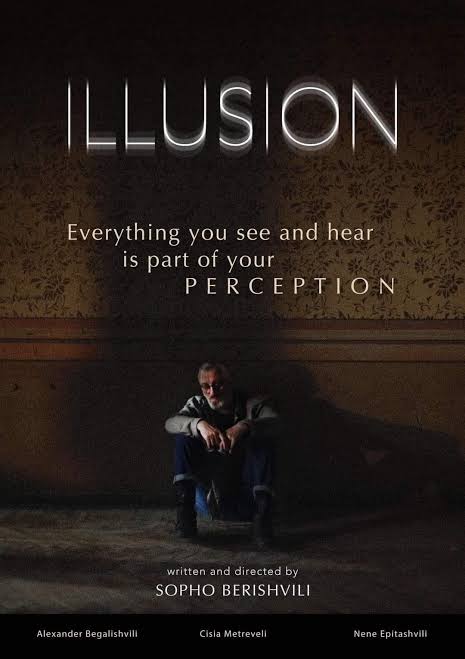
In recent Georgian auteur cinema, we come across more frequently with those directors who say no to classical narrative and build storytelling entirely on visuals. Sopho Berishvili’s short film “Illusion” (2024) is part of this experiment. The film offers minimalism from the very first shots, where there are no dialogues at all and human loneliness is shown in beautiful shots, but to what extent does this silence manage to convey real emotion to the viewer and where is the line between high art and artificially stretched shots?
As soon as you start watching, you get the feeling that time has stopped and everything happens very slowly. The director does not try to surprise the viewer with unexpected events or a detective story. The film is more about mood and shows what happens inside a person when he is left alone with his sorrow.
In the modern world, everything is developing very quickly. Information on phones and social networks changes in seconds, we are always in a hurry and can't notice anything. Sopho Berishvili seems to be consciously telling us to stop and not run away. She stops time and forces us to observe things to which we don't pay attention in ordinary life, for example, how sunlight enters an old room, how characters look at each other when they have nothing to say, or how they sit in the dark and breathe. This slow pace helps us to put ourselves in the characters' place. If the film was fast, we wouldn't be able to catch their feelings of loneliness and sadness.
The title of the film also expresses its content very well. For the director, an illusion is not a simple dream or fantasy. It is a lie that a person invents himself to make life easier. Life is often very cruel and painful. When a person finds it difficult to bear reality, he begins to live in an imaginary world. It can be a hope that does not exist in real or a past love that has long been over, but a person still believes that everything is ahead. The heroes of the film are caught between these two worlds. On one side there is the harsh reality, and on the other - their beautiful lie. They do everything not to look at the truth as the truth hurts their hearts, but the film shows that this lie will still collapse sooner or later. It is impossible to escape from reality, and the longer you hide in the illusion, the more painful it is to wake up.
The most impressive thing about “Illusion” is its aesthetic shots. The director and cinematographer tell the story not through words, but through the way the room is arranged or the way the shadow falls on the wall. Each scene is like a beautiful photograph. The film uses very few objects, the rooms are almost empty, which emphasizes the characters’ inner emptiness. Blue and gray tones convey the sadness that the characters feel. The camera does not rush, does not move quickly, but from a distance, very carefully and quietly observes people. Sometimes there is no one in the shot at all, we just look at an empty wall or window, but this emptiness tells us more than the characters’ cries. The viewer does not look at the screen but seems that he himself is sitting in that cold room and grieving with the characters.
The film does not explain anything to us until the end. Many things remain unclear. For example, who these characters are to each other, what happened to them in the past, or what they are afraid of. This ambiguity makes the film more interesting. The director does not give us everything ready-made, but forces us to think for ourselves, to switch on our imagination and by means of our own life experience fill in the gaps that are not shown in the film.
However, despite the fact that the film has many pluses, it also has side effects. The most difficult thing in art is to maintain moderation. What is art for one person may simply be a long and boring time for another. Sometimes it seems that the film is artificially stretched. The camera stares at the same wall or motionless face for several minutes. To a viewer accustomed to dynamic cinema, this may seem boring. Not everyone has the patience to watch a character's silence for ten minutes. When the director leaves everything to the mood, the story moves to a back seat.
So little happens in "Illusion" that after the end of the film you may wonder what the point was. When the story doesn't develop at all, just beautiful shots aren't enough to satisfy the viewer. In addition, as the director doesn't give us any information about the characters, it becomes difficult to connect with them. We don't understand why they're sad, why they're crying, or why they're silent. If you don't know a character's past at all, it's hard to take their pain to heart. These unfinished questions sometimes become annoying rather than interesting.
Despite these flaws, the main strength of the film is silence. In ordinary films, the characters constantly talk, explaining their feelings to us, but in "Illusion" it's the opposite - here the characters cannot talk to each other. They have their pain stuck in their throats and cannot find the words. This is their main tragedy: they want to say it, but they cannot. Here, silence does not simply mean turning off the sound. This is silence in which the characters’ thoughts can be heard. The camera stares at their faces, eyes, and the movements of their hands for a long time. At this time, you realize that real feelings are much deeper than words. The actors also obey this minimalist style. There are no exaggerated emotions on their faces. They do everything with one look, one breath, or one small movement. Nonetheless, if we look critically, such a game can sometimes make the characters too cold and lifeless, as if they were not living people on the screen but moving statues. The characters in the film are lonely. Although they live in the same house and exist in the same space, there is still a high wall between them. They are close physically but very far spiritually. They are unable to reach each other's hearts. This is exactly what the film shows: the difficulty a person faces to share their sadness with someone else. Even the saddest person in life has moments of laughter or simple, everyday actions. In the film, this sadness is so darkened that sometimes one loses the sense of reality.
Today, when there are social networks, people often invent their ideal life. On the Internet, everyone is happy, everyone is smiling, but in reality, behind the screen, many of them are alone. Sopho Berishvili approaches this topic very carefully. Although the film lacks dynamics, its idea still very accurately responds to the problems of modern life. The work is personal, small, but at the same time quite emotional. There is even very little music in the film. It is heard only when absolutely necessary. Often, ordinary sounds, such as the ticking of a clock, the rustling of a curtain, or the noise coming from the street create more atmosphere than any melody. But here too, there is a double standard: such a lack of music can make a film even heavier. A good melody often helps the viewer understand the character, but here, when there is neither speech nor music, the viewer is left in a complete vacuum, and this is not easy for everyone to bear.
The ending of the film is as uncertain as the whole plot. The story is never fully wrapped up. We don’t know what will happen to the characters next. For those who like classic endings where everything is clear, this last scene will be a disappointment, but for those who like to think, this open ending is the best choice. It’s the same in real life – we never know what will happen tomorrow. Ultimately, Sopho Berishvili’s “Illusion” is a uniquely interesting work, although it is definitely not intended for a mass audience.
This film shows great aesthetic and thematic connections with the most important Asian masterpiece of auteur cinema: Kim Ki Duk’s minimalist film “Empty House.” Both films focus on human alienation and loneliness. Like in “Illusion,” in the Korean director’s world, the plot is completely transferred to objects, empty spaces of the house and everyday actions, where the complete absence of text proves that words often falsify and distort what is happening inside a person for a true emotional connection, although there is a huge difference between them in ideological terms. In Kim Ki Duk’s film, the characters’ silence is their conscious, mystical choice. This is the highest form of protest, spiritual freedom, and love for the world, which in the finale turns into magical realism, where the main character turns into an invisible shadow and thus triumphs over reality. In “Illusion,” the characters’ silence is not an expression of freedom at all. On the contrary, it is a symptom of their helplessness, inner emptiness and captivity. They are silent not because they are above words, but because they are so deeply locked in their own illusions that they can no longer speak to each other. If in "Empty House" silence unites people and frees their souls, in "Illusion" this silence is a heavy, destructive wall that forever confines the characters to their own loneliness.
The comparison with this giant of world cinema shows how difficult and interesting an experiment Sopho Berishvili deals with in Georgian reality. Despite the film’s weaknesses and lack of dynamics, such a cinematic comparison of different cultures clearly confirms that “Illusion” is trying to continue the most important tradition of world auteur cinema: to speak where words are powerless and to show the viewer that the longer we hide in our own fictional world, the more intense and merciless the collision with reality becomes.
This film attracted the attention of the international film world from its very first days. “Illusion” has been presented at various prestigious film festivals and competitions, where film critics duly appreciated its unique aesthetics and bold auteur vision. The film has also won several important prizes. This success at festivals once again confirms that the experimental path chosen by Sopho Berishvili, which may be difficult for the mass audience to comprehend, is appreciated at a professional level as a cinematic achievement of high artistic value.
Teona Vekua


