It is amazing that there are as many stories as there are people and that's what cinema is all about. Nothing saddens a person as much as the reality seen on the screen, which tells you with all its severity about the lack of communication in life and motivates you too. Such works always have a different charm, especially when it comes to student films.
“My Roots Are Leaving Me” (2025) is a joint documentary by Ani Mamaiashvili and Luka Kopaleishvili, which cannot leave any viewer indifferent. It is impossible not to understand and sympathize with the hero without being proud of him and this is precisely the realism that so often lacks in the Georgian “New Wave” - establishing emotional contact with the hero.
“My Roots Are Leaving Me” (2025) is a joint documentary by Ani Mamaiashvili and Luka Kopaleishvili, which cannot leave any viewer indifferent. It is impossible not to understand and sympathize with the hero without being proud of him and this is precisely the realism that so often lacks in the Georgian “New Wave” - establishing emotional contact with the hero.
This incident was certainly followed by many difficult days, depression, or other problems, as Sopho tells us, but despite the difficult situation, she was able to get out of this condition over time and return to the usual rhythm of life.
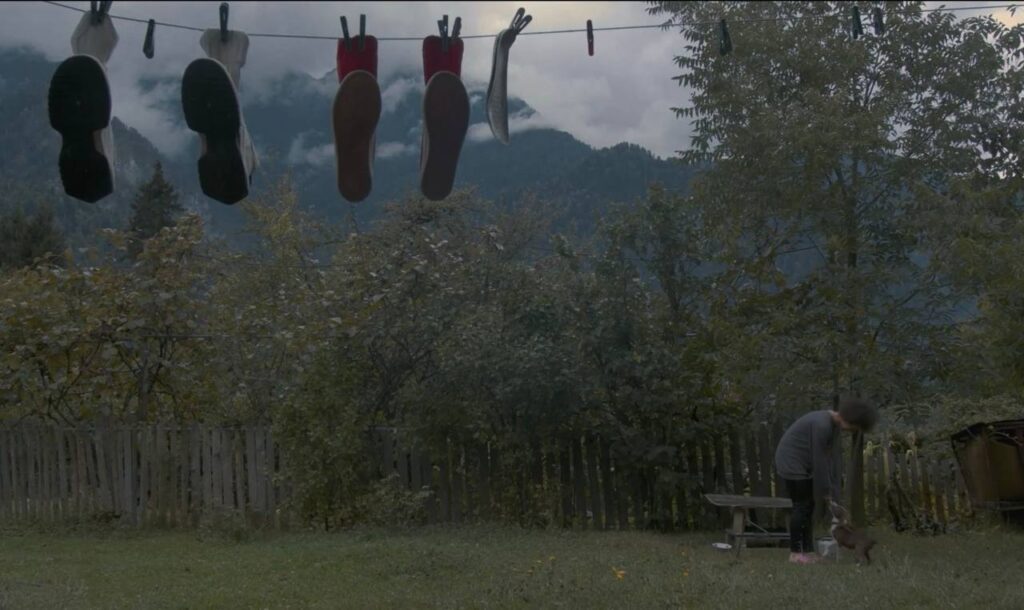
The entire film is Sopho's way but not the process of her development as a person but daily routine seen through a subjective camera, in which she tells us about her life and the viewer accepts all this as a fact. In the film, we can see Sopho's mother – Valia multiple times; she is of Slavic origin and they often speak a foreign language. As Sopho recalls, her mother has always been strict but it is noticeable how this affected the character's life as Sopho is very well-bred - she is never lazy and does not shy away from doing work because life in the mountains requires any kind of readiness. It is also clear that after the tragedy the two of them try to remain calm and help each other in every way - emotionally and physically.
People say that what doesn't kill you, makes you stronger and that's exactly what I would say about Sopho - she is a rarely strong and resistant girl, whose adventures inspire special respect and sympathy in the audience.
Although Sopho tells a story about her past and everyday life in a 30-minute film, she is also a university student and travels from the village to the city together with the audience to pass the national exams, because her life already requires changes, and this is where I can see a great ambiguity. Sopho has the same goals as all her peers, but she is in no way like them - she is different. She is different because her life took such direction and she did not give up. Sopho is her own boss, her own "deus ex machine," a breadwinner as well as a savior.
In the end, she passes all the exams - her life begins anew. Having gone to work in Mestia, she returns to her native house for a short time before leaving it once again. She packs her bag, hugs her mother and leaves. Her mother and the animals remain at home. Sopho goes out the house and hopes that everything in her life will be exactly as her brave heart deserves, because she is the person who deserves great support not only from the audience but also from those around her.
In the end, she passes all the exams - her life begins anew. Having gone to work in Mestia, she returns to her native house for a short time before leaving it once again. She packs her bag, hugs her mother and leaves. Her mother and the animals remain at home. Sopho goes out the house and hopes that everything in her life will be exactly as her brave heart deserves, because she is the person who deserves great support not only from the audience but also from those around her.
Despite the fact that the film covers several periods of time, all this fits perfectly in relation to its running time - there is no sense of loss anywhere and, of course, no excessive action. It is also characterized by the subjective camera effect, which greatly helps the viewer to establish contact with the character. It can be said that, for a student film, it is excellently shot from a technical point of view: colors, framing, sound - everything deserves high praise.
In addition to the fact that the film tells about specific people and cases, in general it is a story about what it is like to live with pain, lose face and then regain it again. This work of directors once again reminds us that the most powerful stories are often hidden in the lives of real people. Sopho's story awakens in the viewer not only compassion, but also hope, the hope that even after the most severe loss it is possible to continue life and find one's own path. That is why this film remains in the memory for a long time and once again proves the main power of documentary cinema - to show us a person as he really is.
Sophio Chitaladze