
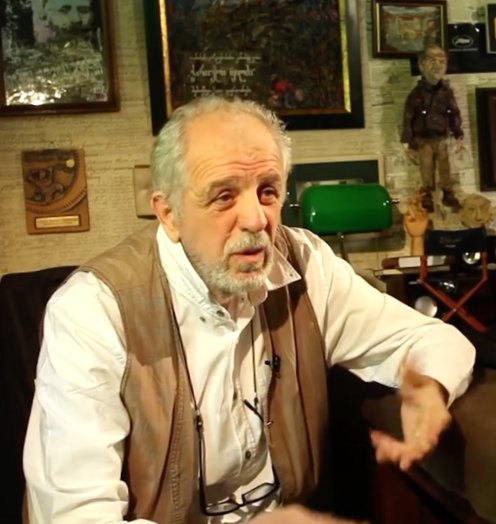
The story of “the first years of the Red Disaster,” “the fight between the perfidious commissar Sasha Oboladze and nimble Gogia Ghlonti” is recalled based on Aka Morchiladze’s narration and “told as an unforgettable story” by director Davit Sikharulidze in the first Georgian 3D animated film, “The Outlaws” (2008).
The film’s designer is Mamuka Didebashvili, who was discovered by Davit Sikharulidze at the Dry Bridge. He didn’t need to “travel far” to find sound director Madona Tevzadze, who was known by every filmmaker in Georgia and who had worked on many of Davit Sikharulidze’s films. It wouldn’t have been difficult to find Zaza Papuashvili, Revaz Tavartkiladze, Zurab Shevardnadze and Teimuraz Ninidze to voice the characters in the film.
It is somewhat difficult to define the genre of films in the category of “The Outlaws,” especially when it comes to animation (and three-dimensional ones) since it does not obey a “tradition,” existing experience and the solid “laws” of the genre.
The film is based on historical facts (which actually unfold in Guria, after the Sovietization of Georgia and describes the adventures of historical characters), as interpreted by Aka Morchiladze, but when talking about and showing them, the writer and director resort to a “non-documentary” and “inappropriate” form and manner and everything is transformed into humor, grotesque and a sharply characteristic layer despite the fact that "The Outlaws" deals with very serious issues, the most acute, painful topics of Georgian history, murder, the Sovietization of Georgia, the loss of freedom, heroism, bravery, betrayal and loyalty, emigration, and nostalgia.
Davit Sikharulidze recalled that in the 1990s, sports journalist Gia Gorgodze brought him Lasha Tabukashvili’s magazine “XX Century,” in which Aka Morchiladze’s “The Flamethrower” was published. It is true that he immediately felt the desire to adapt the story into animation, but “The Outlaws,” like his characters, suffered a difficult fate and work on the film was completed only years later. Davit Sikharulidze perfectly “captured” the character, essence and nature of “The Flamethrower” adapted it to the film and created its own, new artistic reality, atmosphere.
“The plot of the film is taken from Aka Morchiladze’s “The Flamethrower,” in which a true story is told in its own way. It depicts the events that took place in 1923-1925, in Georgia, the region of Guria, as well as Russia, Paris and Hell. The heroes are also real characters. Gogia Ghlonti was a thief who killed Sasha Oboladze and, together with his wife and friends, fled from Turkey to France" (Davit Sikharulidze).
The animation is based on several historical and fictional facts - Lenin and, on his orders, the execution of the king's family, the arrival of the Red Commissar, Sasha Oboladze in Guria and the rioting of the people there, the terrorization of Guria (as it actually happened) - to receive the order; Gogia Ghlonti “being outlawed,” ambush, Oboladze’s murder, etc.
Historical figures and facts are skillfully mixed with fictional stories, which, on the one hand, are written by Aka Morchiladze and by Davit Sikharulidze as well, who creates a "living" atmosphere, spatial and volumetric dimensions through stylization, convention and artistic generalization characteristic of the "laws" of animation, strange personification and a mixture of tragicomic lines.
As Aka Morchiladze characterizes, a vagabond (in this case, Gogia Ghlonti) is a gunslinger, outlawed Gurian, a seeker of truth and justice; “A peasant all armed with guns - who could be more bizarre than that? A peasant armed with guns - who might be more embittered on earth, more self-righteous? If a peasant had taken up his gun, kissed his wife and children, and turned his face toward the forest, they would have said - he had outlawed. Indeed, he was outlawed.”
Precisely about these self-righteous and brave, embittered and unyielding peasants, with guns in their hands and heads high, narrates the film “The Outlaws,” for the first time in Georgian animation, both in terms of genre and technical solution.
Having gone into the forest, Gogia Ghlonti and his comrades are involuntarily involved in a political struggle against the Bolsheviks and supporters of the Sovietization of Georgia, those who have drowned Guria and the whole of Georgia in blood and set it on fire. However, they are not revolutionaries in the sense that we call revolutionaries. The heroes of “The Outlaws” are “ideological” bandits, offended by the government, scoundrels, whose resentment is based not so much on political but on social dissatisfaction and then on revenge.
They fight to protect their dignity and their native land and then they are forced to leave their homeland, successful but defeated in this struggle. They leave and, like many Georgians, take refuge in France (or, historically, in some other foreign country). Then, you will be haunted by sorrow and homesickness your whole life.
Despite the fact that the participants in the unfolding events are characters created by means of "dolls" - technology (and not human actors), and with a stylized and exaggerated texture, each one is so alive and characteristic, their faces, actions, mannerisms and speech are so expressive that you perceive them as "real" people and equate everything with reality.
You also seem to be surrounded by the three-dimensional space of the film, you feel its completeness and fullness – in Georgia, Russia, France, and Hell. It’s as if the Bolsheviks are entering Tbilisi and Guria before your eyes, setting houses on fire before your eyes. It seems the reality, as if you are witnessing the life-and-death struggle between the conquerors and the liberators, you hear the sound of the canon in your ears and celebrate the defeat of evil, just as in life, and just like the heroes of the film, you also feel the piercing gaze of Gogia Ghlonti's luminous, captivating eyes and enter his "reality" accompanied by Mikheil Mdinaradze’s music.
The literary basis of the film has the following title “The Flamethrower, or the Tale of 1923.” Recollections of the fight between the former Commissar Sasha Oboladze and the nimble Gogia Ghlonti – plucked from forgotten or unnoticed books, old newspapers and papers, arranged and told as one unforgettable story by Aka Morchiladze” and ends like this: “Gogia Ghlonti was everything at once – a fighter, a robber and a thief. He was a man – with phosphoric eyes.”
Aka Morchiladze “researched” the “unidentified biography” and unforgettable story of this phosphoric-eyed, “short-legged and broad-shouldered” man, and Dato Sikharulidze transformed it into the three dimensions of an animated film.
All of Davit Sikharulidze’s films actually have won awards at various festivals around the world, starting with his diploma work, “Ephemera” (which won a prize for originality in Moldova). “The Adventures of Naïve Goose” was awarded in Uzhgorod, as well as in Italy and France, and “Babajana”- in Italy; the film “The Plague,” shot with Davit Takaishvili, won the “Palm D'or” at the Cannes Film Festival; “Iakob Gogebashvili – Life and Citizenship” was nominated for the State Prize but for some reason, the prize intended for cinema was additionally awarded to the theater. However, three parts of the animated history of Georgia, “Lower Paleolithic,” “Paleolithic,” and “Upper Paleolithic” are lost; they were filmed in Bulgaria and created at the Tbilisi Animation Studio and made “between intervals.”
Along with short and full-length films (made in film studios), Davit Sikharulidze shot: “The Brave” - a puppet series created on “Channel Nine” (so were “The Outlaws”, scripted by Aka Morchiladze), “The Poor Cry All the Time” and at TV company “Mze,” a multi-series - “Kvachi Kvachantiradze” - the first multi-series animated Georgian film, the first animated screen adaptation of a national classic, of course, based on the novel of the same name by Mikheil Javakhishvili.
P.S. David Sikharulidze died a year ago, on April 21, 2025. Rezo Tavartkiladze, Eldar Mdinaradze, Madona Tevzadze from the “The Outlaws” crew also passed away and this wonderful story came to an end.
Lela Ochiauri


