
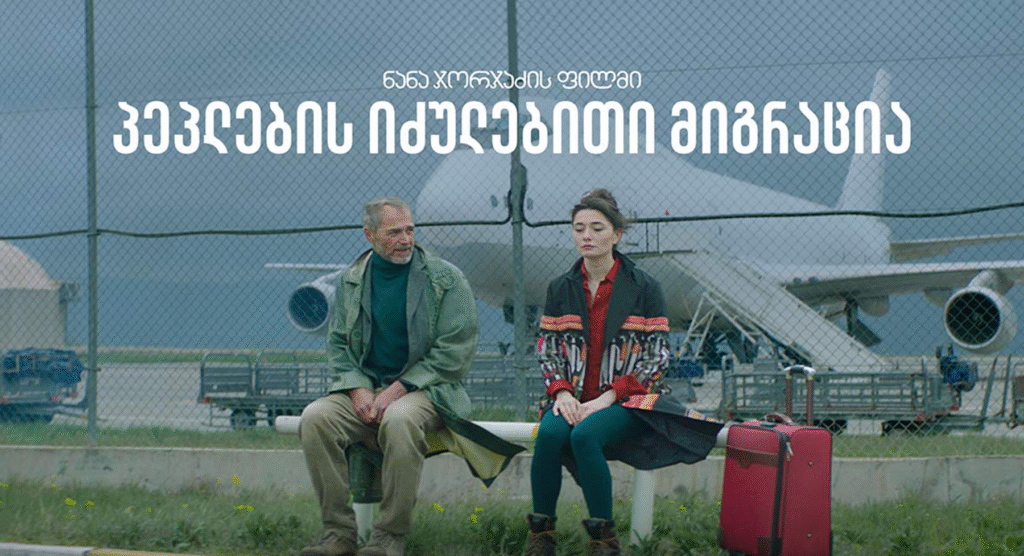
What is the life of an artist like in modern Georgia, who has already reached middle age and his once existing plans, goals and dreams for the future remain in the past due to reality, social and political problems, even though the future seems to be only a hope for "forced migration"?!
Nana Jorjadze's film "Forced Migration of Butterflies" (2024), based on her, Tamar Bartaia and George Shepard's script, is an artistic, civic and personal understanding of these contemporary and important issues.
I can call the film "Self-Portrait of a Generation" as both, the director and the scriptwriters create a complex and diverse panorama of the lives and problems of different generations in many personal as well as contextual aspects. It consists of colorful images of people of different types, fates and qualities and combines and expressively presents the problems of modern society, reflecting the elements of existence, the characters’ inner state and showing the forms and peculiarities of their reactions to life's contradictions.
One of the most important problems is migration. Moreover, it is forced. According to the director, the reason for it is the social situation caused by various circumstances. Migration is accompanied by the loss of one's home, motherland, consequently, the threat of losing one's place and personality. Such losses are especially difficult for generations that have already crossed a certain age limit, beyond which it is actually impossible to start a new life, "adapt" to new circumstances and discover the chances of a full-fledged existence in a new reality to achieve anything substantial.
Nana Jorjadze began filming “Forced Migration of Butterflies” during the pandemic in 2022 (which further exacerbated the general problem raised in the film - the “locked-in” world and an escape from it) and only later, in 2023 she finished it after overcoming various obstacles, in collaboration with producer Zhana Sardlishvili.
The film is about a group of friends and their close people (with the participation of the professional and non-professional actors - Rati Eradze, Tamar Tabatadze, Natia Nikolaishvili, Ana Kurtubadze, Tamri Bziava, Giorgi Tsagareli, Buba Jorjadze, Darejan Kharshiladze, Tamar Skhirtladze, Mari Janashia). It develops around one specific place and in the surrounding spaces, but not for a long time.
The local, private space captured in the film is filled with the dramatic events of Georgia's recent history, which significantly determined and changed the path of Georgian society’s happy and peaceful life, which the country should have had after gaining independence and becoming a free state.
The film begins with the caption - "As a result of the wars, Russia seized 20 percent of Georgia's territories. Samachablo and Abkhazia are still occupied," and the events unfold in Tbilisi, 27 years after the Abkhazia war.
Documentary shot - the demolition of idols - monuments to communist figures - how they remove signs from the streets of communists and revolutionaries, the chronicle of Georgia's recent history - follows the film to the end and is perceived as a single whole.
Its screen reality is a metaphor for actual life, which is created by all the details and their artistic combination. The environment, relationships, the characters’ psychological and typical features, the expressive, exaggerated expression of the elements of existence and imagination in some cases and, conversely, lyrical, sad and internally charged episodes, organically fit into each other with Nana Jorjadze and Giorgi Bartaia’s editing.
Dato Evgenidze’s original music and arrangements of famous melodies, themes, fragments of musical works are actively involved in the creation of this space, present or recent history, general cultural and modern screen convention; as their “continuation,” the “audio” sequence of life and “internal” sounds, noises created and arranged by Ivane Gvaradze and Valeri Sarkisov.
With this kind of depiction of the life reality, Nana Jorjadze explores the conditions, causes and consequences that have stipulated this kind of society's life. And she uses a striking, intense, expressive form to create an adequate screen world, which she then replaces with episodes of "minor," calm action and dynamics, as it is characteristic for the structure and formal arrangement of a classical musical work.
The film's action area and its world have their own natural, specific signs and characteristics. They are driven by rules and laws that are "identifying" signs of a specific group of people as well as include generalized features and problems of the internal and physical state of modern society.
The action unfolds - in the spaces created by artist Giorgi Maskharashvili and captured by cameraman Mikheil Kvirikadze - in the main character - artist Kosta’s studio (in an interior equipped with the main and specific props and objects of the action), from the closed and intimate environment of the epicenter of the film characters' meetings and everyday life, to outside its walls - at various public gathering places, in the bosom of nature or in the streets - the characters and the world are seen from different angles and points of view.
Yet, the life of butterflies is short. It lasts only a few days. However, this is still a whole life, equal to the “normal,” “normalized” duration of the life of any other spiritual being. The rare species of butterflies that one of the heroes finds live only in Georgia and nowhere else. Just like the film characters, they cannot live, despite their decision, desire or occurrence.
Nana Jorjadze might be the most extraordinary person in Georgian cinema. Artistic, energetic, extravagant, socially, civically active. With a characteristic and universal appearance, many personal signs and qualities. As a director - distinguished by an individual manner. She is a musician and an architect by the first professions, and spatial, large-scale harmonious thinking is also clearly visible in the films. It is obvious in terms of systematization of thematic and social problems, intersection of eras, sometimes, ahead of time. In terms of frame composition, overall artistic solution, dynamics and lively tempo- rhythm, and peculiar editing “selection.”
The first statement of artistic directions, authorial position and interests and success in the international space (which continues till today with each film and is enriched with new features), began with the very first short film “Atlant.” A satire created with metaphorical and subtle humor, with an organic unity of reality and fiction, with a connection of contemporary and universal human issues, which, at the same time, clearly shows the strength and weakness of the individual in front of and against the regime during totalitarianism. It eloquently shows how the system enslaves, suppresses and turns a person into a victim of violence. Who still manages to be strong and shoulder the entire burden of personal duty and the inhumanity of tyranny.
After the film "Atlant," there appeared completely new topics and characters for Georgian cinema in Nana Jorjadze's films shot in different periods and settings - "Journey to Sopot," "Help Us Climb the Yalbuz," "Robinsoniada or My English Grandfather" (which won the "Golden Camera" at the Cannes Film Festival), "1001 Recipes of a Culinary Lover" (Oscar nominee), "27 Lost Kisses." Films about tyranny, the cruelty of the Soviet regime and the destructive power of Bolshevism, their influence on society, historical processes and the fate of people. And about people who fight, do not obey and defeat evil.
“The Forced Migration of Butterflies” is also a continuation of this path. On the one hand, it presents political, social, historical circumstances and, on the other - the power of their influence on the fate of the country in general and each person in particular. On their physical or mental, moral existence. On adaptation and resistance. On the search for ways to survive.
Nana Jorjadze’s cinema is like the author. What is characteristic of her and her films is - metaphorical, parable language, lively, sharp and hidden humor, a delightful manner of narration, openness, clarity of story and message, a firm position, individual views and attitudes, and creative boldness.
“The Forced Migration of Butterflies” is also like this - multi-layered, kaleidoscopic, built with many lines, on many characters, relationships between multiple characters and on the personal and common, different stories of each of them. Sad and nostalgic, but still, characteristic of Nana Jorjadze as a person and an artist - full of hope, optimism and love of life.
Lela Ochiauri


