
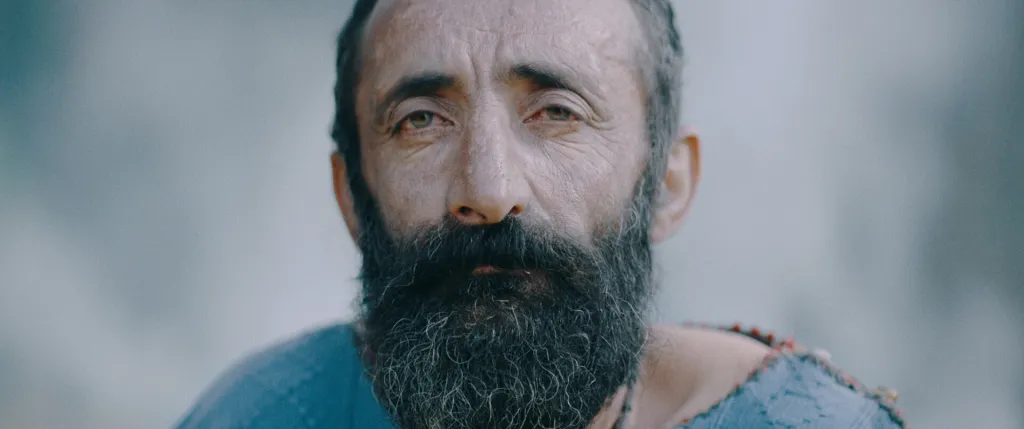
Cinema is a very broad and diverse field. There are films on almost every topic: love, war, loneliness, human inner crisis, yet, death still remains one of its most difficult and rarely discussed topics, as it really is. Perhaps because mortality is always associated with something imperceptible to the living. Consequently, when a filmmakers approach this topic, it is either over-dramatized or too unrealistic. Giorgi Arabuli’s short film “Aldi” (2024) is a different case in this regard. This is a work that looks at death not as a terrifying event but as a natural process that is associated with a certain order and ritual in human life.
The main character of the film, Aldi, is the last inhabitant of the village, but despite this loneliness, he still has to continue living and as well as prepare for his own death. Aldi does everything that is determined by tradition - he prays, cultivates the land, even digs his own grave. All this may seem strange and difficult to watch at first, but over time it becomes clear that the main idea here is not the fear of death but the acceptance of it as a part of life. The director seems to be trying to show that a person prepares for death all his life.
Another important aspect of the film is its connection with the poem. Giorgi Arabuli uniquely serves as both the author of the text and the director of the film, a rare creative feat in cinema. It often happens in cinema that the director takes someone else's work and processes it in his own way, but here everything is in one hand. This gives the film a kind of integrity. Both the poem and the film seem to convey the same idea, just in different languages. In one word, in another image. “Aldi” combines poetry and cinema, tradition and modern vision, silence and visual language.
There are no dialogues in the film. Silence is very important here. The sounds of the environment, the rustling of the wind, the sound of the ground, and human footsteps all create an atmosphere where words are no longer needed. This silence makes the viewer to watch the shots more closely and figure out the situations themselves.
Aldi's daily actions seem like simple activities, but actually, each of them has a symbolic meaning. Praying, mowing, plowing, digging a grave - this is both a continuation of life and preparation for death. This shows a very old, traditional vision, where a person is not separated from nature. He is a part of it and eventually returns to it.
The visual aspect is also quite an important factor. The camera often focuses on one shot for a long time. This may seem to some to be a slow and heavy style, but this is precisely what creates the film’s character. The viewer is not forced to quickly "jump" from scene to scene. He has time to observe the environment, details, the character’s movement. Each shot seems to be a small picture that has its own finished form.
It is very interesting to understand death. It is not just an end or a tragedy. In a broader sense, death here is a state that can exist in different forms. In the poem that forms the basis of the film, death is described as follows:
"To be consumed by shame - that is death.
To be destitute, trapped within your own walls - that is death.
To feel dishonor in the eyes of your children - that is death.
To rage fiercely at home, yet cower in silence outside - that is death.
To fail a defenseless enemy or abandon a bedridden soul - that is death.
To bury your son with a wound in his back - that is death.
To endure absolute solitude - that is death.
To draw breath, yet cease to truly live - that is death."
Here, death is conceptualized not as physical cessation, but as the agony of shame, isolation, and social exclusion. A person may be biologically alive while remaining spiritually and socially dead in his condition.
What is especially interesting is that Aldi does not seem to be fighting death. He submits to it, but at the same time tries to do everything right. Death seems to be a system of rules that must be obeyed so that everything ends the way it should. His attitude is very different from the view of the masses, for whom death is often associated only with fear.
Another strong point of the film is the mythological atmosphere. Everything here looks very old, almost archaic. Nature, rituals, actions - everything creates the feeling that this story may not even take place in a specific time, it is placed in a more general, universal space, where human existence is always equally difficult.
Another strong point of the film is the mythological atmosphere. Everything here looks very old, almost archaic. Nature, rituals, actions - everything creates the feeling that this story may not even take place in a specific time, it is placed in a more general, universal space, where human existence is always equally difficult.
After the film ends, the viewer is left with a lot to think about. On the one hand, this is a very simple story about the life of one person in a village, but on the other hand, it is a story that touches on very big topics: death, tradition, loneliness, the inner state of a person. It is precisely in this duality that the power of this film lies.
It can be said that “Aldi” is not a film that is easy for everyone to understand. Its pace is slow, the narrative is minimalistic, and there is almost no action, but for those who are comfortable with this style, they will find a very deep and thought-provoking work. This is a film that does not try to quickly impress the viewer, on the contrary, it slowly, calmly gathers emotions.
It can be said that “Aldi” is not a film that is easy for everyone to understand. Its pace is slow, the narrative is minimalistic, and there is almost no action, but for those who are comfortable with this style, they will find a very deep and thought-provoking work. This is a film that does not try to quickly impress the viewer, on the contrary, it slowly, calmly gathers emotions.
After getting acquainted with such works, a certain feeling of injustice often remains. There is some very important and valuable work, but it is known only to a small circle. “Aldi” especially strengthens this feeling, because it is more of an experience that allows a person to think and changes his attitude towards cinema at least a little.
The question naturally arises: why don’t we pay more attention to such films? Why do they remain in the space of festivals, small screenings or narrow audiences? It is as if cinema is divided into two parts - on the one hand, high-level art, and on the other - mass culture. In fact, the problem is not only the fault of one side. Such films are often not commercially profitable. They are not based on fast action, great dramatic effects or a simple plot line. On the contrary, they demand attention and thought. Modern viewers are often accustomed to a quickly consumed film product, where everything happens directly and without thinking.
There is also the circumstance that the public is provided with quality art less and less. When films that are constantly shot on the same topics, similar to each other, dominate, it is natural that tastes gradually become homogeneous. The viewer no longer has the opportunity to often encounter works created in a different, deep and special style.
Here the director's responsibility arises. When he works, he has a choice either to create another ordinary work that repeats already seen themes, or to try something new, even more complex and less commercial. Of course, this is not always easy, as festivals often favor more established forms, but that is where the strength of an artist lies, to dare and create something different.
That is why it is important to promote films that have depth, which gradually creates a demand for a higher quality product. Although we cannot avoid the existence of commercial films, a balance is needed. A place must be found for different types of cinema.
Works like “Aldi” remind us that cinema is far more than mere entertainment. Perhaps that is why it is important that such films do not remain only in the festival spaces. They should reach a wider audience, because it is precisely such works that can gradually change the public’s attitude towards art.
Teona Vekua


